
The show De mirar se trata, with sixty-four works specially created for the occasion by Doménica Aglialoro, Harry Schuster, and Gustavo Zajac, was open to the public at Spazio Zero Gallery (Altamira, Caracas) from October 5th to November 5th of 2006. The three Venezuelan artists worked together over several months to develop this unique project, which can be defined as an “individual show by six hands.”
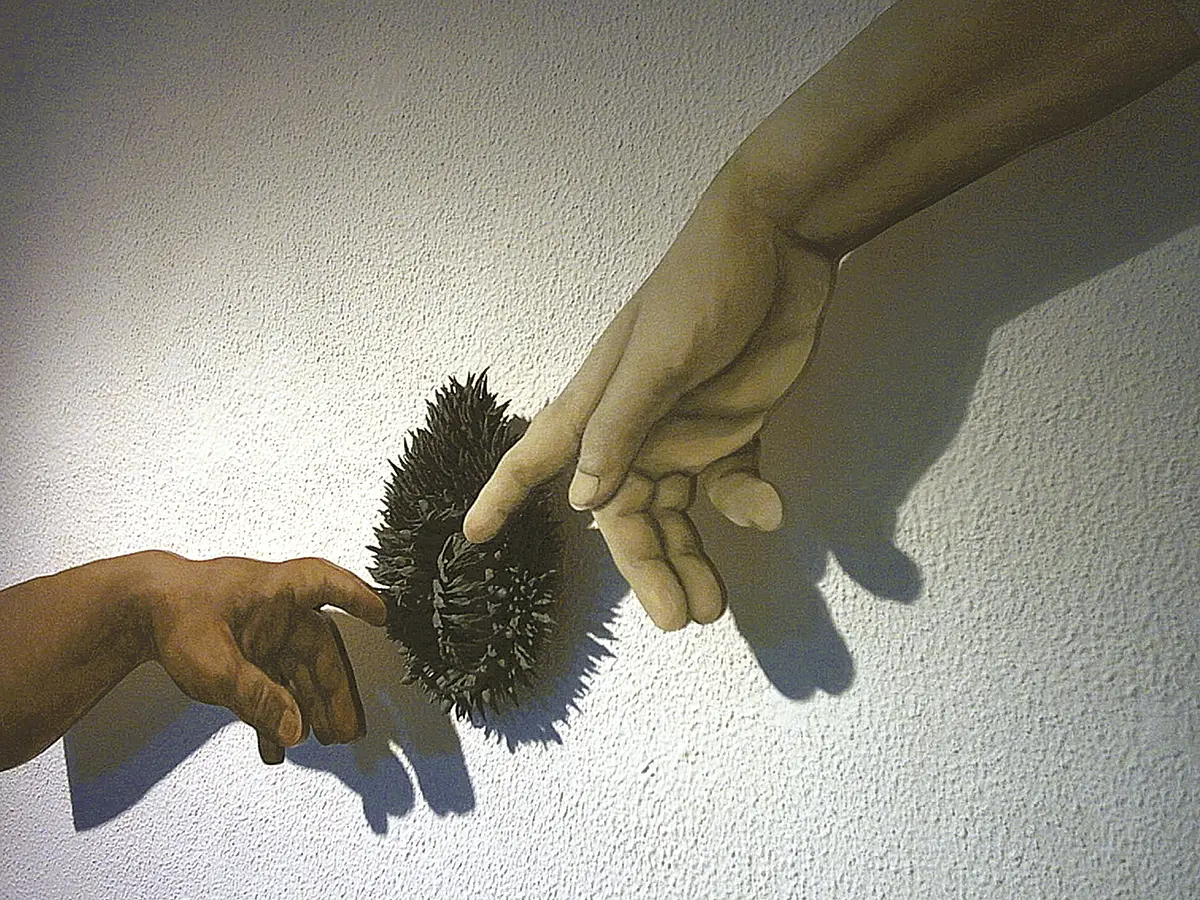
Schuster and Zajac have collaborated for several years in two ways: each one creates a portion of the work, or one of them modifies a finished work by the other. Aglialoro joined them for this specific project. The painters Schuster and Zajac and Aglialoro with her ceramic works and assemblages brought together their previous meditations on gender (gay art and feminism), played with the ambiguity of the concept and its representation, and reframed their discourses about the creative process and the artist’s demiurgic power. The work that welcomed visitors to the show, a pictorial quotation of Michelangelo’s Creation of Adam in the Sistine Chapel, summarized the general meaning of the show. Schuster represented Adam with Zajac’s arm and Zajac rendered God with Schuster’s arm; at their meeting point, Aglialoro placed female genitalia made of small ceramic strips shaped like petals and penises, which created something like a protecting nest that was also sharp and prickly.
After this, one moved into a gallery where the works could be read as independent units or as parts of an installation. The axis was Inmaculada-Crucifixión, a male/female hybrid from the female perspective, which implied the coexistence of pain and pleasure. Around them were the Nubes, boxes in which Aglialoro’s pink muslins outlined female genitalia that spouted eyes painted by Schuster and Zajac. For the three artists, the issue was to re-contextualize previous works. Doménica Aglialoro has used gauzes and muslins in her installations to evoke the feminine world, and Schuster and Zajac have created the series titled Miradas, taken from famous paintings and photographs. In the new works, one saw in each box the eyes of the Virgin Mary, Christ, devils, and art critics; in the last box, the eyes had been replaced by mirrors—or the viewer’s own eyes—and the muslin by small ceramic penises. From both a plastic and a conceptual standpoint, the way that each artist confronted and enriched the others’ work was evident.
In the next gallery, visitors encountered a pair of rubber boots, one decorated with a crown of thorns and the other one with a crown of flowers, like a metaphor—with religious references—of the paths one walks through life. Next, a St. Sebastian (the patron saint of homosexuals), painted by Schuster and Zajac in the Baroque style of large church paintings, awaited an arrow placed by Aglialoro outside the frame, frozen like Xenon’s, to involve the viewer, who could complete the scene by firing the arrow or not. The same occurred with a complex Crucifixión, painted in segments by Schuster and Zajac, which was at the same time a portrait of the two artists. A red cloud placed above it evoked suffering, while a feather glove made by Aglialoro allowed the visitor to clean and caress the Christ. With another work that formed a kind of diptych with this Crucifixión, Aglialoro revisited her work with ceramic ribs in order to offer her version of a Crucifixión-Dolorosa. In the same spirit, there was a small painting, perhaps one of the better ones for its synthesis and its plastic resolution, in which Zajac painted the hands of the Dolorosa at the Valencia Cathedral. One of Schuster’s recurring themes, the hands held a large ceramic crown of thorns made by Aglialoro, in which the thorns were small penises. In this work, the dualities of pain and pleasure and death and life were inseparable.
Another important work was by Aglialoro, comprising three ceramic spinal cords ending in a single head as well as three hearts inscribed with the number of the artist’s identity documents, which functioned as a portrait or self-portrait. The hearts came together to form a mouth and/or female genitals, which became symbols of the artist’s expression and creativity.
FEDERICA PALOMERO