

Recent works by ten Venezuelan artists were included in the Extra-pictórico exhibition at the Corp Group Cultural Center in Caracas. María Eugenia Arria, Paulo Castro, Sigfredo Chacón, Ricardo Goldman, Víctor Hugo Irazábal, Javier León, Pepe López, Daniel Medina, Julio Pacheco Rivas, and Mariángeles Soto-Díaz presented works created specifically for this show, curated by Miguel Miguel.
To begin, let’s probe the title. Literally, Extra-pictórico means that which is outside the pictorial, or it can be a surplus of the pictorial, or what is beyond the pictorial. With the exception of two works by Ricardo Goldman, made in acrylic, the works on exhibit were not pictorial in strict terms. But almost all of them simulated the pictorial. On the one hand, they took advantage of the two-dimensional support, and on the other hand, they mimicked the expressive elements of the pictorial (texture, color, composition, line, balance, etc.) without using the materials of painting (oils, acrylics, etc.). This condition of a simulacrum was significant, inasmuch as an appreciation of the expressive elements mentioned above is pertinent to works of modern art but is not always applicable to contemporary art. Thus, what is the link connecting these two artistic notions?
Modern art has been characterized in large part by its emphasis on the visual: a material work created under formal parameters and explorations. So intense have these explorations been that form has determined the differences between the artistic avant-gardes in the twentieth century. This is why these differences established such radically distinct movements as Cubism, Orphism, Expressionism, Geometric Abstraction, and Informalism, to name but a few. Contemporary art, on the other hand, has often but not always been characterized by placing the formal on a secondary plane and giving preeminence to the idea, either as a concept or as the formulation of content closely linked to social reality. It has even been thought that contemporary art in the first decade of the twenty-first century is not based on the materiality that characterized modern art—understood as an object and on formal concerns—given that ideas by themselves can constitute works of art. However, the very notion of contemporary art can be as mutable as the variety of its manifestations that have existed since the 1970s. It is always important to revise and contextualize this notion, since the media and the motivations of art change from one decade to the next, as they do from one cultural context to the next.
Extra-pictórico summarized ten contemporary proposals by Venezuelan artists. These were based on modern formalism but with contemporary concepts. The modern tradition could not be set aside because this referent underpinned the project, and it justified the words of the curator, who said that this show made evident “the diversity of the new painting being developed in Venezuela.” How could one give the name “pictorial” to what is formally not and yet base the exhibition on that very term?
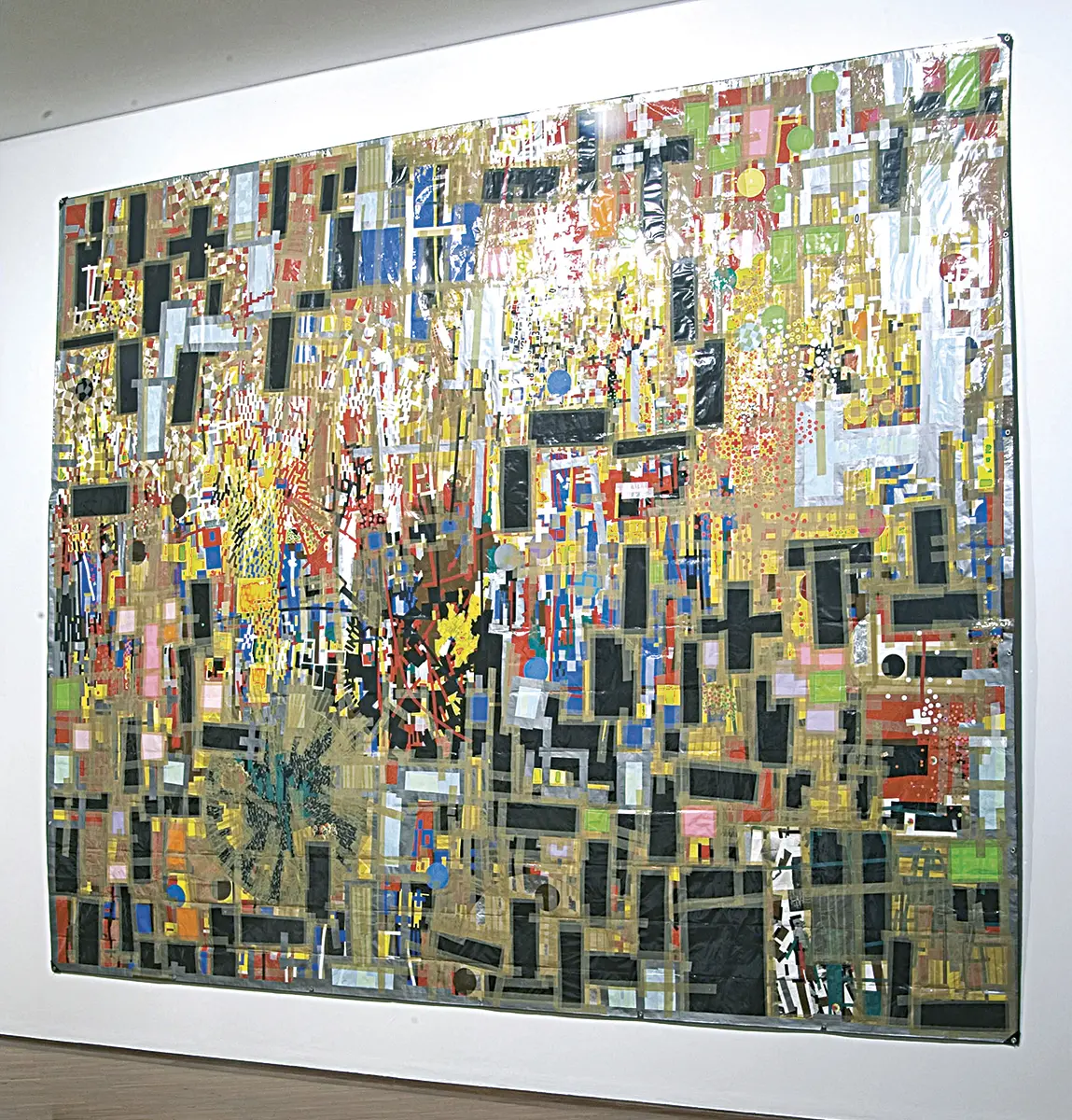
A possible answer lies in the problematization of painting as a means of expression and the focus adopted by these artists in questioning what has been established as “painting.” Pepe López, for example, used an interesting process that referred to Mondrian. The color accents in Broadway Boogie-Woogie were echoed in López’s Caracas Showtime, a work of waxed canvas, electrical tape, packing tape, and lead, as well as labels, decals, and stickers. The tradition inherited from Duchamp and his ready-mades legitimize an everyday object as an art object so that an assemblage of brooms, dusters, and other domestic objects here parodied a peacock, which was López’s way to upend what has been traditional representation.
The very idea of legitimization became a theme for parody in the work of several of these artists. Javier León has worked for a while on his series Hipercapitalismo salvaje within the series Dinero sucio. As the title indicated, three modules filled with paper money critiqued the exacerbated corruption that has plagued Latin American countries; the strongly textured surfaces mimicked the impasto of certain styles of painting. Mariángeles Soto-Díaz, on the other hand, created tiny collages that posited an intimate reading of monetary liquidity. What previously were monetary notes became cut-up visual matter, a new abstraction. With this, Soto-Díaz questioned the lack of liquidity, a situation that is apparent to many Venezuelans. After all, money is an abstraction; it isn’t real.
There was an undoubted undercurrent of humor in these works, which inserted them within contemporary discourse; reality requires that we see it with irony, and the same goes for visual languages. Daniel Medina parodied the tradition of geometric abstraction in the volumes he created on the pictorial plane. Painting works almost as an architectural plane in that its two-dimensional format is altered to convey three-dimensionality; in Medina’s work, chairs and cubes were arranged in a modular fashion, like architectural models or dollhouses. Here, the strictest Geometrism was a formal parody. At the same time, the ambiguity between the two-dimensional and the three-dimensional justified the term “extra-pictorial.”
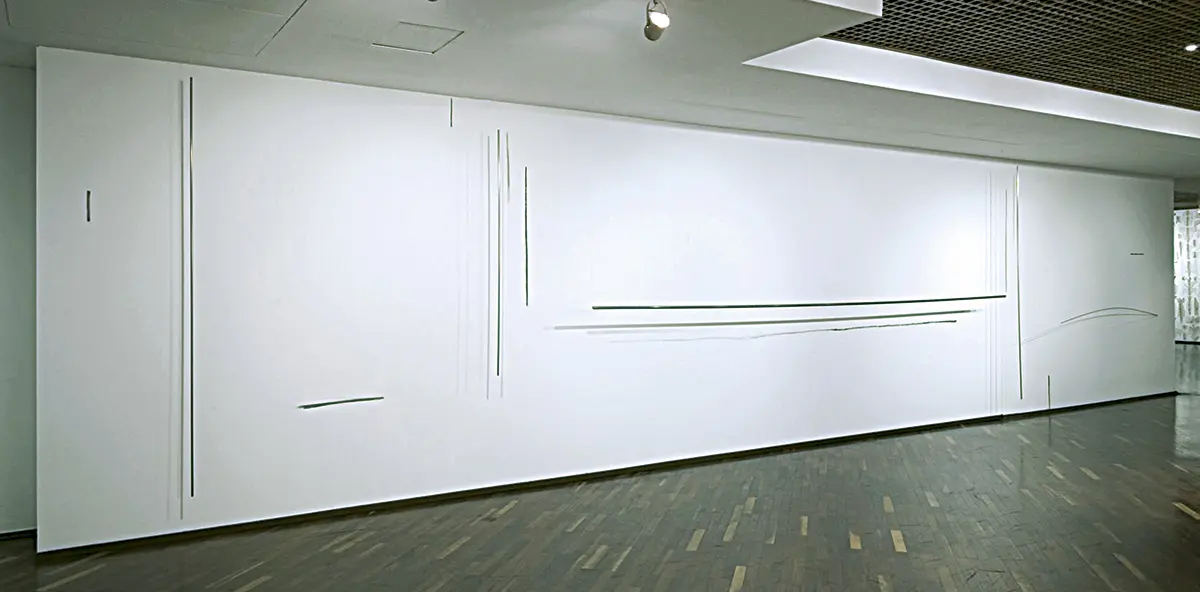
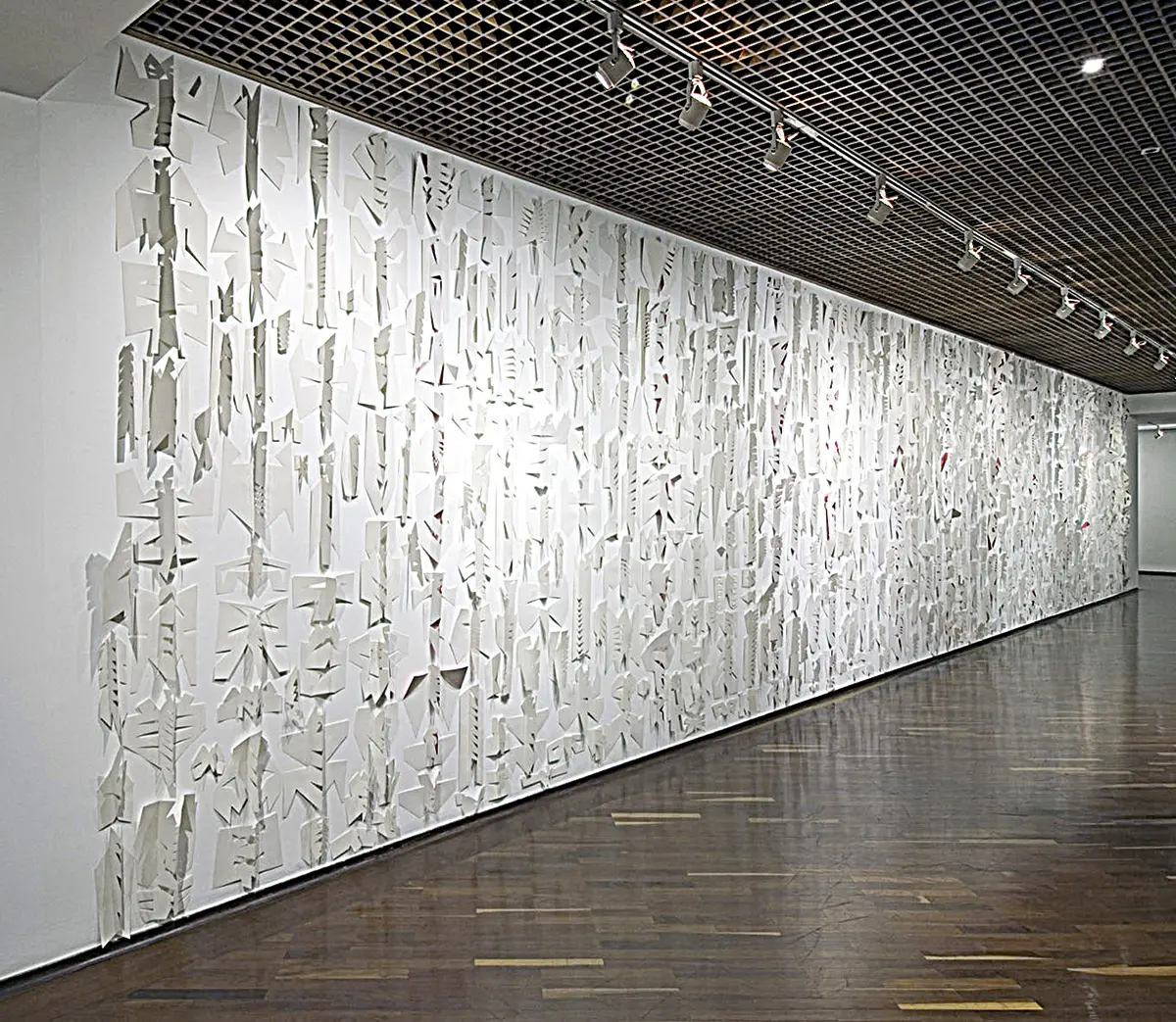
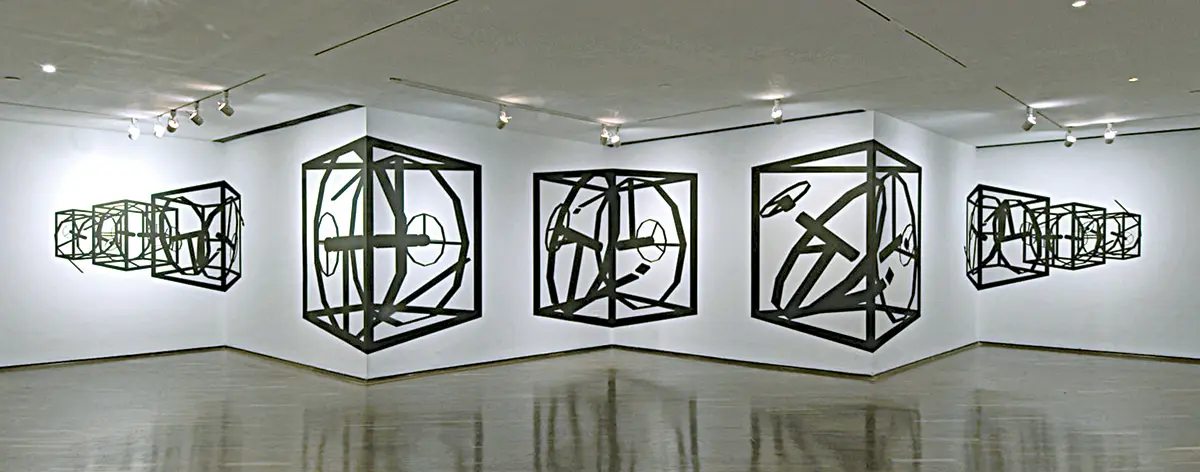
This ambiguity was an extension of the material potential of two-dimensionality since it moved into a third dimension. This was clearly seen in the stretched Lycra on canvas in Paulo Castro’s monumental-scale work, which asserted the concept of relief as well as the pictorial criterion of black on white. Meanwhile, Víctor Hugo Irazábal’s mural/collage exalted the white-on-white image, which acquired a warm hue in Vuelo del Shapori III: Homenaje a Óscar Vásquez; some of the folded papers that composed this work had pink interiors that were reflected on the wall on which it was mounted. The work alluded to the “origami posters” featured in some of the Venezuelan designer Óscar Vásquez’s work. Both Julio Pacheco Rivas and María Eugenia Arria explored drawing as a medium on the wall. Rivas created spaces in false perspective, taking advantage of the zigzag angles formed by joined panels (A la vuelta de la esquina), and Arria made a beautiful linear composition filled with complete subtlety and spatial sense, conjugating synthetic traces with levitating rods.
The artist more firmly anchored to the pictorial medium was Ricardo Goldman, who has adopted painting as a means of expression since 1975. Goldman’s works, such as En algún lugar del pavimento de San Marcos and Hábitat flotante sobre geografía desconocida, revealed worlds with irregular, asymmetric geometry. Finally, Sigfredo Chacón, who has based his pictorial work on the exploration of thick resin gestures, opted for a form of self-censorship: an empty gallery with nails placed in the wall in a systematic and organized fashion that alluded to the installation of paintings, but without the paintings. This “nothingness” was a muted scream in protest.
*All works illustrating this text are photos by Charlie Riera.
SUSANA BENKO