
The show Orbis: Homage to Walker Evans prompted comments for a variety of reasons. Among them was an apparently innocuous detail: the presence of gilding in the work of José A. Toirac. It is true that in the work of Toirac (born 1966), white, black, and gray have been predominant, a rare quality in Cuban visual art traditionally characterized by polychromatism. But this stripping of color didn’t originate in the negation of dogma but rather in the lack of color that was habitual in documentary photography prior to the 1970s; for some time, Toirac has quoted, parodied, and paid homage to the genre.
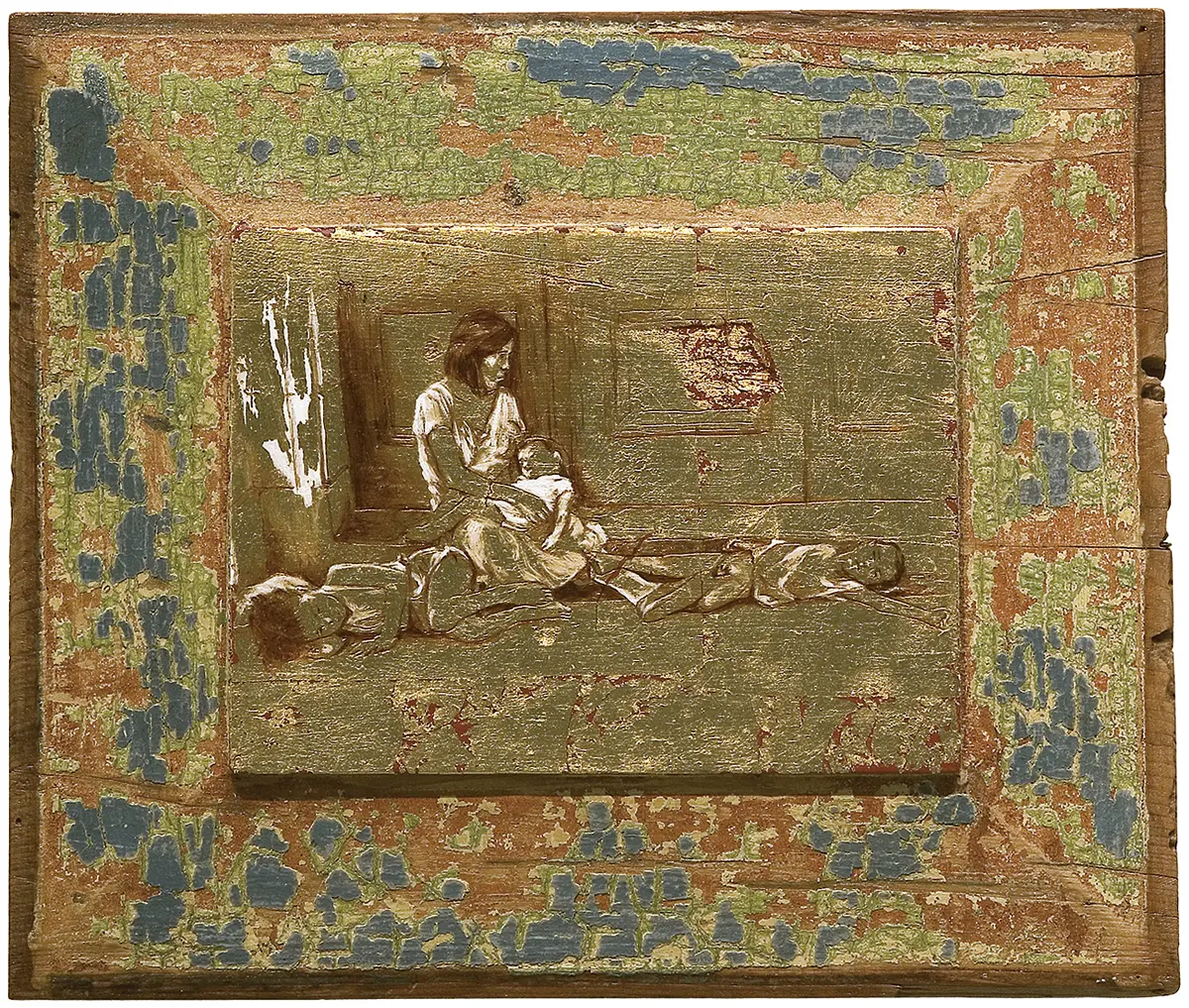
In Orbis, Toirac continued to refer to this form of photography. This time the images referenced had been captured by the American photographer Walker Evans in 1933 in Havana, and they were incorporated in various ways into the installation. One strategy featured Evans’s photos as references for analogies to images of the present photographed by one of Toirac’s collaborators, Ricardo G. Elías. Evans’s photos were also used as sources from which Toirac took figures that he then outlined in acrylic and gold leaf on pieces of wood. These diverse fragments, juxtaposed along the wall and aligned at the bottom, described the architectural profile of a city.
A brief reference included in the technical notes made it impossible to ignore this visual allegory. It conveyed a didactic mission that, without being excessive, should be a part of all art exhibitions, including those of contemporary art and especially in a museum. In this context, the presentation of Evans’s images as specimens under glass worked well. This approach protected them from dust and physical contact and above all established the images that Toirac was interested in showing. However, they were not simply presented in traditional cases. Reproductions of the original photographs hung from the walls, like Elías’s photographs, but smaller. This facilitated dialogue, a more direct confrontation between artworks, and it preserved the aura of the valuable historical document in Evans’s photographs.
To a degree, a counterpoint was established with exposed fragments of wood: tangible testimonies of the city and shreds of a reality that is hardened and obscure, while golden on its surface. This discourse was emphasized by the materials but even more so by the explanatory texts.
As in Toirac’s previous works, the images here were pregnant with intention and meaning. At the Sixth Havana Biennial (1997), Toirac exhibited an installation that proposed a walk through the city’s then impoverished and uninhabitable areas instead of a tourist trail through Old Havana. In Orbis, the images of human beings, with multifaceted social gradations and amid a de-contextualized joining of timelessness and the present, suggested and qualified the spaces they inhabited.
Such views were incorporated into Toirac’s reflection on Cuba’s socio-historic path, not only via renowned personalities but also through anonymous actors encompassed under the term masa, which voids all individual identity. In previous works, the artist has called them “unrepresentables,” yet paradoxically he has been able to characterize many of these individual personalities by their social role or projection, both in epic feats and in the everyday.
Evans’s images partook of both circumstances. They reflected the eye of the socio-political hurricane of 1933: newspaper coverage, “objective conditions,” and the apparent normalcy that preceded the popular explosion that ended with that year’s revolution. Only a knowledgeable viewer could establish a connection between that episode, aborted shortly afterward, and the fragment of El anhelo inútil, a poem by the avant-garde poet Rubén Martínez Villena, who from his deathbed directed the revolutionary action against the Machado dictatorship. With this fragment, reproduced on another wall, a link was made between life and utopianism or idealism—a dilemma for artistic modernity that has been extended into the contemporary.
Toirac is accustomed to working as part of a team, even with occasionally invited colleagues, and has collaborated for several years with his wife, Meira Marrero, an art critic. In Orbis, Marrero appeared alongside Toirac as co-exhibitor and co-curator. In previous exhibitions, she has co-written prologues to catalogs, a task undertaken for Orbis by the show’s other curator, Corina Matamoros, a specialist at the museum. Toirac and Marrero have received national awards for their curatorial efforts. Will Orbis prompt another one?
ISRAEL CASTELLANOS LEÓN