
Lately, I’ve heard opposing opinions about art as a document. Some think that the artistic document touches on issues that hold no interest for the mass media and the State. Others believe that art is not a one-to-one reflection of reality; for this reason, “facts” need to be reflected in a more ambiguous and subjective manner. What I do know is that the recent exhibition of María Elvira Escallón’s work allowed me to ponder the matter more carefully. Escallón’s work has moved from being a photographer’s “objective” document to being a fictive document in which the artist expresses her opinion, thus involving the viewers.
Escallón has been working on the project En estado de coma since 2005. That year,
the project received a National Arts Fellowship from the Ministry of Culture
and was presented at the National Salon; in 2006, it garnered further
recognition, the La Ciudad Patrimonio de Todos award offered by the City
Council. This project was exhibited for the first time at the Museum of Bogotá,
a museum that is the “intellectual property” of its architects. I mention all
of this because I feel that En estado de
coma is of interest to many outside the artistic community. This work
vindicates the fact that art has many things to say about the problem of
patrimony, taking into account not only the fate of a building but also the
testimony of those directly affected by it. The project reveals a hospital, the
San Juan de Dios in Bogotá with its entire architectural, urban, historical,
and social charge, which today finds itself in a sort of limbo.
The project began with an anonymous message received by the artist in the visitor’s log of her previous exhibition. The note said, “Visit the San Juan de Dios, which is dying.” Like a good secretary (recalling Coetzee, who says that certain topics call him and he follows them like one), Escallón went to the hospital, located in the center of Bogotá. She found a nine-floor hospital built-in 1955 by one of the country’s most important architecture firms.
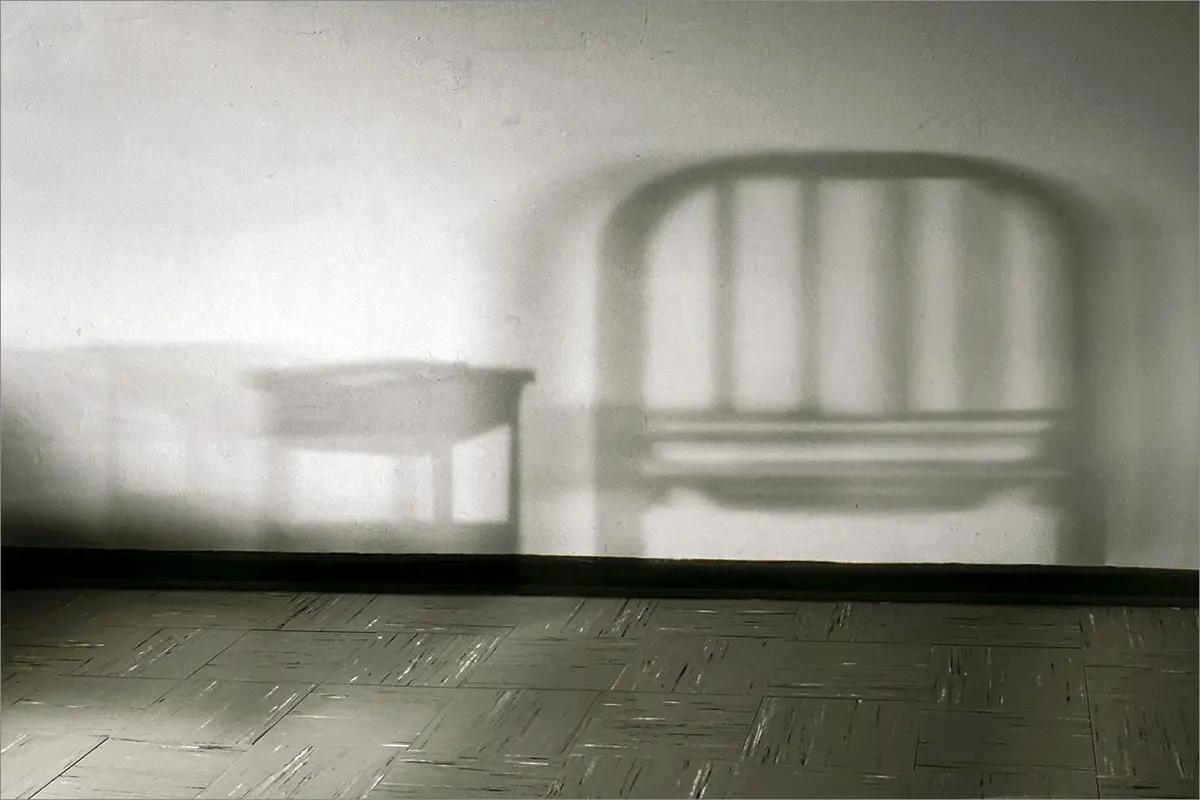
In the earliest version of this work, the photographs of this hospital were impressive: modern and spacious rooms, generous windows filled with the light of Bogotá, and lonely beds and desolate medical equipment. Behind a series of postcards created by the artist, one read a list with all the canceled services of a hospital that at one point serviced 100 patients each day in its emergency room, plus a 540-bed teaching hospital and research center.
The abandoned structure that the artist found was impeccably clean, thanks to the intervention of twenty workers, most of the nurses, who have continued to clean the hospital since its closing in 2005, without any pay. This same team of women spoke in the testimonial videos about having Congress declare the building national patrimony so that the State couldn’t take it away in the name of urban renewal. The videos told the story of the hospital’s transformation from public to the private one and the sacking of its assets by the State.
In the new exhibition of the project, the first version’s “objective” photographs were transformed to underscore the subject, a place that could help many to suffer less and even to survive. In the photographs, the beds were cut in the middle and became useless. A series of photo-collages of stained ripped, and abandoned bed sheets followed. Lastly, there was a series of photographs of hospital box springs on which grass was growing.
It is difficult to believe, but I think that this documentary fiction shifted my understanding of the project. While the issue seemed worrisome but alien at a personal level in the initial version, the new series of photographs suggested a State for which illness is a burden on the budget and also a system where public institutions, like universities under the mantle of efficiency and privatization, are transformed into places where the grass grows wild. En estado de coma spoke of a hospital closed for 2,070 days, expressed an opinion about the decay produced by State intervention and proposed the motif of a grass-covered bed to focus public debate on human needs.
NATALIA GUTIÉRREZ