
In her recent exhibition of fifteen acrylic-on-canvas paintings at Artepuy in Caracas, María Eugenia Arria reasserted her great mastery of color and once again seduced the viewer with her unique yet sensible alliance of draftsmanship and chromatic values.
Devoted for a time to her great passion, drawing, Arria did not abandon painting as a medium for study, reflection, and creative will. As an artist, she remained close to its suggestive presence, loyal to the chromatic veneer of two-dimensionality that is the companion to draftsmanship in her work. She revisited the notion of art that characterized the Quattrocento in Florence: drawing is what is essential, and painting should follow its dictates. Despite contemporary paradigm shifts and novel processes, Arria retained a conscious identification with painting, the trade that mediates desire and channels the will in an act that continues to be intimate and vital, despite the profound transformations experienced by the visual arts.
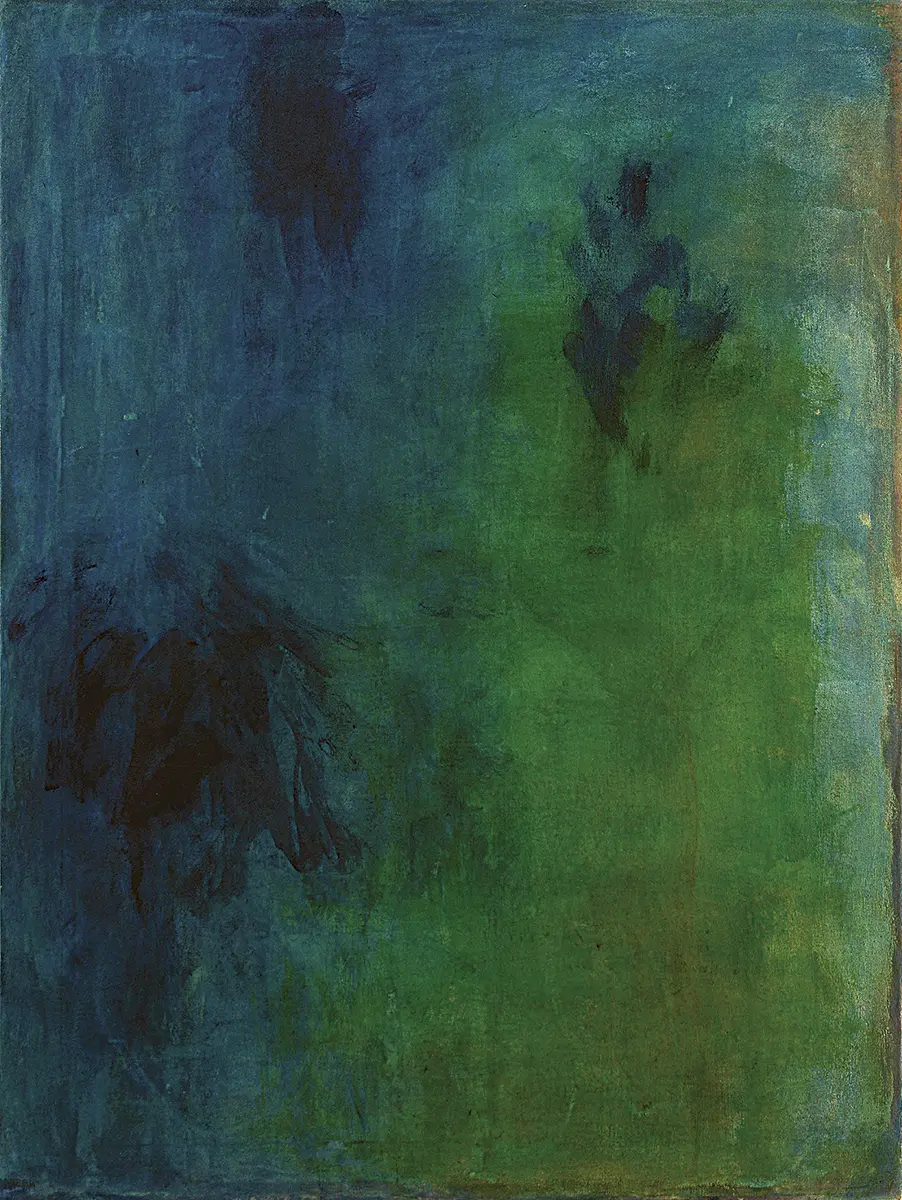
In Arria’s exhibition of small- and medium-format works, color played a central role, and blues and greens predominated; the viewer moved from one work to the next as if through a series of late-afternoon landscapes. Some were accompanied by warm tones, furtive presences, and colored light shining on the cold palette. In other works, yellow, red, and ochre were preeminent, with associated violets and pinks. The restricted palette did not impede emotion from filling the exhibition space.
The paintings were harmoniously arranged, connected by brushstroke, tonal variation, and nuance of color; tints that settled at the bottom rose through veils and became the dominant value. The paintings’ structure also contributed to a perception of the whole; the issue was not the only color—there was a vertical order, a direction that was organized and modeled. This norm emphasized intensities, established harmonies, and created cohesion between the chromatic event and the draftsmanship, which remained a constant presence, albeit now transformed into a brushstroke, a lightning trace of color. Thus, Arria’s painting was painting in the widest sense of the term, an intellectual and affective event at the same time—emotion and rationality in a well-balanced synthesis.
Naturaleza en llamas (2006, acrylic and charcoal on canvas) presented a large yellow plane that expanded visually beyond the dimensions of the work; in the center, a highly gestural drawing on charcoal emerged as an organic shape, a truncated flowering isolated in a space saturated with color. It was unavoidable not to think of the work’s title, of the persistence of the every day; in the same way, it called attention to the danger that lurks for living beings. Ultimately, the work presented two stages: the artistic—the elaborate relationships between yellow, ochre, and orange, the mutual exchanges, and the value of draftsmanship—and the real, veiled in the metaphorical recreation of fire, its intensity, and its destructive force.
Bastón del Emperador (2006, acrylic on canvas) contained chromatic tension and overflowing passion, combustion that seared and burned, a subjugated will—an uncontrolled power that overtakes everything. In this work, red dominated the surface; it was a flame that flowed upward, an intense and failed effort to surpass the limitations of the support.
The calm Nenúfares, Homenaje a Monet (2007, acrylic on canvas) evoked the quiet of cooler moments, the serenity of dusk anticipating nightfall. Blues and greens became lighter and darker, surfaced and submerged in a watery yet vibrant atmosphere, it was a musical dance composed of shades and hues. Fluid yet contained, the materiality of Arria’s work established the differences from and the dialogue with the floating illuminations created by Monet in supreme and unexpected anticipation of modernity.
Despite the extensive debate about painting and the continual discussions in which its importance is revised, the genre remains one of the essential manifestations of art. María Eugenia Arria says, “What is important is not only the painting as a result, but all that takes place in the process of execution, the distance between the painter and the canvas, what occurs between one and the other at that moment.” Seeing her intense, emotional paintings, the viewer recognizes that two inseparable human wills matter: the need to communicate and the need to create.
FREDDY CARREÑO