
Although the Portuguese painter Maria Helena Vieira da Silva (1908–1992) is well-known among Brazilian and international artists and critics, it seems that very little is known about the years between 1940 and 1947 that she and her husband, the Hungarian painter Arpad Szenes, spent in Rio de Janeiro. The couple immigrated to the city after running away from the war in Europe. Upon their arrival, their first contacts were a number of Brazilian writers and poets. They became very good friends of the poets Murilo Mendes (1901–1975) and Cecília Meireles (1901–1964). The latter was responsible for Vieira da Silva’s only commissioned work in Brazil: a set of tile panels for the refectory of the recently founded National School of Agronomy (which later became the Federal University of Agronomy), in 1943.
In the Museu de Arte Moderna exhibition organized by the curator Nelson Aguilar (a friend of Vieira da Silva and a student of her work), this commission was accompanied by other pristine works of her Brazilian period. The exhibition also featured a selection of musical pieces, which one heard while viewing her works; Vieira da Silva was a music lover and had been trained as a pianist, and she liked to listen to music while working.
Though the exhibit’s main attraction was the set of panels at the former National School of Agronomy—which included a real-time video of its restoration process—the greatest achievement of the exhibition was its conveyance of a unique part of the artist’s production. Vieira da Silva mounted three solo exhibitions when she lived in Brazil. The first took place at the National Museum of Fine Arts in 1943, followed by a very enthusiastic essay by Murilo Mendes about the work. However, this event would not contribute significantly to her integration, or that of her husband, into the group of Brazilian painters of the time. Thus, the viewer was confronted with an intimate work. It was also suggested that Vieira da Silva abandoned the cubist influences of her formative years with the painter Fernand Léger in Paris and returned to figurative painting in her Brazilian period.
Nevertheless, certain aspects of her work that came to light in this exhibition showed Vieira da Silva as a greater and more curious artist than previously known. Firstly, her position on being a woman painter was clear by her choice to sign her paintings with only her surname, never using Maria Helena; it seems that she played with painting’s history as a manly pursuit by using an ambiguous signature and left the viewer to guess whether the name belonged to a woman or a man. Secondly, certain qualities of her Brazilian paintings showed an artist rethinking her references and rereading traditional sources. One of these qualities was a primitive way of dealing with her media (including painting, drawing, engraving, and tile), treating the surfaces as fundamentally material. The production of the set of tile panels for the National School of Agronomy showed the painter reconsidering a traditional medium from her beloved motherland and one often used in other Brazilian projects at the time (for instance, the set of tile panels that Candido Portinari made for the Ministry of Education at Palácio Gustavo Capanema, in Rio de Janeiro in 1941). Vieira da Silva prepared sketches using matte blue hues on a brownish carton to give the idea of a primitive panel.
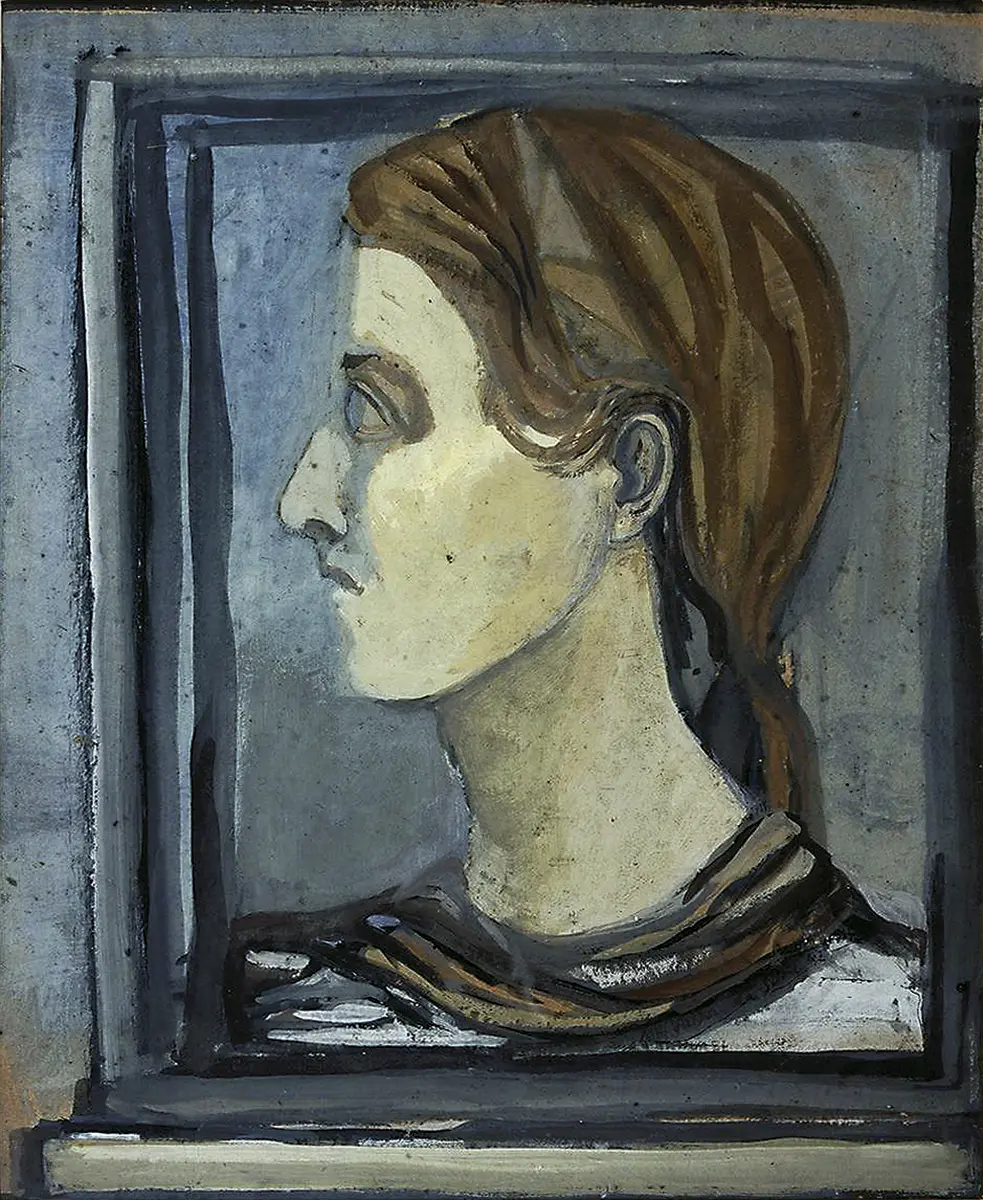
In a special text for one of her masterpieces of the period, Le métro (1940, gouache on carton), Aguilar compared it to a Pompeian fresco, pointing out the materiality of the colors, certain graphic elements, and the presence of a draped figure. Vieira da Silva’s Self-portrait in profile (1942, gouache on carton) alluded to Florentine portraiture of the Quattrocento, as she depicted herself as a classical figure. This quality reappeared in a set of portraits of Judith Cortesão (the daughter of the eminent Portuguese historian Jaime Cortesão, who at that time was also exiled in Brazil with his family). In these portraits, the round back of the sitter’s chair encompassed the torso of the figure, and the colors were very matte and pale, like in an old fresco.
Finally, the exhibition included a series of drawings. The most finished-looking one was Intérieur ou L’Harmonium, la bibliothèque, les échecs (1946, tempera on carton), which featured two figures playing chess on one side of the composition, one in front of the other across a table, and a seated figure playing the harmonium. The same composition reappeared in a drawing with the biblical motif of the meal at Emmaus.
The first drawing presented at least two elements that were symbolic for the artist: the harmonium and the library. They belonged to her memories of childhood; the harmonium was an instrument that she brought with her when she came to live in Rio. As visual forms, they help to structure the setting where the figures are inserted, as does the table where the other two figures play chess. The images are very hieratic because of their austere and slim shapes; the drawing of the two players especially reminds one of a sacra conversazione. Although they share the same space, the three figures (the two chess players and the harmonium player) are separated by a rectangular glass window that breaks the colorful rhythm created by the books on shelves to the right. They seem to be completely absorbed in their activities and are silent, although the sound is suggested by the presence of the harmonium (and the visual rhythm created by the colorful graphic elements of the library and the floor).
The silence was one of the strongest elements suggested by Vieira da Silva’s paintings. Cecília Meireles spoke of the artist as a very shy and reserved person. The at-times stern quality of Vieira da Silva’s paintings and drawings of her Brazilian period emphasized this silence. Since she dealt with very simple materials and media, the visitor to the exhibition at MAM could easily see what a great artist she was.
ANA GONÇALVES MAGALHÃES