
Fantastical, large-eyed beings and beasts with intertwined bodies and gaping mouths populate and devour the space in Marta Pérez García’s paintings. The iconography in these works—recalling the Gothic vision that altered the classical image of man—is the product of the freeing of fantasy and the creative imagination toward a savage character. The monstrous takes the place of the human in these small-format works that are offered, in some instances, as amulets against the forces of Evil.
In the painting titled Vejigantes, eight faces with expressive eyes and mouths baring their teeth seem to incarnate a repelling force. Such potent images are reduced in other paintings to frightening eyes that resemble those of the Gorgon, with prophylactic abilities. The iconography of eyes is closely connected to that in La vara de Asclepios. The healing aspect of the art of medicine, represented in Greek mythology by the demigod Asclepios, appears in this image as a three-headed winged monster leaning on a bar. The impression made by this work, like the rest of the eighteen-work exhibition at Botello Gallery is that the image rises as a protective screen, at once beautiful and repellent.
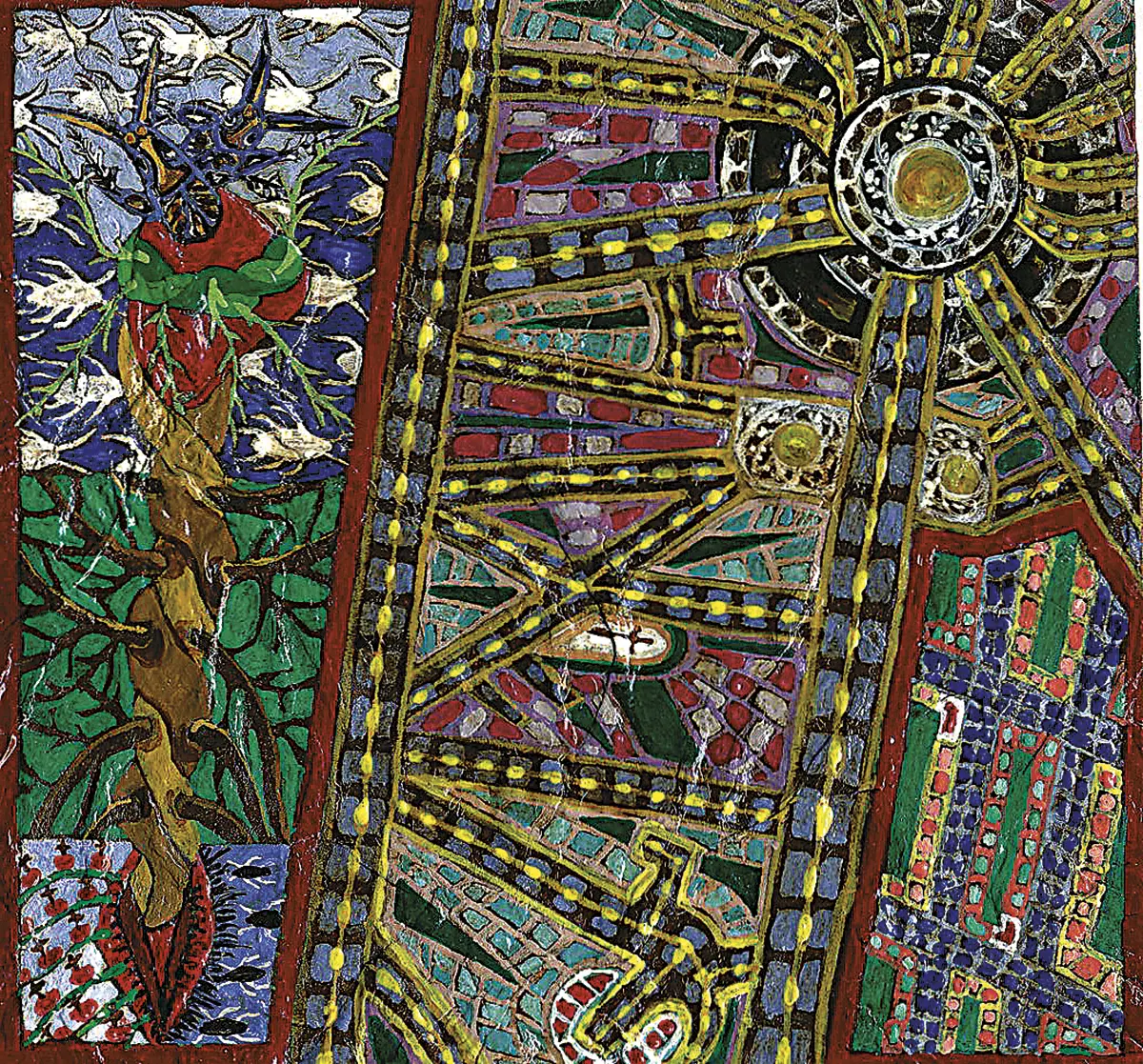
It would seem that Pérez García’s entire oeuvre invokes apotropaic magic against forces that can only be stopped by means of an image inundated with figures full of the most unexpected features. The efficacy of the visual image is made concrete by showing a powerful otherness, giving the impression that the artist assumes her work as a protection for herself and for art. By making her work the example of an aesthetic that deliriously emphasizes horror vacui, Pérez García seems to be impeding the disappearance of representative space by filling and canceling it. Through those fascinating eyes, masks, and beasts, she makes visible the strength and unsettling strangeness of an image capable of safeguarding for art that which only appears in the work as a whole.
Could horror vacui, the fear of nothingness or of empty space, be what gives direction to contemporary culture? It shouldn’t be surprising that culture and an art trapped in the obsessive consumption of space on the Internet and of visual signs in the mass media, which trigger uncontrollable desires, have folded back into horror vacui. Faced with the excessive delectation of the visual in a world subjected to consumption, art would need prophylactic eyes, reflective mirrors, talismans, or apotropaic images against commercial and media abuses.
The cancellation of emptiness, Henri Focillon has explained, creates two kinds of form. One kind of form remains intact and is guaranteed permanence in the space that contains it, and another kind of form is plotted or fused into an undulating continuity in which its parts, the beginning, and the end, are hidden. The latter model creates what Focillon has called the “system of the labyrinth.” Pérez García’s art is structured as a labyrinth where the eye can be confused by each line that suggests a new dimension with illusory depth and movement. The motifs of hybrid fantastic beings that appear in Final de la Odisea or Target are juxtaposed, mixed, and fused into one another in an intricate tapestry that seems to articulate and rearticulate itself. The visual movement suggested by zoomorphic figures in Pérez García’s painting comes from their incessant metamorphosis.
Pérez García has renounced a background defined by the clarity and order of Euclidean space, replacing it with one dominated by sequences of repetitive and intertwined shapes. These shapes, twisting and expanding, fill up even a section of the map of the city of Paris, represented in Desde aquí hasta Nation. The profusion of iconographic elements expresses the urban density of a fragment of the city seen from above. Desde aquí hasta Nation suggests analogies between Pérez García’s delirious creative process and urban development, conjoined with a city environment overloaded with graffiti, neon lights, and display windows. This painting—like the manic language of film, the unstoppable Muzak, techno-babble, scratching in rap music, and 24/7 news programs—feeds on excess.
In the work of this artist, formal accumulation could be linked, first, to a critique of the most general cultural trend of consumption and, second, with the human tendency to devour and possess, which can result in alienation. It also points toward a more specific meaning: the nullity of the work of art invaded by the banal, the derivative, and the insignificant. Pérez García’s work rises against all that like a protective screen for the space of representation, a place reserved for a primordial, savage, and magical image, as characterized by the iconographic elements in the series of works presented in this exhibition. They reiterate the idea of blank space in the current era, as in Malevich’s painting, which tends, according to Abraham Moles, to eliminate its contents to its progressive reduction and to isolate human beings from the world and its objects, killing our acquisitive character.1
In the art of Marta Pérez García, to avoid the vacuum is to create an artistic dimension for the significant, in the manner of a pure repellent against the superfluous visual signs that overload the world with their ubiquity, their delirium, and uncontrollable acceleration.
NOTE
1. Abraham Moles, El Kitsch: el arte de la felicidad (Barcelona, Buenos Aires, Mexico: Paidós Editions, 1990), 35.
INGRID MARÍA JIMÉNEZ