
Mi Puerto Rico: Master Painters of the Island 1780-1952, which opened at the Newark Museum this past winter is a small and brilliantly thought out exhibition that not only enlightens and entertains but sheds much light on Puerto Rico’s little known artistic heritage. With a mere fifty-five paintings executed by three of the island’s most historically prominent artists —between them their work spans two hundred and fifty years— curators Cheryl Hartup, Chief Curator of the Museo de Arte de Ponce and Marimar Benitez, the Director of School of Fine Arts in San Juan visually re-created the rich and varied history of both the island and its people.
First to greet the visitors was the work of José Campeche (1751-1809). Born in the days when the island was still an eighteenth-century colonial outpost, Campeche, who is considered the founding father of Puerto Rico’s art world, was a mulatto in a society dominated by illusions of racial purity. His artist father, a slave who had bought his own freedom, had his own workshop. It is here that Campeche, who was to rise from his humble beginnings to become the official portrait painter of eighteenth-century Puerto Rico, first learned his trade.
In The Blessed Souls in Purgatory (ca. 1790), one of Campeche’s most strikingly paintings, the artist, incorporating Baroque compositional devices and dramatic contrasting colors, depicts the journey of the soul from Purgatory to Heaven. Standing amidst incandescent flames, we see the Virgin Mary, a king, a cleric, a friar, and what appears to be an “everyman.” All eyes are looking heavenward, no doubt hoping that the Virgin Mary will quickly expedite their celestial flight. Painted in shades of blood red, this otherworldly tableau could be right out of Dante’s Divine Comedy.
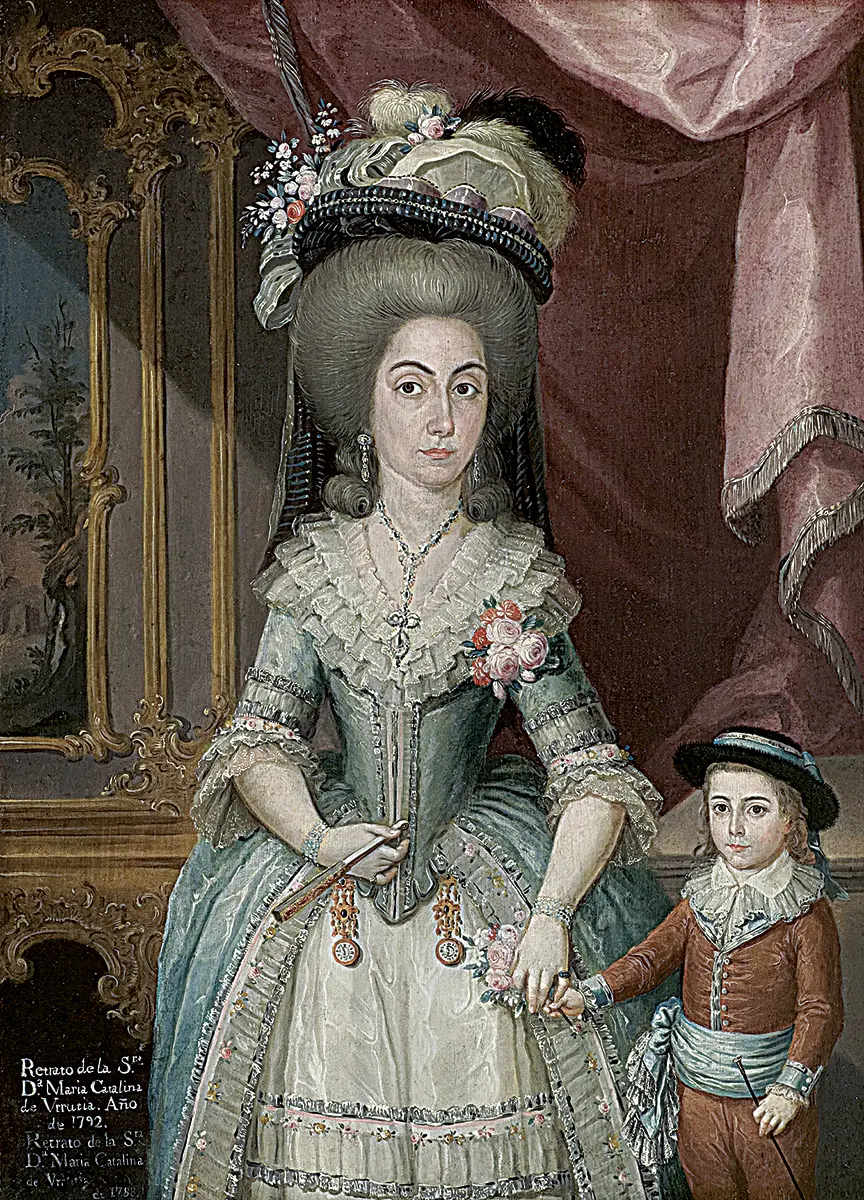
While Campeche’s religious paintings enamored him to the church, his portraits elevated him into the upper echelons of society. In Portrait of a Lady (ca. 1782-1786) and Doña Mariá Catalina de Urrutia (1788), the wife of one of Puerto Rico’s governors, the artist places each of the richly attired grande dames (one with her son) in an eloquently appointed room. Then, in an act of sanctification, he meticulously recreates the jewels they are wearing, the feathers that adorn their hats, the lace that anoints their bodice and the opulence of their elaborate surroundings.
Though very much in demand, Campeche still found time to participate in the Urban Militia. It was in this capacity that the artist helped the city defend itself against an attack by an English fleet of sixty-eight vessels and 8,000 men. In Ex-voto of the Siege of San Juan by the English (ca. 1797), painted the year after the people of San Juan repelled the English invaders, Campeche returned to the battlefield to paint a panoramic view of the city and its harbor. On the bottom of the painting, written in script, the artist thanks to the Virgin of Bethlehem for saving the city from defeat.
By the time Francisco Oller (1833-1917), the dominant figure in Puerto Rican art in the second half of the nineteenth century, appeared on the scene, the role of the artist, in general, had already shifted from the chronicler of society to that of a critic. The most accomplished of the three artists on view, Oller was the island’s first major artist to go abroad. In Spain, he digested the Prado. In Paris, he befriended Pissarro and Cézanne embraced the Realism of Courbet and Manet and absorbed the tenets of Impressionism, all of whose advanced lessons were incorporated into his paintings.
In his portrait Manuel Sicardó y Osuna (ca. 1866-1868), an architect and mathematics teacher who taught alongside Oller at San Juan’s Colegio de Santo Tomás, the imprint of both Manet and Courbet make their appearance. Sicardó, no doubt standing in his classroom, is holding a sponge in his right hand. Behind him is a blackboard with algebraic notations. He is ready to erase his formulas. Using Manet’s signature, his stark black and white contrasts, and Courbet’s bravura brush strokes, Oller lovingly captures the seriousness and dedication of his late friend who spent forty years devotedly passing his knowledge on to his students.
While Campeche placated the powers that be in
Puerto Rican Society, Oller, with his anti-clerical, liberal, abolitionist
views, which couldn’t help but bled into his work, fought an endless battle
with the Puerto Rican ruling classes. Still, the artist continued to bravely
follow his heart. In The Flogged Negro
(ca.1872), exhibited at the Salon des Refusés in Paris, a group of slaves is
seen watching one of their own being cruelly whipped as their smiling master
looks. In The School of Teacher Rafael
Cordero (ca. 1891) we see Cordero, the son of a freed slave, sitting among
his young students in his workshop-turned classroom. A shoemaker and
tobacconist by trade and a local hero to liberals and abolitionists, Cordero
ran a multiracial school, for children of all classes, for fifty-eight years.
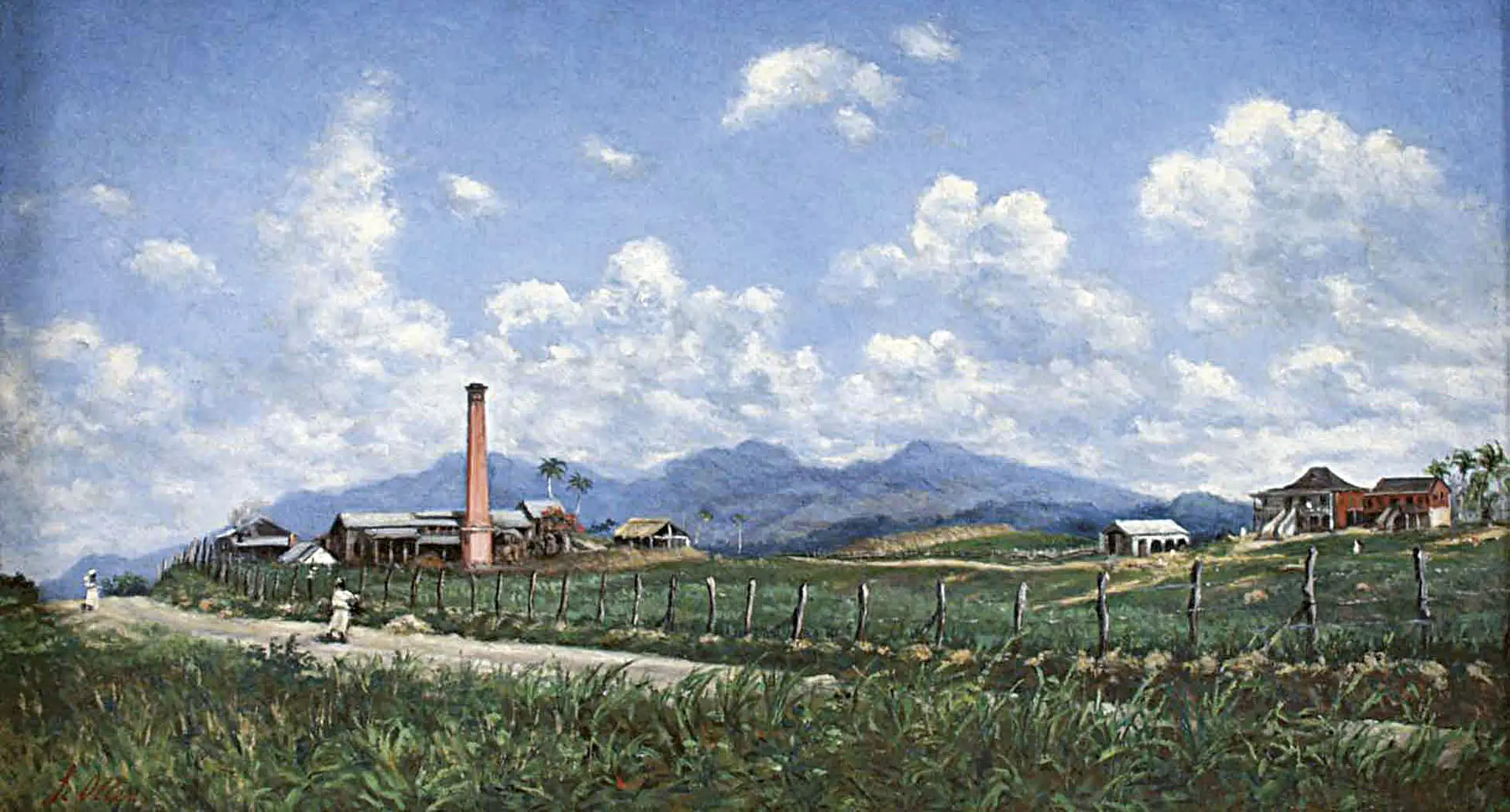
Harboring a deep love for the island’s lush vegetation and sugar cane fields, as well as for its lower classes, Oller continued to paint landscapes that showed the daily life of the island’s inhabitants throughout his life. In his earliest, still-existing landscape, The Ponce Silk-Cotton Tree (ca. 1887-1888), which provided the artist the opportunity to paint the reflections on water, laundresses are seen washing clothes along the banks of the Portugués River. In Hacienda Aurora (1898-1899), Oller captures the sugar cane plantation that he and his family fled to in order to escape the invading troupes of the United States Army
Oller’s most original works, most-likely influenced by the seventeenth-century Spanish painters Francisco Zurbarán, Juan Sánchez Cotán, and Diego Velázquez, whose work he became familiar with when he lived in Spain, are his fruited still lifes. The tropical fruits, many of which are coded social statements, were depicted in their many forms; green, ripe and most unique, sliced open to reveal their innards. In Still Life with Coconut, (ca, 1893) alluding to the people that work the land and fruit’s consumers, we actually see the machete that halved the coconut in two.
Returning home from his last stay in Europe Oller found that he lost the support of the island’s Spanish governors. It was only after the United States took over the island from Spain in 1898, and the new government awarded him a number of painting commissions, that the artist regained his footing. During his lifetime Oller opened ten schools of drawing and painting. All except the last were free. Looking back over his life, he was to write ‘the artist like the writer has the obligation to be useful; his painting must be a book that teaches, that serves to improve the human condition that castigates evil and exalts virtue...” To this aim, though thick and thin, he was to remain true.
Neatly bringing us into the middle of the twentieth-century is the work of Miguel Pou Y Becerra (1880-1968), the first artist of note to study in the United States. While Pou’s heart was in the right place “the idea that that largely guided my work was to reflect the soul of my people and the characteristics of the landscape of the country,” the artist’s unimaginative canvases, which veer towards the nostalgic, rarely rise above his ‘painting by numbers technique. Despite his claim that “the most notable influence in my work has been the Impressionists in regard to color” Pou’s work continued throughout his life to bask in the light of the academic teachings that he absorbed as a student at the Art Students League in New York and the Pennsylvania Academy of Fine Arts in Philadelphia.
A life-long teacher who eventually opened his
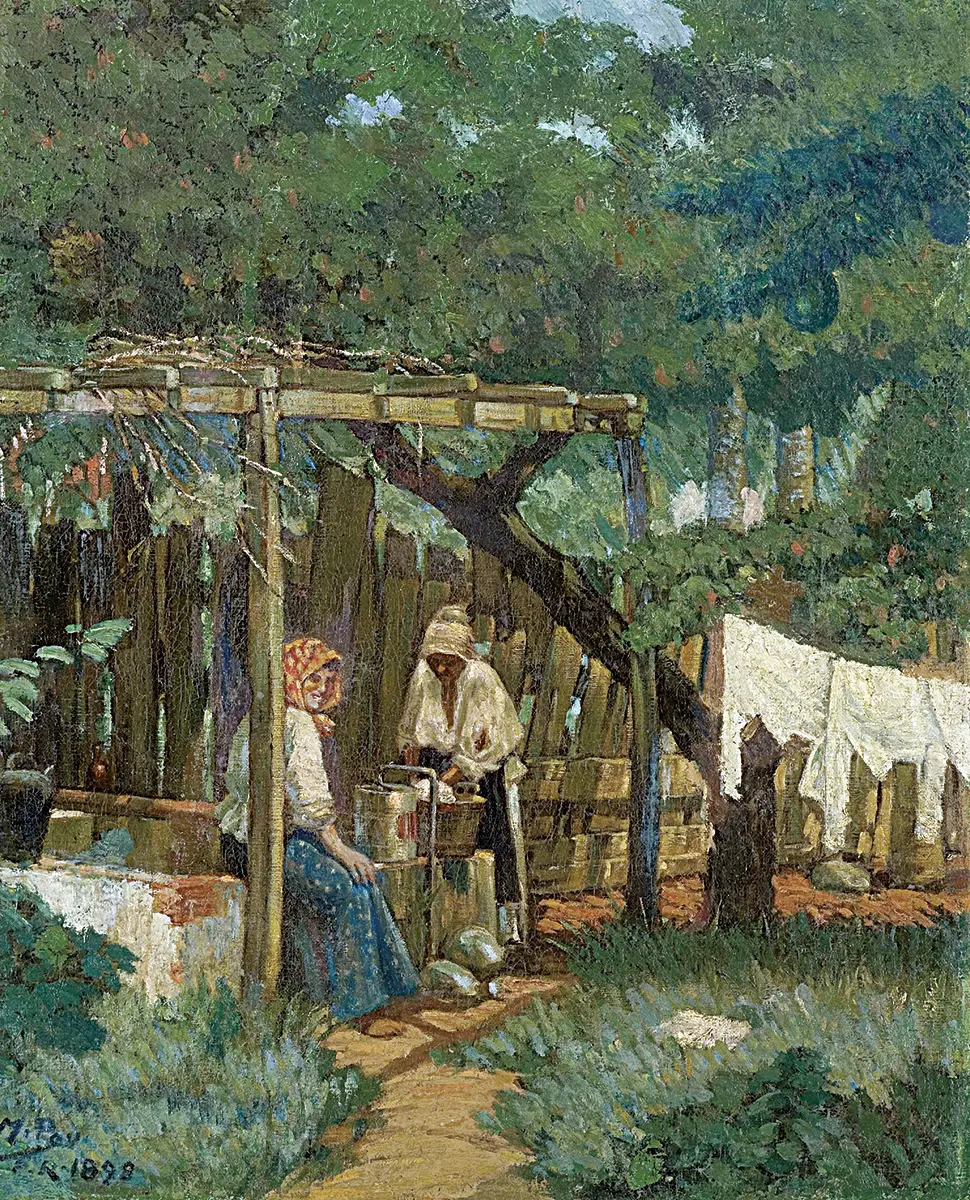
own painting academy, Pou, loved to paint the everyday life of the people. In Washerwoman (1898), the artist’s first
work that he painted outside, we see two washerwomen in a lushly planted garden
surrounded by trees. In Horse Drawn
Carriages in Poncé (1926), Pou portrays the picturesque “Plaza of Delights”
as both the heart of the city and a timeless place. His lushly painted
flowering flamboyán trees and glorious orange blossoms all but obliterate the
painting’s horses, the carriages, and the cathedral.
Pou’s most ambitious undertaking, on which his reputation primarily rests, is his series of seventy-five paintings of what he called “regional types.” Sensing that all would be swept away in his fast-changing world, eventually disappearing, he documented local tradesmen, jibaros, their families, and assorted island characters. In The Vow (1928) we see an old woman holding a picture of the Virgin Mary and Child. Pou, who often wrote about his paintings, knowing full well that the old woman’s ways are a mixture of superstition and belief explains, “Today she lights a candle to God and tomorrow one to the dead.”
In A Race of Dreamers — Portrait of Ciquí, (1938) the sitter, a famous early twentieth-century baseball player from Ponce, dressed in casual clothes and looking a bit uncomfortable, appears eager to return to his game. In another painting we see a seller of hammocks hawking his wares along the town’s street. As strange as it seems, given Ponce was one of the island’s main sugar-producing areas and had a large black population, Pou rarely depicted Afro-Caribbean subjects in these works. Ignoring the reality of centuries of racial mixing, ironically he chose to document the jibaros of his dreams, the “white hill dweller, the direct descendants of the colonists with all their virtues and voices.” who long ago ceased to exist.
Pou may have written, “I long for a past that cannot return.” But in this sentiment, he is only partly right, for as the paintings on view in Mi Puerto clearly show, "the past is always today and often tomorrow". In this respect, the work of Campeche, Oller, and Pou, overflowing with the love and respect that the artists had for their island and its people, remains gloriously alive.
EDWARD RUBIN