
Three of the galleries on the first floor of the Museo Nacional de Bellas Artes in Santiago host Teresa Gazitúa’s beautiful exhibition Línea de Tiempo. Educated as an engraver, this Chilean artist has incessantly pushed the traditional envelope of her discipline, seeking new forms of production. The current show includes six well-differentiated yet connected works: two installations, one video, two series of engravings, and an artist’s book.
An inexhaustible referent for the artist is the landscape that surrounds her, in this case, the Maipo river, which runs close to her workshop in Pirque. A mountain river that tirelessly drags down the very body of the Andes, where it forms: dirt and rocks that follow a tortuous, sonorous path. In its shores, there are rounded pebbles, guardians of the honor of the waters that continue their course towards the sea. Teresa has been finding her material there for a number of years. The pebbles are like matrices, like exhibition bodies, like supports for the very act of engraving creating a visible trace on their surface. And they serve, also, as voices of the river, audible thanks to the sub-aquatic recordings made under the flow of the Maipo. For the video, the sound comes from rocks that clash, pushed by the current. The image of the current itself, shot at close range, is overwhelming, even frightening. It is the raging water that submerges us, that doesn’t ignore us. It is the line of time from which we can subtract ourselves.
Alfredo Torres, the show’s Uruguayan curator, says that there are two immediate precedents: the show Primera música del río at the Museo Cabildo de Montevideo (2001,) and Piedras Cruzadas at Galería Animal, Santiago (2003.) This presentation completes a conceptual and thematic trilogy, as recorded in the excellent catalog that accompanies it. A single phrase to record the outstanding display achieved at the Museo de Bellas Artes: light, ethical signal, management of space, everything was attended to in detail, in order to achieve a truly moving whole.
Some of the installations shown in Primera música del río is reproduced at Bellas Artes, accentuating a cathedral-façade quality that wasn’t as evident in its first installation. These are dozens of hand-worked paper pulp molds for which the artist used, for her matrices, fifteen rocks from the river, marked with the incision of a cross. They are exhibited clustered on a wall, like juxtaposed blooms, like chrysalises, that show themselves from inside. The rocks left their traces, and that is what we see. A white, delicate composition that generates a wall for thinking and which, despite its origin in stone, has plenty of the organic. The stone molds transmit an appropriating action that is persistently careful, almost tender. They have to be half-wrapped in doughy paper so that we can see them as imprints. Then the rocks are taken out, they leave, like butterflies abandoning their cocoons. And their trace remains in a moving arrangement, perhaps an unintended metaphor for the altarpieces of our Baroque period. A wall that demands time for contemplation, and which, with its potential for allusion brings us closer to other realms. Such is its aesthetic strength, not only visual but also strongly suggestive.
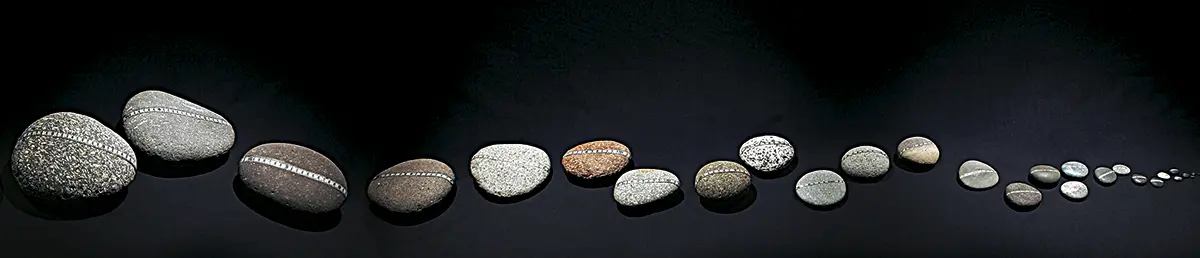
Other rocks comprise the Line of time that the show’s title alludes to. These are pebbles arranged by size, in loose form each marked with a fragment of measuring tape that indicates its size: from the largest, with close to 40 cm, to the fine sands that are left at the end of their existence, when the river has ground them and deposits them in the sea. The long line covers the totality of one of the gallery’s largest sides. It reminds me of Marshal Berman’s brilliant essay on Modernism, Everything Solid Melts Into Air. The pebbles, aligned on the black floor, largest to smallest, each with its own texture and color, make the course of time present. In the almost dark gallery, a spotlight highlights each work. The “line of time” seems to be not only light but a veritable source of light in itself.
In the same gallery, on support that places at the right height for us to observe it, is Río de Papel y Arena, the artist’s book. It comprises twelve plans, forming a continuous “accordion.” Unfolded, the books are another kind of river, another current. Its text is the small pebbles that produce the visual discourse (photography, embossing with and without ink, worked on acrylic sheets, and printed both on white paper and on pieces of transparent material.) Since 1997, Teresa Gazitúa has created eight artist’s books in limited editions. She made 12 copies of this one, with an epigraph from the journal entry in which Charles Darwin registered his impression of the Maipo: “…night and day you can hear that clackety-clack all along the course of the torrent…” The pages condense time in successive images and also take us over the course of the river, from the thick rocks at the beginning of its path to the fine sand kept in the last folio, inside a think glass tube.
The third gallery contains two groups, each comprised of six engravings and their stone matrix, exhibited on pedestals. The engravings are superpositions of several planes that seem to float in the air thanks to the way in which they are displayed, at a certain distance from the wall: frameless, they are supported by two wires, one above and one below. There is dry embossing and photographic images printed on transparent supports. One of the series also includes drypoint. These engravings are the show’s most abstract section, the most transformed and distilled from its original theme. The gallery as a whole is rather solemn: we have arrived at the essence. The old aphorism is fulfilled: When the river roars, it carries stones.
MARÍA ELVIRA IRIARTE