
I don’t have to file a change of address to live in Dystopia. There’s really no tension anymore between it and ...gosh, I forget... what else was there? Don’t you hate it when dualities collapse? They made things so much easier, like the roles of art and government, for instance.
Art is supposed to stake out a place that guards the unique, subjective experience that is not possible in an overly rationalized world, both before and especially after 9/11. The flip side of the chaos of terror is the reputedly protective and calming experience of surveillance. That’s why both the avant-garde and the police state have jobs and are important, right? But weren’t they opposed to one another at one time? Can they be any longer?
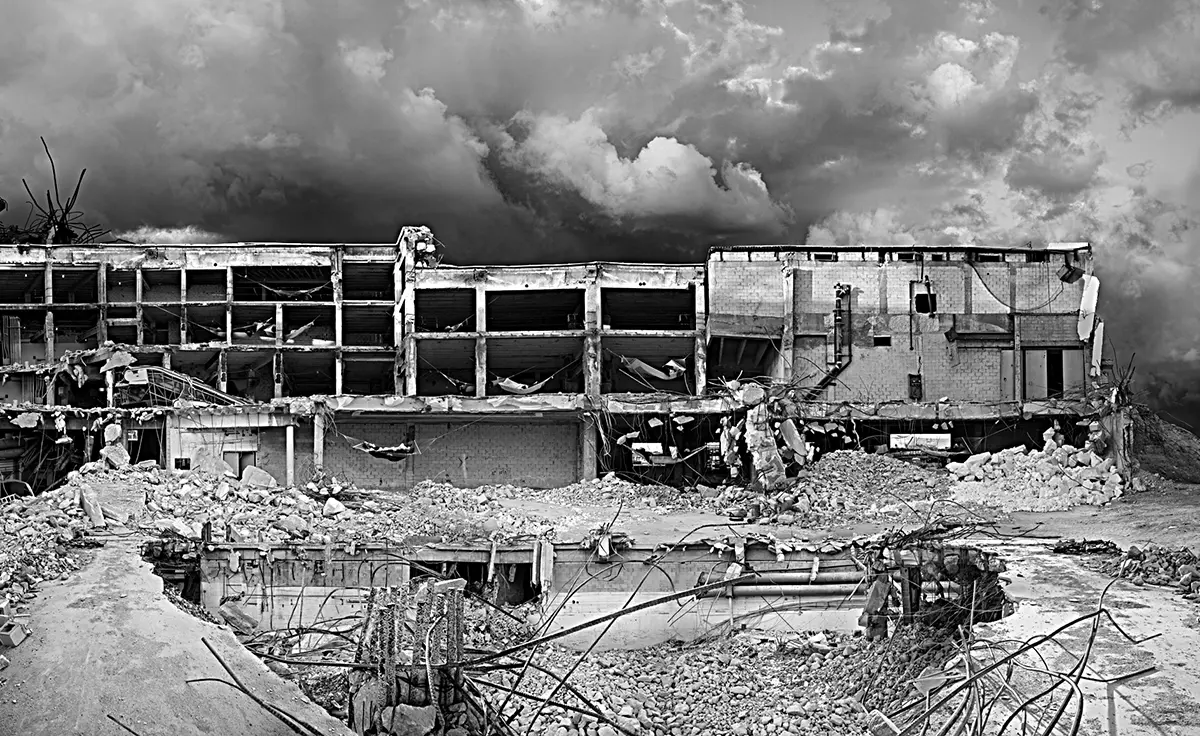
Few people seem to be aware that there is no outside world, or even aware of our own complicity. Anthony Goicolea, the creator of the work in Almost Safe, seems to get it, or maybe he doesn’t, but there’s no doubt more of us need to get it. Dystopia is where we live; it’s not a postcard from another location. And we helped to construct it. Many Americans still buy SUVs in support of North American oil terrorists, to feel safe as we help to create an environment that will devour us. Both conservatives and liberals support the very capital markets of causality that tear families, values, and landscapes apart.
In the exhibition, Goicolea’s large-scale presentations—six digitally created composite photographs and one painting—were rich with a desolation that surrounded the viewer and created a decidedly chilly atmosphere. These works featured vast views under thick clouds, frequently with snow and mostly littered with industrial waste, power lines, and silent, deserted, Modernist industrial buildings. People were mostly absent, and when present, they were at a small and inconsequential scale. It was the post-industrial, apocalyptic song-and-dance. But my verbal descriptions don’t come close to the feeling that Goicolea created, which was quite effective, nor do they capture the smaller vignettes within his larger scenes, such as some old people snuggled in hammocks strung among blown-apart and ruined buildings that might once have provided a nice, concrete, Modernist retirement village (Deconstruction, 2007). The seamless digital composites were successful because they sutured in the necessary artifacts of the real. Details were beautifully interwoven into the vastness.
Goicolea transferred the same elements into his painting Search Party (2007), using an abbreviated figurative style with purposeful acrylic drips and washes, but this work failed to convince one of anything other than a self-conscious parody. It was too cartoon-like and distracted one from Goicolea’s most effective accomplishment: the hypothetical believability in the world he has created. Of course, that may be exactly why the painting was in the exhibition—to break the spell.
But this does not mean that Goicolea is unable to use the implied as well as the literal. His looped, seventy-five seconds-long, 16mm film Code (2007), shown in a tight, black-painted rear corridor, was a delightfully effective use of implication and intrigue. In a forest at night, flashlights popped on and off in multiplying numbers and increasing movements (assisted by the careful insertion of set lights in the trees—think of early X-Files) that evoked a chilly undefined threat: the panic of a chase, the worry of loss. After a while, the viewer could laugh at the wonderfully affective spooky signifiers as the chaos was built and then subsided. (Think Blair Witch Project. Sounds tacky, right? But it worked, especially if you watched it several times!)
Between these two installations were a series of small diptychs: negative and positive portrait busts of elderly people. Goicolea drew the negative images on Mylar and Plexiglas and used them to make the positive color photo prints. Titled with the names of the sitters, these works had a monochromatic, X-ray-like quality that made them seem more like records of vanished specimens than of living hopes. In Goicolea’s work, this world is dead on arrival, and safety is reduced to acceptance, an attitude and practice that might be more fruitful for all of us in the long run.
RICHARD LESLIE