
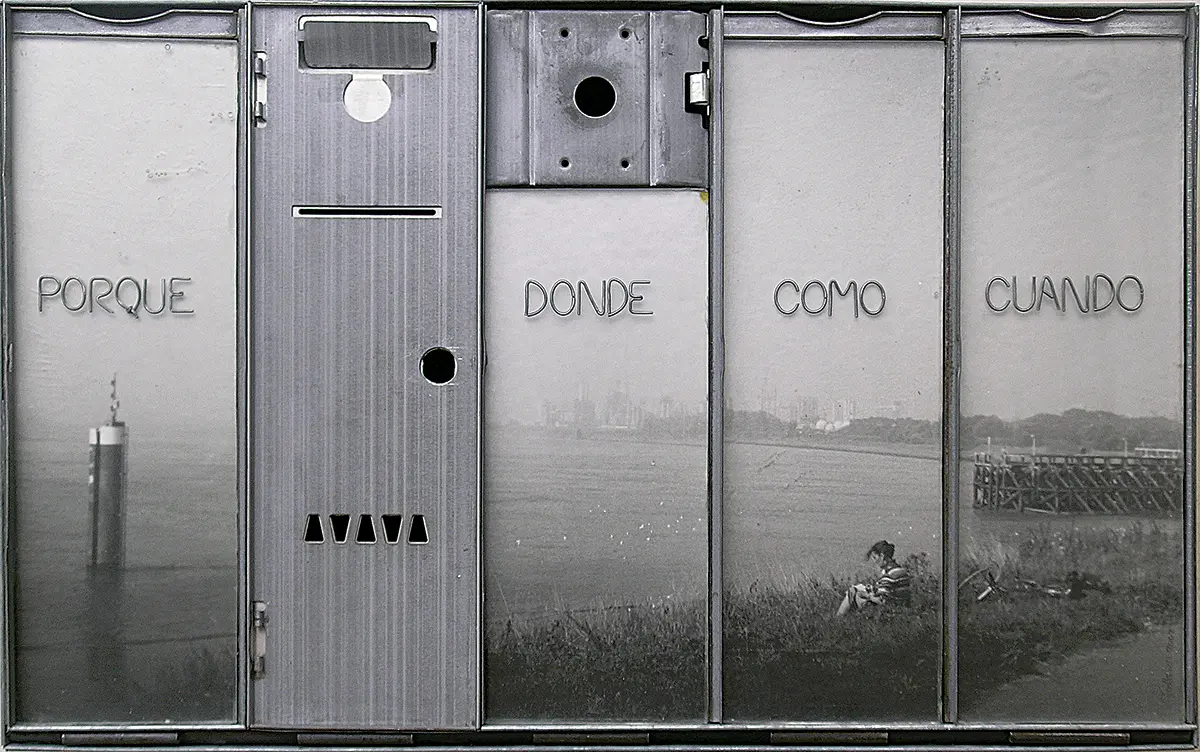
In twelve mixed-media works, the Argentine Carlos Gallardo adopted the conceptual essence of documentation, the “who, what, where, when, why, and how” of modern journalism—words that he repeated as a kind of leitmotif across the surface of several works, to explore forms of memory.
Gallardo’s visual language is based on two components: letters and photographs, objects that transcend individual experience and speak to human hopes and fears that are nearly universal. It has long been recognized that letters can evoke the physical sensation of the presence of another, regardless of the distance in time and geography that may separate the writer from the reader. Photographs, while a form of communication of much more recent vintage, are even more potent containers of individual beings. Gallardo’s combinations of the two forms—neither being more than pieces of paper with little inherent value—give visual expression to the rich and powerful emotional associations invested in them.
In works like Tiempo a Tiempo IV (1996), Gallardo hinged a tattered photograph and sheaves of old gelatin-preserved letters together in the form of a book to acknowledge the novel-like quality that collections of letters inevitably evoke. A segment of this book also was bound with metal wire, holding the letters in place atop a base of iron. This additional binding suggested both the desire to contain the memories within the letters and the effort invested in conserving these manifestations of memory.
In a series of numbered works from 2003, each titled Finale, Gallardo presented preserved letters on a group of music stands as if they were the scores to some unknown work of chamber music. Both the name and the numbering system of these works recalled the scholarly catalogs that chronicle the creations of the great composers. Each piece in the series was clearly unique, as one would expect for the scores for a variety of instruments. Their grouping also made it clear that these individual parts were meant to be played together, creating a richer, more complex composition in the process.
In an extension of these metaphors, Gallardo juxtaposed photographs and otherwise mundane mailboxes, like ones found in millions of apartment buildings across the world. This combination invested these objects with the hope and expectation of potential contact that are often projected on them. While the artist’s understanding of the internal forces that can accompany the simple act of retrieving one’s mail arises from his particular history as a political exile, anyone who has lived away from home and family for any reason will recognize the anticipation associated with this act.
In On & Off (Floresta) from 1998, Gallardo made explicit the mailbox’s role as a container of memory. Transparent doors revealed dozens of jumbled photographs in each compartment, a non-random mix that suggested the biography of an individual apartment and of the building itself. Other mailboxes bore perhaps the reflection of a particular place or a projection of a far distant place. The landscapes they showed were not romantic postcard images. Instead, they depicted factories and wharves, the locales of everyday working life. Abismal II (2004), for example, depicted a person who, having arrived at an industrial port by bicycle, appears to be reading or writing a letter. One mailbox of this unit was missing only the nameplate. This missing section did not forcibly interrupt the panorama, suggesting little more than a temporary vacancy. Another segment was missing the entire cover—completely interrupting the image covering the unit’s surface—which could be interpreted as a sign of a more lasting absence. Either way, the missing panels suggested the interruption of an entire emotional landscape that the absence of just one person from the daily life of a family may create.
These works lifted mailboxes out of the realm of the strictly utilitarian and charged them and their contents with a kind of psychic power, transforming them into modern counterparts of medieval reliquaries. Perhaps the evocation of reliquaries could only be evident when the containers themselves had been imbued with an aura of antiquity and nostalgia.
Technological changes sweeping the world will rapidly transform the mailbox, letters, and even family snapshots into the relics of a past age. Historians have bemoaned the advent of the digital world and its attendant loss of physically written records. It is certainly doubtful that a computer screen will ever hold the psychological power and presence that a packet of old letters or a family photo album still evokes today. Gallardo’s juxtapositions of both letters and photographs distill their expressive force in elegant, poetic form, bringing otherwise invisible sensations into sharp focus.
K. MITCHELL SNOW