
One of the most vital trends so far in the twenty-first century is that of landscape portraiture. A reason may be the nostalgia of representing a planet in danger of disappearing, at least the planet that our ancestors knew, or simply the immemorial human delight in representing the surrounding environment. The Mexican photographer Diego Pérez (born 1973) seeks to portray the landscape of places besieged by the relentless presence of the human hand in the form of construction. Against a peaceful and expansive sierra, a barren ground endures the often-unfinished construction of a variety of shapes in concrete that was planned to serve some function but is currently devoid of use. Homes with no roofs, bridges in the middle of abandoned highways, staircases leading nowhere, columns supporting lintels without vaults, and other building fragments rise in a landscape that is both the frame and the background of such expressions of the presence of humanity.
In some ways, the structures in Obra negra resemble Sir Edward James’s unfinished surrealist building in Xilitla, in the state of San Luis Potosí in Mexico. A whimsical amalgam of columns, staircases, roofing, and sculptural shapes seem to senselessly populate the jungle amidst reservoirs and canyons; uninhabitable sheds, unending walkways, or labyrinthine passages make one feel as if one had stepped into a wonderland. Pérez depicts Xilitla’s younger siblings dispersed throughout the Mexican republic, with finishes that speak of budgetary constraints rather than a project of a multimillionaire’s architect. These structures are as frustrated as that of James, an Englishman who lived in the building in Xilitla until the time of his death and who was a friend of Leonora Carrington, whose mural can still be seen in one of the few restricted-access rooms with a roof.
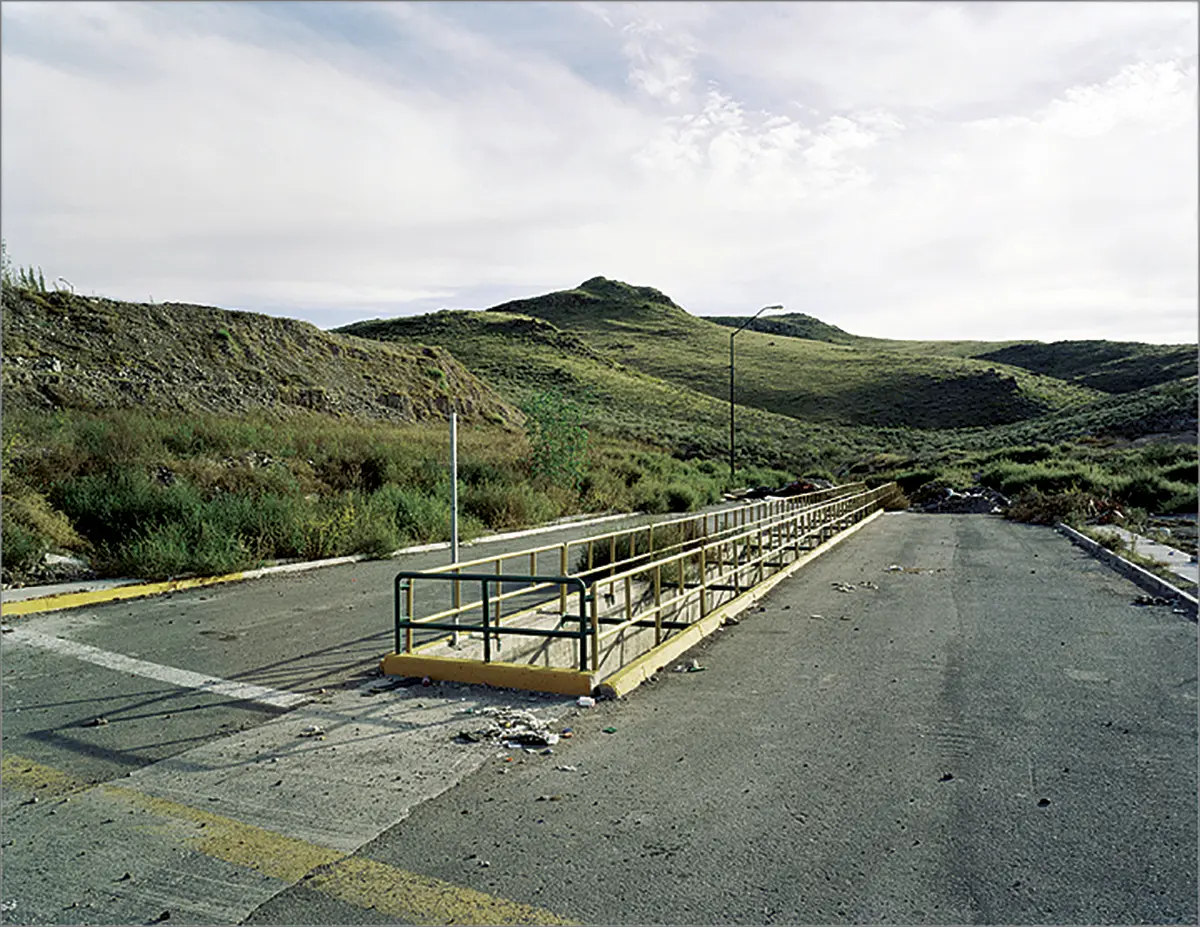
There is no surrealist intention in the works that compose Obra negra, but their ineffectiveness as functional or merely aesthetic elements within the surrounding panorama of the everyday encourages a more thorough observation. Examining closely the image of a carving that has penetrated an element of nature, one wonders whether the photograph is the product of Photoshop or some other technological artifice. Yet, it is enough to turn around and look at the landscape of Mexico to verify the sad reality. The large chunks of chapopote between two mountains are not parts of an earth-artwork but a failed highway project. A tunnel in the middle of an avenue is not a path to a better world but an overpass, allowing the inhabitants of a desolated town to move from one side of their village to the other without being crushed by automobiles. A modern staircase leading to a concrete pedestal that supported a vanished statue of an unknown hero is just proof of the fact that something had been there and no longer is. Other buildings that were to be warehouses stand in front of the view, with a backdrop of a magnificent blue sky and terrain covered with maguey plants, yellowing grasses, and wild nettles.
When concrete—a uniform, easily handled, malleable mixture that hardened quickly—was invented in Scotland in the second half of the nineteenth century, it was considered a universal solution for construction. And, in fact, concrete is the most often used and most efficient material in civil engineering. But this hardened compound generates the most noticeable aberrations of the landscape.
Pérez follows an unplanned route through Mexico’s suburban and rural areas and captures with his lens some of the effigies that, being so ugly on the horizon, lend themselves to aesthetic analysis. The contrast between the debris and fragments of unfinished construction projects and the surrounding landscape makes the result of a hypothetical residence seem more a utopia than a reality. Walls and façades are not the entryways to a house, because what continues beyond the front door is the implacable landscape. Construction roots and incomplete turrets are nothing but instances of the unrealized and the truncated. Even so, in his medium-size photographs, Pérez highlights the non-contingent and a convulsive beauty that in other times was declared sublime.
LUZ SEPÚLVEDA