
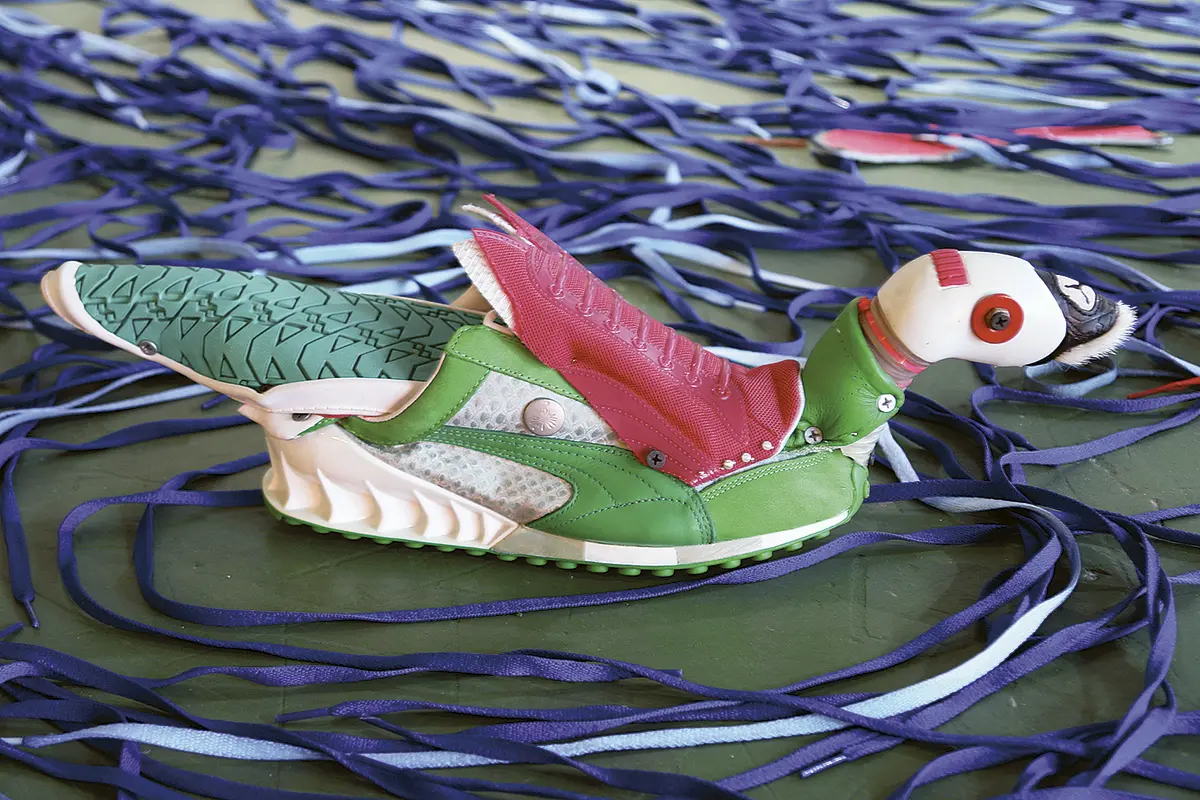
Upon entering Federico Uribe’s exhibition, one encountered a clear, open forest. Knowing viewers saw a new turn in the work of this Miami-based Colombian accumulation artist. Those who encountered Uribe’s objects for the first time saw unusual conjunction of the industrial, every day, and the sports-related in these accomplished artworks. One knows how threatening a crocodile, a leopard, or a puma can be, but thanks to Uribe’s labor, one was able to get close to these beasts, to relax, and even to smile at them. The open jaws, the extended paws, and the fixed stars on the visitor were amiable surprises. These animals were not alive nor were they mummies but rather objects made of rubber, plastic, cotton, and other synthetic materials. Closer inspection led to discovering surprising elements: shoelaces, pieces of tennis shoes, and, occasionally, the word “PUMA,” either whole or fragmented.
The exhibition was a creative, playful, and ecological challenge. Uribe has always used a trompe l’oeil approach in his work. Both in his early paintings and in the objects that made his name on the international art scene, Uribe developed a passion for accumulating utilitarian everyday objects. Uribe’s vision using bottle caps, pacifier tops, cleaning gloves, and disposable eating utensils, among other things, produces an inversion of meaning; he makes the functional aesthetic, grants meaning to each mass-produced part, and turns each into a component of unusual objects and installations. Uribe creates references to the human and to nature through such contrasting representations. Similarly, other ideas can be read in his work, such as freedom from the rigorous demands of religious education and expressions of sexual repression within schooling in much of Latin America.
At the Chelsea Art Museum, Uribe’s exhibition Human Nature presented a contradiction to the viewer. One was confronted with a non-threatening jungle, one that was amenable rather than oppressive, and once the fool-the-eye quality was discovered, one could differentiate the “palm trees” and the “lake water” from the shoelaces of which they were made, as with the duck, the turtle, and the toucan from the tennis-shoe soles used to build them, and so on for every “jungle” feature and each compositional item that provoked one’s attention. The whole installation, which comprised 1700 pairs of tennis shoes and 35,000 shoelaces demonstrated a very intelligent use of those elements as well as an excellent example of collaboration between an artist and a commercial firm.
The show was a large installation composed of groups of large painting-reliefs and of smaller connecting scenes. Throughout the gallery, colors were varied and intense. The tableaux had shoelace “vines” that hung from the sides and in whatever space accommodated them. The gallery, flooded with natural light, revealed the outlines of the tableaux against other more intertwined sectors. This spurred an awareness of the work’s layers of origin and meaning: from the jungle to the museum, from the museum to the workshop and intense production without brushes or paints, from the workshop to the museum, from the museum to an awareness of nature and the jungle, and back to the museum. The work was a Pop Art exercise, one more cinematographic than related to the more static visual arts.
This exhibition brought together the forests of Uribe’s native land, the impact of his seven years in Mexico, his string of exhibitions in New York, the fact of his living and working in Florida, and Puma USA, the company that sponsors some artists with its products. Worked over by the artist, the components of athletic shoes were altered; they were no longer products for walking, jumping, and running but we're used to expanding the social imagination. Uribe sought to express the depredation of the forest and the impotence of those who understand and suffer it. The ecological aspects were clearly understandable in Uribe’s references to the animal, vegetal, and human realms but with a visual language and a general perspective directed toward pleasure. Uribe says, “When I started working with tennis shoes, I couldn’t stop thinking about where they came from and about all the materials from nature that we use for our comfort in everyday life. Thus, as a tribute to what nature offers all of us, the idea developed of reconstructing nature on the basis of its own materials. I can’t give my creations life, but I can give them an echo of life, which is as much as art can do.” If with this jungle he created fossils for posterity, Uribe activated an ecological concern that prompted reflection and amusement.
GRACIELA KARTOFEL