
In his second solo show at I-20 Gallery in New York, Gonzalo Lebrija accomplishes the rare feat of making politics look astonishingly beautiful. One is distracted and subdued by aesthetic pleasure when one looks at these works, such that one stops worrying about the meanings of politics. The piece in the exhibition that best exemplifies this dynamic is Lebrija’s four-minute video of a businessman riding a bucking bull. Its rich colors and sumptuous forms put Lebrija in the same league as a slightly older generation of artists who have used film and video to seduce us with beautiful images while tackling themes of displacement and globalization: Doug Aitken, Pierre Huyghe, and Gabriel Orozco, to name a few.
Images of men in uniforms fill the exhibition. In addition to the video, the exhibition features four photographs. A series of three modestly sized photographs titled Playing High shows a group of men wearing business suits. These gentlemen obviously pay attention to their appearance, and the press release reveals that they are lawyers in Guadalajara. Their suspended-action poses and the image’s palette, brown punctuated by crisp white cuffs and collars, mimic the conventions of seventeenth-century Dutch portraiture. Rank and stature matter. Two graying attorneys are surrounded by their young colleagues. This formality is humorously undercut by two men contemplating the aerodynamics of a paper airplane in the rear, and by a seated man exhibiting his desire for a cigar. In the first photograph he’s fondling it; in the second, smelling it; and finally, in the final shot, he’s smoking it with his head back and eyes closed. Lebrija has an eye for the absurd.
Pomp and swagger are also on display in Chivastar, a large photograph of a football team surrounded by the Mexican army. In this image, more than one hundred people are standing in a star formation on a runway. This way of photographing a group evokes nostalgia but is also a reminder of how bodies are controlled by institutions.
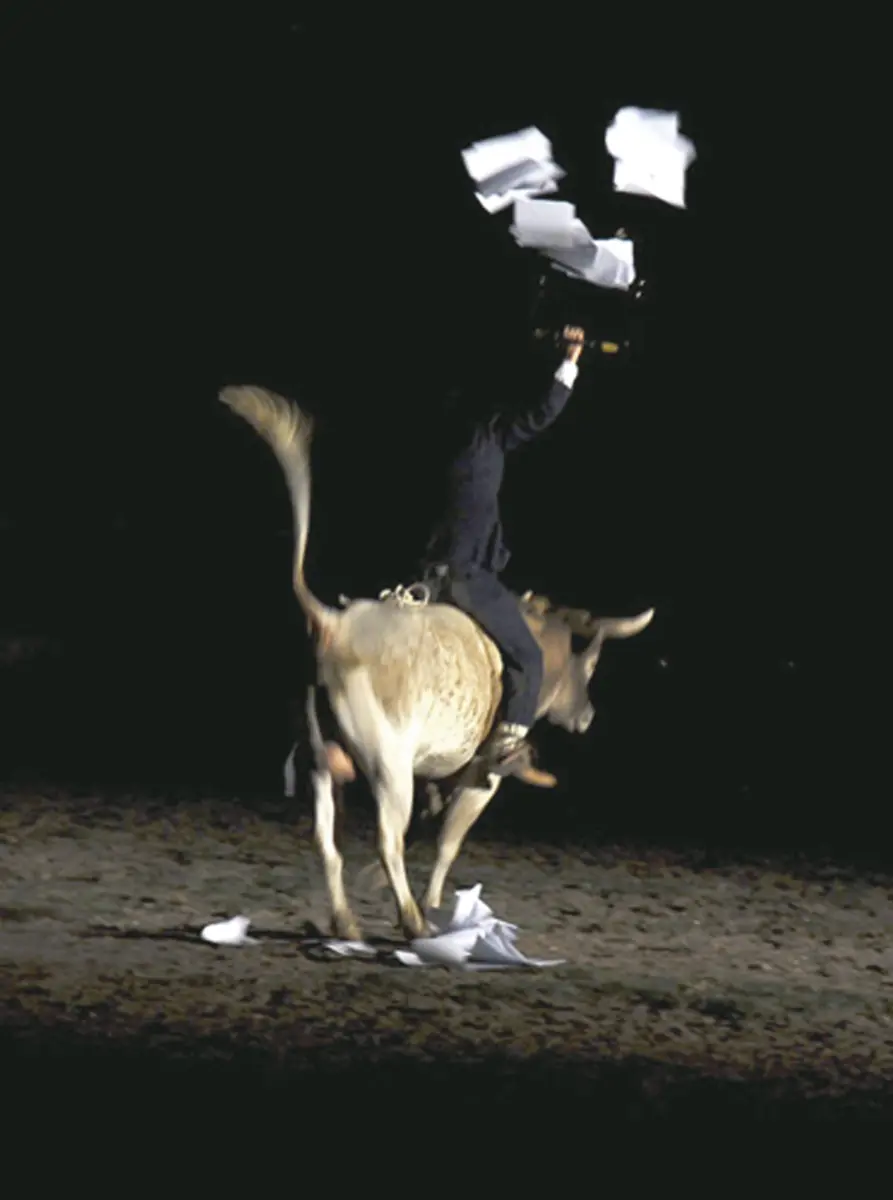
Returning to the video, Lebrija raises the stakes. Watching it evokes awe. The narrative of this four-minute work titled Asterión is actually quite simple, if somewhat absurd. A clean-cut man in a suit approaches the paddock where a bull awaits, pawing the dirt with its hooves. The man carries a briefcase and, as he mounts the bull, he continues to hold the briefcase, grasping the bull with one hand and the case with the other. After he rides the bull for a minute or two, the case opens and white papers spill out of it and are blown into the sky. A couple of seconds later, the man falls off and the camera follows the bull as it continues to buck for a few seconds, then the image fades out.
The video achieves the sublime by evoking both a Baroque painting and a contemporary horror flick. Lebrija slows the video and audio tracks so that the bull’s movements become graceful, and its grunting and bucking sounds are like thunder and dinosaur moans. The action takes place at night, and the work’s palette comprises seventeenth-century browns and beiges interrupted by an occasional white accent, as in Playing High. Vermilion accents and an infinite range of beiges and browns push the artfulness of the palette to the extreme. This makes sense when one realizes that the video’s climax is aesthetic in nature. The climax doesn’t occur when the man falls off the bull but rather when the papers that have fallen out of his briefcase float into the sky and the camera follows them as they loop and bend against the black night sky.
A businessman riding a bull suggests the allegory of man versus beast or, more generally, culture versus nature. But the reasoning behind Lebrija’s coupling of businessman and rodeo bull is not really apparent. It is the work’s suggestiveness, its evocative openness, that makes it both sensually enthralling and intellectually challenging.
Lebrija is part of a younger generation of artists working in Mexico who have turned away from the violence and excess that characterized much of the work by Mexicans shown in the United States until now. Part of a conceptually minded group of artists working in Guadalajara, Lebrija has used collaboration and site-specific approaches to making art that poses broad philosophical questions about how institutions and individuals negotiate with one another. In this exhibition, Lebrija has brought these questions inside a white-cube gallery in New York, to good effect.
HARPER MONTGOMERY