
In 1967, the French writer Michel Tournier put a twist on Daniel Defoe’s classic Robinson Crusoe, turning the innocent primitive educated and trained by the castaway Crusoe in the original story into the protagonist who leaves behind his native island to explore unknown places. On Friday, or the Limbo of the Pacific, it is Crusoe who voluntarily decides to remain on the island of his previous misfortunes, as though this were his only chance for a pure way of life in direct contact with nature, while the young Friday adjusts to the uniform of the modern man and experiences progress and civilization. As a newly enlightened being, the former savage faces what Crusoe wants to leave behind, outside of his island, now transformed into the land of his desires and aspirations.
Naufragio con espectador (Shipwreck with Spectator) was the title of Iñaki Bonillas’s most recent exhibition at OMR Gallery in Mexico City. Inspired by Hans Blumenberg’s book, the metaphorical title referred to the notion of a shipwreck as an emotional experience, a paradigm of human existence. The exhibition comprised a site-specific installation, a photographic series, and several drawings that focused on equilibrium.
Like the old houses found in the city’s Colonia Roma, OMR’s building has lost solidity from erosion and earthquakes and has a fifty-three-centimeter incline, causing visitors not only to occasionally lose their balance but also to feel unease. In order to ameliorate and emphasize this peculiarity of the building, Bonillas built four platforms in each of the gallery’s main areas. The four structures ranged from small steps to veritable empty pedestals. Against the darkness, the light emitted from outlines in the gallery walls made evident the slant that traverses the building.
One imagined Bonilla’s platforms as an archipelago where viewers could experience the steadiness of terra firma; it was a metaphor between the building’s slant and the need to return to the original state of things, before the actions of nature, caused the change. The islands/platforms built by the artist progressively lost any negative connotation of isolation and separation from the ground and became a castaway’s personal dominion, refuges created by the ingenuity of survival. In a shipwreck, however, one possibility is to move away from the land and to drift; this work was particularly apt to be read as a journey through the irrational or the instinctive, the “risky navigation” that Blumenberg posits as the essential basis of existence. The viewer that drifted on the platforms, transformed into a boat, was freed from land, and was now governed by indeterminacy, a metaphor for the loss of reason or of order.
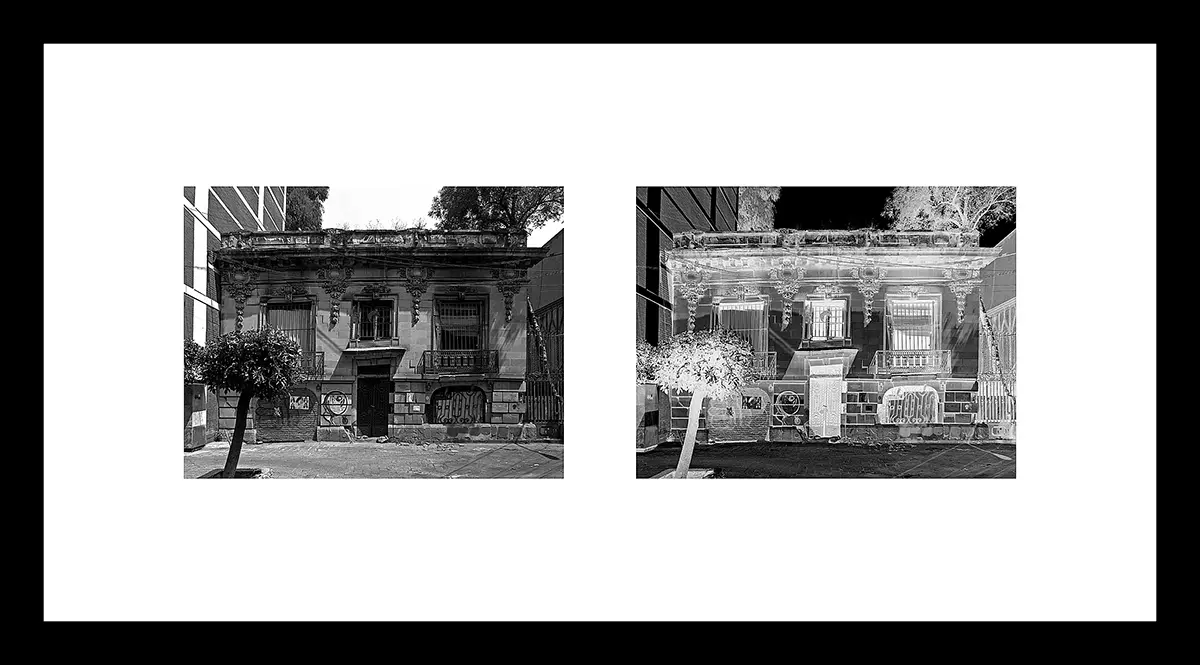
The photographic series, Espectador del Naufragio (Spectator of the Shipwreck), showed thirty-six Colonia Roma buildings whose foundations have suffered the same fate as OMR’s. With this archive of photographs and negatives, the artist persisted in his obsession to rescue the medium, the most ephemeral aspects that characterize it as a technique. But unlike his previous works, the images captured in this archive were more than photographic opportunities, becoming instead the Colonia’s history told through a unity made visible by the artist.
Naufragio en silencio (Shipwreck in Silence) was the title of eighty drawings made with an architectural pen. Once again there appeared the need to manually define a horizon, to create equilibrium in the face of the uncertainty generated by the blank space. Despite using the proper instrument, the artist’s drifting hand made the lines oscillate slightly without finding a precise position. As in many of Bonillas’s works, repetition and the inevitable margin of error implied left the plan without an established route to follow and thus generated the artistic object.
With these three means of representation, the exhibition made the viewer both the spectator of a debacle and the castaway. It offered one the possibility of Defoe’s Crusoe or Tournier’s Friday, an opportunity to establish one’s point of view in the face of everyday structures, architectures, shared images, and memories—objects and situations that despite their familiarity have the potential to bring one closer to the unknown.
RUTH ESTÉVEZ