
Whenever someone refers to Jac Leirner’s work as “sculpture” or “object making”, I remember how this artist indulges in the conceptual strategy of associating her work with an idea, however, expanded, borrowed from painting— whether it be due to the number of wall objects she produces, or because of the intense chromatic relations reigning over a good part of the components of her works. At her last solo exhibition in São Paulo, this association was ever-present and more difficult to dilute within the confines of the given aesthetic praxis. An example of this is her work A pièce-de-résistance, which comprised a large surface set on a wall and adopting the shape of an object-painting in the expanded field that formed an enormous monochromatic rectangle, much wider than taller. Alternatively, one can also gather from this piece the artist’s lively interests in the manipulation of certain forms borrowing from geometric abstraction, more specifically from Minimalism and Neo-minimalism. Nevertheless, Leimer’s current works are characterized as being created with found and “appropriated” materials originating from the typically wasteful consumption and merchandising environments. Consequently, “signing the world”, taking the everyday and transforming it into a “work of art”, is one of the archetypical devices Jac Leirner uses; regarded, on the other hand, as one of the most identifiable characteristics by which the world recognizes the Latin-American art of the 1980s. Leirner’s poetics is well known for the artist’s series of works based on the creation of the obsessive and apparently endless collection of banal and trivial objects.
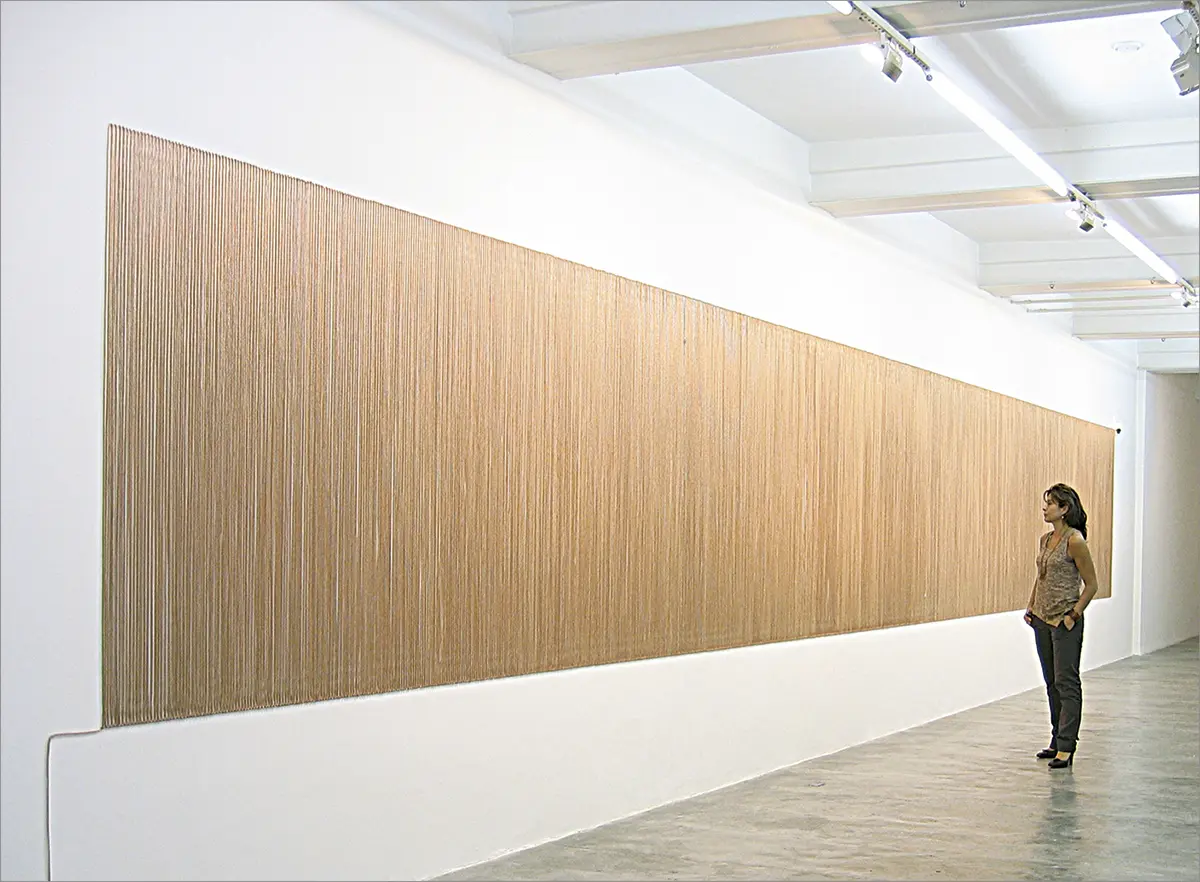
For the exhibit at the Galería Baró-Cruz, her first São Paulo solo show in 5 years, the artist presented for the first time in Brazil two works belonging to the series Little Lights, begun in 2005 and previously exhibited in France at the Centre d’Art Contemporain de Saint Nazaire. This is new and significant work in Jac Leirner’s already great artistic trajectory.
To account for her rigorous and complex artistic methodology, it is necessary to mention that Leirner herself considers Little Lights to be only her second work to date, while the artist regards all of her productions—those involving collectibles, from her initial series created with swarms of cigarette packages and out-of-circulation currency, to Leimer’s most recent works, composed of visitor ID cards and vinyl adhesives—merely as a body of study and experimentation, classified under several studies or working sub-groups that expand for more than 20 years.
In Little Lights, Leirner again takes up many of the most singular “wordings” of her artistic vocabulary: Line; repetition; accumulation; relationships between material and metaphoric qualities, and her inclination toward geometric forms.
As we concentrate on analyzing the exhibit’s central objectual art piece, we first must describe it: It is constructed with four kilometers of copper thread rendering a “visible body”, and most importantly, a sensory element to the energy used to power a 60-watt lamp, tied to the extremity of the copper thread.
The deliberately disproportionate structure, with its threads connecting the source of energy to the lamp, was laid out in zigzag fashion and affixed to the wall with nails that on their own formed an enormous monochromatic surface.
Here, what matters to the artist is the conceptual connection or “disconnect” between the actual creation of energy, typical of the poetics included in process art, and the material this “gesture” emits, a disproportionate interplay between matter and effect. As always, Leirner’s work is open to subtle metaphorical and subjective implications that find their emphatic added worth in the work entitled Little Lights. What should the necessary size of the gesture be to power the little lights? Little Lights was exhibited simultaneously with artist Mira Schendel’s vast retrospective show at another gallery in the city of São Paulo. Leirner’s new works are very much in tune with the aesthetic direction initiated by Schendel. While Little Lights was being shown, Schendel’s anthology included the installation Ondas Paradas de Probabilidade (1969), a penetrable environment consisting of millions of nylon threads attached to the gallery’s ceiling.
The works in both exhibits gave shape to profound questioning and metaphorical and spiritual examinations, in the manner of great artistic gestures based on the idea of repetition.
In Leirner’s solo exhibit, another less spectacular piece also utilized copper threads in large quantities of endless rolls to cover wood coils set on an industrial pallet, which gave an artificial and at the same time a more “crude” quality to the physical properties of the new material present in this splendid series of works.
On including the copper thread, as the conductor of electric energy in her select and revisited list of “assisted” materials, Leirner approaches with these works the series of pieces contained in Os Cem (1986–1998). Just as the long, compact set of copper threads provides matter for the lamp’s electric energy, a similar gesture occurs in the millions of old cruzeiro bills that conferred “density” on the idea of devaluated currency during the hyperinflation of the 1980s in Brazil. Both works are employed as materials of circulation: of value and of energy. Even less Pop and closer to a minimalist aesthetic or to industrial materials, the artistic and the spatial potential of Little Lights continues to be an adventure of undiscovered messages, codes, and crisscrossing of unknown directions embodied in items of deceiving triviality. Accordingly, and brilliantly so, the “world” once more ascends to the status of “work of art”.
RODRIGO MOURA