
It is usually refreshing and sometimes stimulating to see changes and shifts in an artist’s trajectory. That was exactly the case of Janaina Tschäpe’s second solo show at Sikkema Jenkins. For the first time in the U.S., this exhibition presented Tschäpe’s oil paintings and some of her watercolor and crayon-based works on paper.
In the past, Tschäpe has worked with a variety of media including film, video, photography, and sculpture. Her works carried fragmented narratives that usually incorporated the artist or her friends in theatrical and staged poses involving balloons, inflated condoms, wings, and prostheses of water-filled latex attached to their bodies. The images, made in outdoor spaces, created a communion between body and nature.
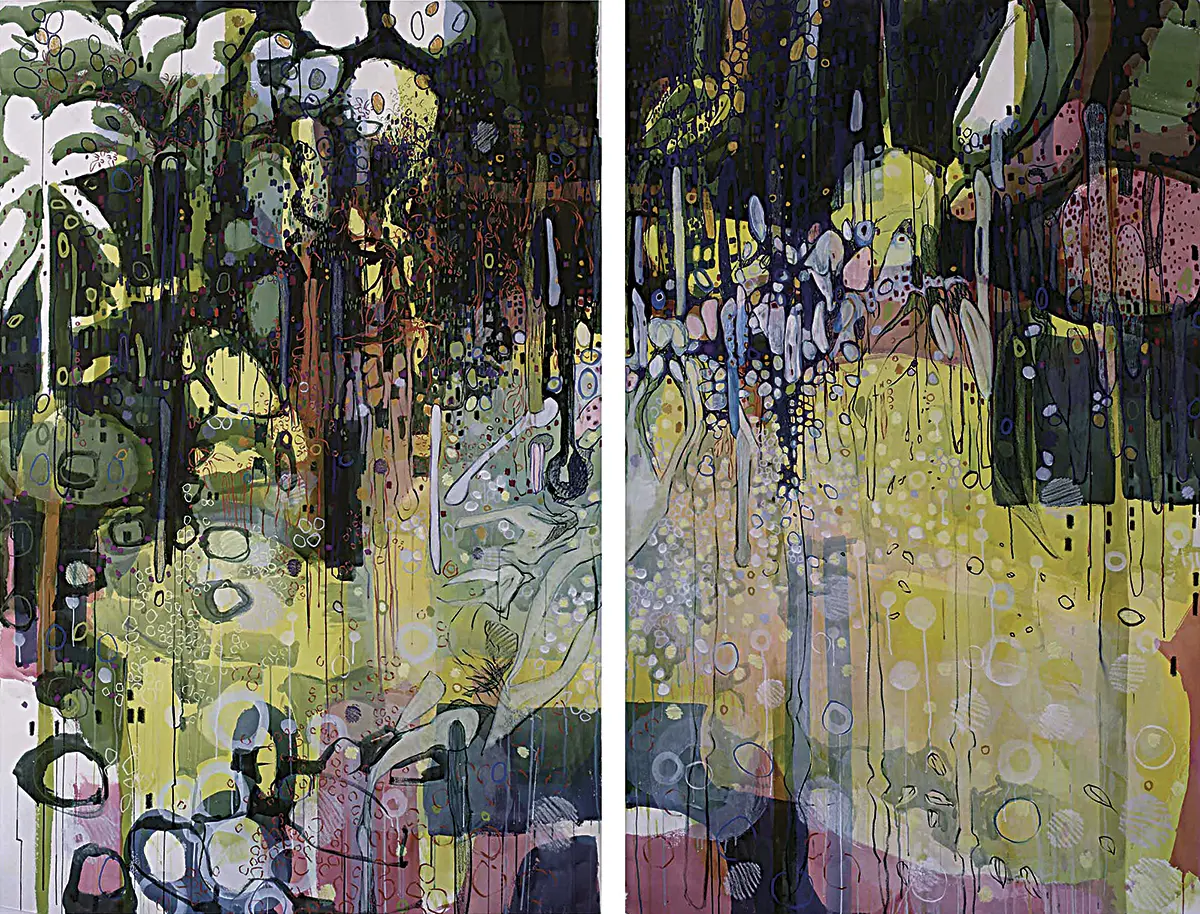
In this show, however, there was no theatrical, narrative, performance-based tableaux exploring biography, myth, and biology. The framed, mounted, and edited images were gone. Instead, Tschäpe displayed quieter concerns that concentrated more intimately on the color palette as explored with canvas, crayon, and paper.
In these new paintings and drawings, Tschäpe moved toward abstraction and into a more lyrical mode. The hybrid beings and fragmented narratives that permeated her videos and photographs became even more disjunctive and sparse; their presence was only vaguely suggested through some scattered images that still alluded to biological forms. If drawings were used earlier as sketches and springboards for Tschäpe’s ideas for the staged photographs and films, now they came to the forefront and were no longer merely preparatory layouts. They became the work itself.
Previous art historical references, such as Tschäpe’s earlier affinities for the complex and artificially built universe of Matthew Barney, the self-staging photographs of Cindy Sherman, and the disruptive and erotic dolls of Hans Bellmer, here gave way to new connections. Charles Burchfield’s luminous watercolor landscapes, the decorative lines in Gustav Klimt’s Art Nouveau canvases, and the biomorphic mindscapes by the Chilean Surrealist Roberto Matta was among the presences that hovered behind the new work. The literal depiction of the landscape was replaced by a more polymorphic longing for nature as evoked in the works of nineteenth-century German Romantic painters such as Caspar David Friedrich. In Tschäpe’s recent work, the Romantic ideal and the possibility of a recovered sublime were central issues.
Landscapes in Brazil often figured prominently in Tschäpe’s videos and photographs. But that concern has been infused with her experience at the Hamburger Kunstakademie, where she studied in the 1990s, before moving to her current residence in New York. Born in Germany in 1973 to a German father and a Brazilian mother, and having grown up in Brazil as a child, Tschäpe has combined these two cultural influences in her recent work.
In the diptych Monsoon (2007, watercolor on paper) —named after the summer rains of sub-continental Asia—Tschäpe created a colorful surface of blots and splashes in watercolor. Here, gestural brushstrokes drip and pours coexisted with the more defined contours of abstract shapes made with crayon and watercolor-pencil on paper.
Allusions to the aquatic realm were still present in many of the works on view, as attested by the bubbly, sometimes transparent, and varied shades of blue that impregnated canvases such as Early Afternoon (2007, oil on canvas). The artist’s first name, Janaina, refers to Yemanjá, the Afro-Brazilian sea goddess, and in works such as Ghost (2007, watercolor on paper), this double reference was made manifest, as an outline of the artist’s body could be identified inside the imaginary seascape.
In the end, this exhibition was more about the senses than the mind. Tschäpe seemed less concerned with her conceptual framework than in earlier work, concentrating instead on the sensuous experience of the viewer when confronted by the artist’s imagined realms. Sacrificing plot for presence, she clearly embraced the idea of working with a fragmented narrative, so the viewer was free to complete the vision.
CLAUDIA CALIRMAN