
There are two ways to appraise the three-dimensional work by J. J. Moros (born 1960, Caracas): one emphasizes the artist’s technical dexterity, and the other notes the conceptual potency emanating from his work’s significant austerity. The second approach corresponds to the Venezuelan artist’s recent work, exhibited between May 4th and May 24th at La Cuadra Gallery in Caracas. The twelve pieces that composed the show, titled Sculptures and Reliefs, expressed a keen devotion to geometry and were inscribed in the stern authority of the elemental forms.
The material pulchritude of these works did not hide the memorable genealogy that precedes them, harking back to Kasimir Malevich’s Suprematist compositions and reaching to the minimalist proposals of Donald Judd and Sol LeWitt. A series of principles were derived from these sources, and economy of resources, and a structural simplification that was revisited and enriched by Moros in a singular way. In this case, geometric axioms were handled with a certain flexibility, which resulted in the incorporation of discontinuous elements, juxtaposed planes, and specific interventions of the surface.
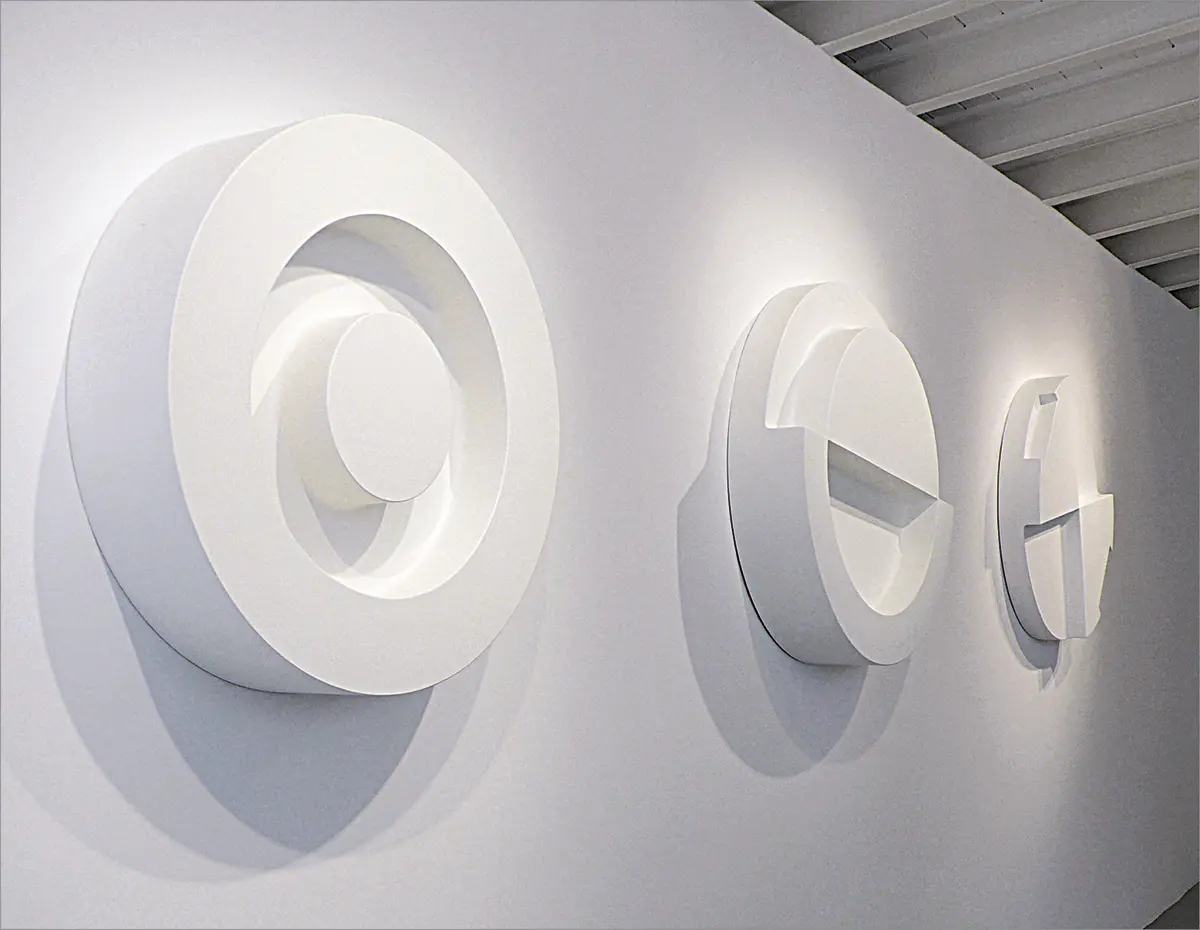
The selected works were distributed strategically on the gallery walls, corners, and floor, working in some instances as the meeting of perpendicular planes, for example, the bisectors located at eye level in one of the gallery’s nooks. A similar effect was created by the installation Trazador (2007), comprising a semi-circle attached to the wall and a diagonal bar that traversed the air and touched the ground with its lower end. This forced the exhibition environment—including the usually overlooked nooks and the gallery’s exterior areas—to behave as another component of the work, allowing for a dialog between the two- and the three-dimensional. In that sense, the artist achieved a contemporary reading of Modernism’s white cube.
Moros’s proposal ranged from the orthogonal plane to volumetric shapes, reaching spatial plenitude in some cases. This displacement had important consequences for assessing and valuing the latent meaning of the works. Circles, squares, and diagonals acquired a forceful corporality once their corners were projected as structures in space, transformed into disks, rings, frames, and bars whose three-dimensionality was subtly reinforced by cuts, depressions, and slants that interrupted their outlines.
Cercle et carré, a diptych evoking the legendary group of geometric artists founded by Michel Seuphor and Joaquín Torres García in 1929, synthesized the exhibition’s dominant perspective. However, there was a symbolic premonition—a sort of pre-alphabetic glimpse—that transformed the circle’s area into the support for an “inscribed” signal and the square’s sides into an “appointed” border. The same could be said of Triángulo blanco (2006) and Campo tensorial (1995), works in which surface and vacuum functioned as units of meaning circumscribed to the figures that shaped them.
Finally, the exhibition reiterated the concept of the binary, expressed in the juxtaposition of positive and negative surfaces, as well as in the use of black and white. However, there were minuscule variations between those extremes—grooves, discontinuous borders, points, etc.—that were clearly discernible from the trajectory described by light on the painted iron. Moros’s work harked back to the primordial language of the visible, one based on the contact of illumination with solid forms.
FÉLIX SUAZO