
Now as Then, a one-person show of works by Leyden Rodriguez-Casanova, opened on May 12th at the David Castillo Gallery in the Wynwood art district of Miami. Rodriguez-Casanova is one of the most active young artists working today. Since 1996, he has taken part in many group shows, mostly in Florida and New York. He was one of the founders of The Box, Miami’s artist-managed alternative exhibition space, which was open from 1997 through 2004. His work has also been shown in various museums as part of group exhibitions; among the most recent was Miami in Transition at the Miami Art Museum. Currently, his work can also be seen at the Frost Museum among the five finalists for the prestigious Cintas fellowship.
For Now as Then, Rodriguez-Casanova drew upon seven domestic objects, the trappings of suburban life. Among them were common living-room lamps, curtains, multiple picture frames (to display family photographs), and the fences that inevitably demarcate gardens. All of these items are essential to the décor of the suburban house, establishing a uniformity that spreads like a fog. The show’s title referred to the stasis of a domestic culture of inertia, where time seems to stop.
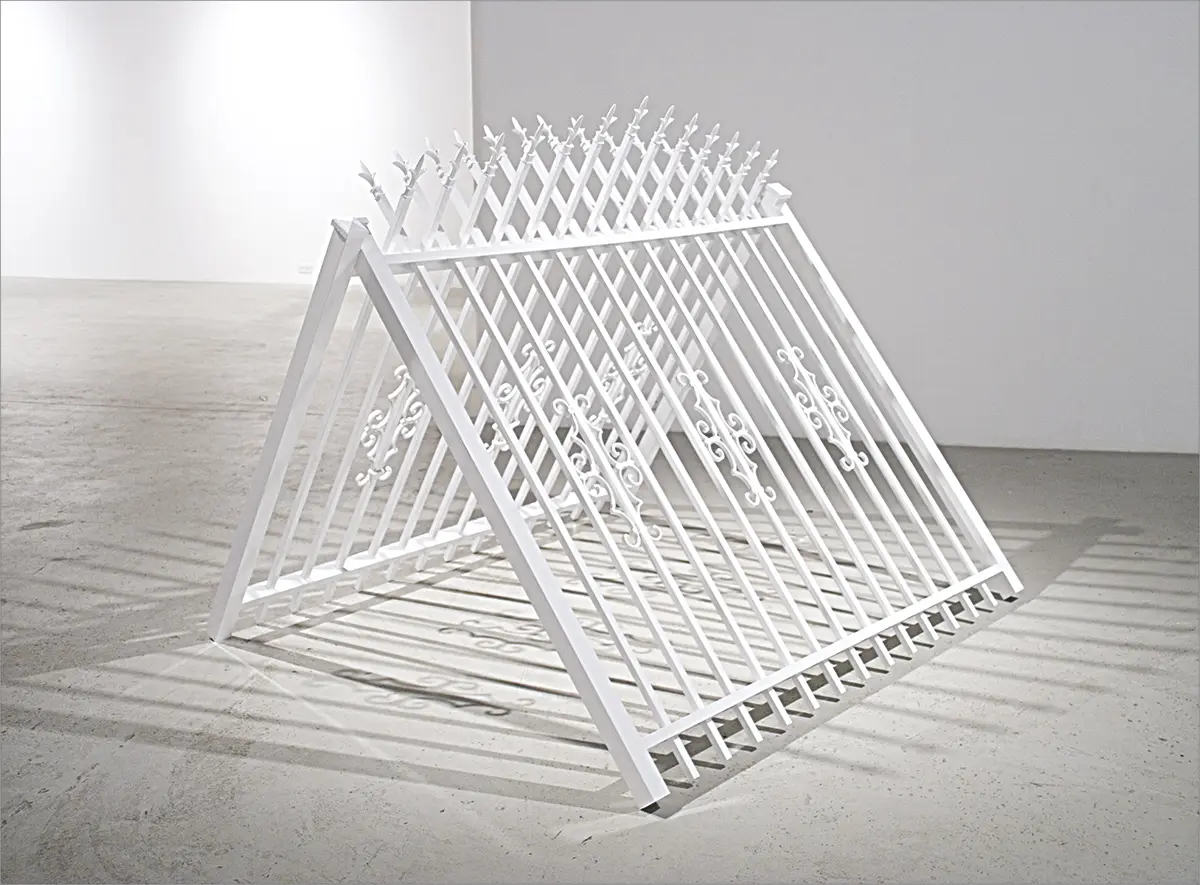
Through these works, Rodriguez-Casanova explored the apparent triviality of suburban life and the kitsch that dominates it. Although this is not a new topic in the visual arts, attention to suburban culture has usually emphasized the frequently baroque quality of its décor or an exaggerated religious presence and its attendant paraphernalia. Rodriguez-Casanova offered a new perspective on every day, minimalist-looking artifacts outside the domestic context. Although both tendencies focus their attention on the kitsch aspect of suburban culture, they differ in their aesthetic point of view. Also, Rodriguez-Casanova avoided recreating any specific environment, preferring to isolate the objects and to concentrate his attention on their particular qualities.
Eighty-four Reflections referred to the picture frames that are always present in a traditional suburban home, displaying photos of the family. One often encounters these images as part of the décor; fragments of family memories are presented in a prominent place. In his work, Rodriguez-Casanova placed mirrors instead of the anticipated photographs in the frames’ spaces, so that one saw one’s own reflection fragmented into eighty-four sections. Approaching and viewing the work was a kind of meditation, prompting one to wonder how large a part suburban culture plays in one’s own experience.
The First Cabinet Structure was the exhibition’s centerpiece, dominating a large part of the gallery. Rodriguez-Casanova built a triangle-shaped structure based on the cabinets normally used in kitchens, pantries, or garages. Usually, the function of such cabinets, wherever they are located, is for storage, but they also “protect” objects from exposure. Rodriguez-Casanova’s structure was a metaphor for the accumulation of experiences and memories throughout his life.
De-contextualizing the objects from their everyday functions, Rodriguez-Casanova played with them and presented them in a new light. Their primary functions ceased to exist and were replaced by different ones as the objects became works of art in the context of the gallery. These items were completely impersonal, devoid of allusion or reference to specific neighborhoods or regions. Rodriguez-Casanova’s works called one’s attention to certain aesthetic elements that unify suburban culture. He denoted a visual uniformity that extends to many homes, a lack of individuality almost equivalent to mass production. It was an idea of suburban culture as extensive and general, without originality or personality.
IRINA LEYVA