
In Marcelo Pombo’s recent suite of paintings, on view at the Christopher Grimes Gallery, the artist juxtaposes decorative, anthropomorphic, and abstract forms to produce dazzling and surreal images that confront the history of art. The nine paintings (all 2007) by the Argentine artist reveal his mastery of enamel paint, his chosen medium. The works feature such fine detail that although the subject matter can be quite droll, the works are so visually mesmerizing that one cannot help but be lured to further contemplate what is seen.
Five paintings (all forty by sixty inches) are prominently displayed in the larger of the gallery’s two rooms. Each of the works contains organic subject matter, a surreal landscape, and rectangular forms resembling a canvas, a frame, or, in one instance, a grid. Dots within dots of pooled paint meticulously applied using the tip of a brush, chopstick, toothpick, or syringe compose much of the works.
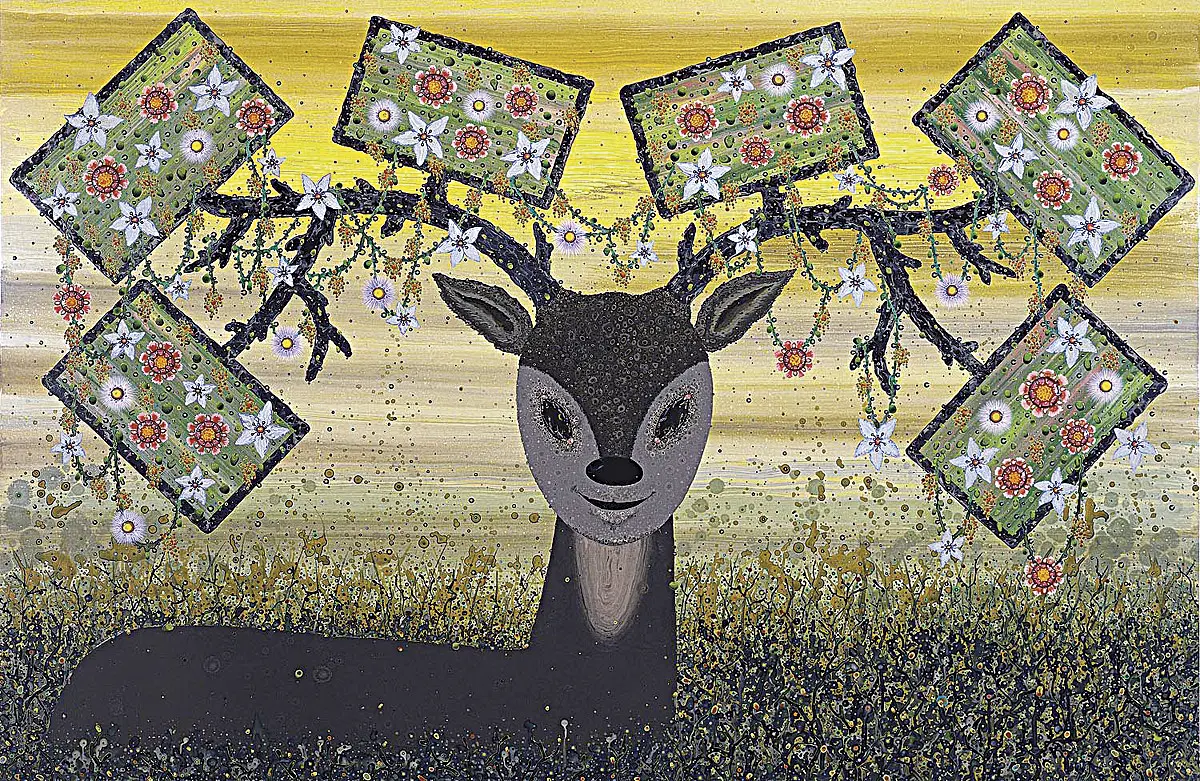
El ciervo de la pintura features cartoon-like smiling deer with large eyes, emerging from grass to stare at the viewer. Within their antlers are six rectangular forms covered in flowers, connected to one another by draping floral vines. Here nature meets artifice, with an anthropomorphic deer made of inorganic paint, where one’s attention is drawn to the paint as paint and the nature of the work of art as an object.
Noche escocesa con piedras preciosas y cuentas de vidrio—a dark blue panel, mapped with varying grids of “stars” and glass beads as ornate as Fabergé eggs or Venetian glass—perhaps depicts a tartan, since Scotland is named in the title. Moreover, the work cites the grid—common in the works of Piet Mondrian, a prominent influence on Pombo—composed of highly decorative objects rather than pared down to its most minimal abstract form.
In Ave fenix en un gruta en el fondo del mar, the body of a large, exquisitely rendered phoenix stands on stylized sand, framed by foliage and a blue border. A rectangular form painted in warm tones takes the place of the bird’s neck and head. Typical of Pombo’s oeuvre, this piece jolts the viewer with the unfamiliar: with such intricate detail in the plumage, one expects to see the head of the beautiful animal, yet one is instead confronted with an abstract painting. Is the viewer meant to complete the work or was the head replaced by the rectangular shape to draw attention to the panel itself?
Six similar rectangular forms are placed in nests, replacing the egg and/or bird in Arbol con nidos y cuadros. The tree itself has a trunk, yet instead of blossoming into leaves and flowers, it blooms into an empty black frame, from which sprouts the branches holding the nests. The tree is positioned horizontally in a surreal landscape, before the night sky and over what may be a body of water. Again, a seemingly natural scene is full of peculiar rectangular forms, which in this instance are titled pictures.
La lechuza esta volando depicts an owl with wings outstretched, soaring over treetops and gripping a frame in its talons. The bright yellow eyes composed of hundreds of tiny lines stare out from the image and are a warm contrast to an otherwise cool palette. The owl grips, not a menacing black frame as in the previous work; rather, it is made of whimsical green and blue twining vine-like forms. In addition to references to the frame, the work features another central art historical idea in the gaze. The piercing stare of the owl is complemented by dots that resemble eyes floating in bubbles.
Known for alluding to the work of other artists and having a deep interest in art history, Pombo offers his take on such long-debated art historical problems as the confinements of the canvas (or panel, in this instance), grid, and frame. He questions the relationship between art and nature. Rather than create mimetic representations, he turns the natural into the artificial using highly decorative forms composed of industrial paint and transforms the ordinary into the extraordinary.
In the backroom, four smaller panels (twenty-eight by forty inches) alternate between two motifs: the bust of an extraterrestrial-looking figure with an ornate headdress (Joven verde con adorno en la cabeza and Joven rojo con adornoa en la cabeza), and a floating heap of debris full of the rectangular and floral elements found in other Pombo works (Isla de escombros flotante N% 1 and N% 2). Although not entirely new (these paintings are very similar to paintings from 2006, as are a couple of the previously discussed works), they are full of Pombo’s characteristic drips, dots, and garlands of flowers and beads, turning the unusual or even discarded into something magical.
BETH ROSENBLUM