
Marcos Chaves (born 1961, Rio de Janeiro) presented an outstanding series of large-scale photographic works and a video piece at Nara Roesler Gallery between April 10 and May 12, 2007. It is important to note that the group of works was distributed throughout the gallery’s ample spaces and that it had never seen before. Chaves’s latest work portrayed a dreamlike, playful, and humorous universe, in which photography and video art was recovered from the transience of the present as nostalgia for an inaccessible absolute.
Perception is an entirely mental matter, as Leonardo Da Vinci noted in his celebrated Treatise on Painting. Thus, it affects the totality of what is known but it also anticipates and desires the unknown, without limiting itself to merely intellectual or cognitive data, or folding dogmatically under the rules of logic. In that sense, Chaves’s recent works comprised Pandora’s box, with a vast array of meanings related to the culture of the appropriated object, the bibelot and the iconographic paraphernalia has taken from serially-produced statuettes made in porcelain, enameled china, painted plaster, or minuscule silver-colored Venetian tiles, as noticed in the monumentality of a small Buddha was taken to an outsized scale thanks to the manipulation of photography. The artisanal objects photographed came from the artist’s personal collection; they were produced for mass consumption as souvenirs and purchased in flea markets.
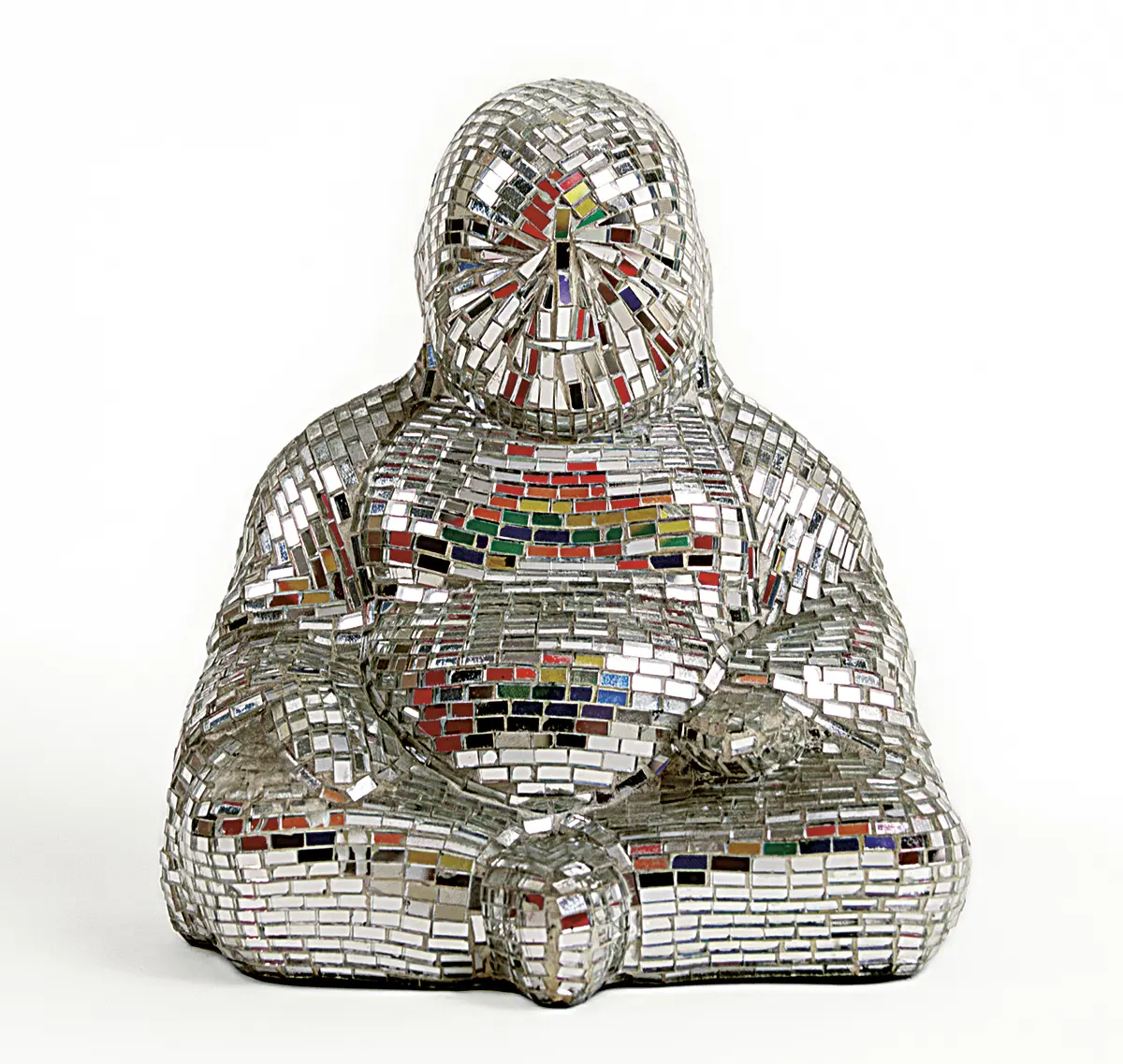
Time and again, the revisiting of certain classic mythologies have driven Chaves to the use of figuration through mechanical means. However, he doesn’t stop there: he also decided that the image allows one to approach different psychological models or archetypes from the past, which coexists with a variety of anthropological and social objects immersed in the hyper-reality of the image that characterizes our late-modern or post-historical times. What is invisible but exists becomes visible and recognizable to the artistic will. After a conflicted debate between doubt and the selection of the original images, Chaves followed a propitious path in his attempt to capture the very moment of decision and subsequent closing of his Pandora’s box. This “photographist” says: “Humor, Duchampian intervention, and popular culture is for me instruments that are able to reach a subjective place. Working with the popular is also a form of politics. I am interested in politics, in psychology, and in how the world can be apprehended by people, and in how people dilute that world because the role of today’s artist is to dilute, to distill, and to propose.”
In Chaves’s new repertoire of large-scale photographs, the works were not synonymous with one another but were connected by associations. The attentive and inquisitive observer could discover the way that the artist froze the transience of his images and how he articulated them into a narrative. For Chaves, representing the world is, above all, to rearrange its fragments through an array of photographic metaphors. His latest works could be interpreted as evocative juxtapositions. The issue was to know how he achieved such efficacy in these allegorical representations created from the most innovative montage techniques.
In the work on display, the perceptual characterization of photography was inscribed between the boundaries of the self and of the other. Indeed, perception is an intertwining of the sentient body and the sensed world, giving shape to or modeling a subject or several subjects, in which what is perceived as a central place. Each one of the 150-by-125-centimeters works testified a singular aesthetic plan manipulated by the artist, in which visible data was redoubled by an invisible depth. This was evident in works of great iconic and objective force, such as Buddisco, Ducky, Ainda nao, and Baroco e Moderno (which measured thirty-by-forty-centimeters).
In some way, the appearance of the photographs possessed an intrinsic discourse that connected them in metonymic fashion. In other words, this strategy that produced chains of meaning, so particular to Chaves, made one feel a certain intensity that implied a morphological dimension in the works, a pregnant culture of the appropriated object. In his works, space and time were joined and infused with subjectivity. And the sensory being, the subject in action, was the guarantor of such perception. The sensory and cognitive specificity behind the artist’s painstaking fieldwork for each of his photographic series and each of his videos emerged from the interplay between the visual and the tactile.
CLAUDIA LAUDANNO