
Miguel Calderón is an artist characterized by the way he manipulates the boundaries between the true and the false, resulting in works that explore the arc between an easy smile to an elaborate joke and that include more or less ironic commentary. This quality was already visible in works like A propósito—in collaboration with Yoshua Okón—which consisted of a mountain of car stereos and a video showing the artists as they stole one. This work, including among those that inaugurated the urban aesthetic that is at the root of contemporary Mexican art as we know it today pointed toward Calderón’s ability to locate himself at the limit of the permissible, of that which may or may not be real, and which reflects the impunity that is often enjoyed by the higher classes in a country like Mexico. Other works, like the carpet of the artist’s résumé that could be stepped on except for a uniformed maid’s incessant vacuuming, or the series Postcards from my balls—a series of images in which Calderón supposedly uses his own testicles as the stage for various scenes—are examples of an attitude that place him in the realm of the artist-as-jester, much closer to Maurizio Cattelan than to Duchamp.
From this point of view, Calderón’s work is directed above all to our sense of humor—even when it touches on the macabre—and our capacity to establish connections. In truth, the works presented in Madrid were not part of a clearly interconnected series but rather formed a disperse group of gags or skits: a Roman helmet transformed into a broom; a column of shot glasses decorated with the Alcoholic Anonymous logotype; and a triptych of photographs of an ice truck (a common sight in Mexico City) branded Igloo, spouting large streams of something that resembled blood. These were the less elaborate works and, like the rest of the exhibition, were presented as the result of the various trips Calderón made to Madrid while preparing the exhibition. The show evolved during these trips, and the final result must be read as part of this process of contact with the surroundings. This kind of contextualization also occurred, interestingly, in a very immediate manner—perhaps the glasses alluded to Madrid’s bar culture. Other works were more ambiguous, even if they were located in the context of the city; such was the case of the photographs of two adolescents in Retiro Park, who grabbed Calderón’s attention with their gray hair. The artist sought the kids out (they are brothers) and took photographs that conveyed the discrepancy between the maturity implied by the gray hairs and the child-like faces of the subjects.
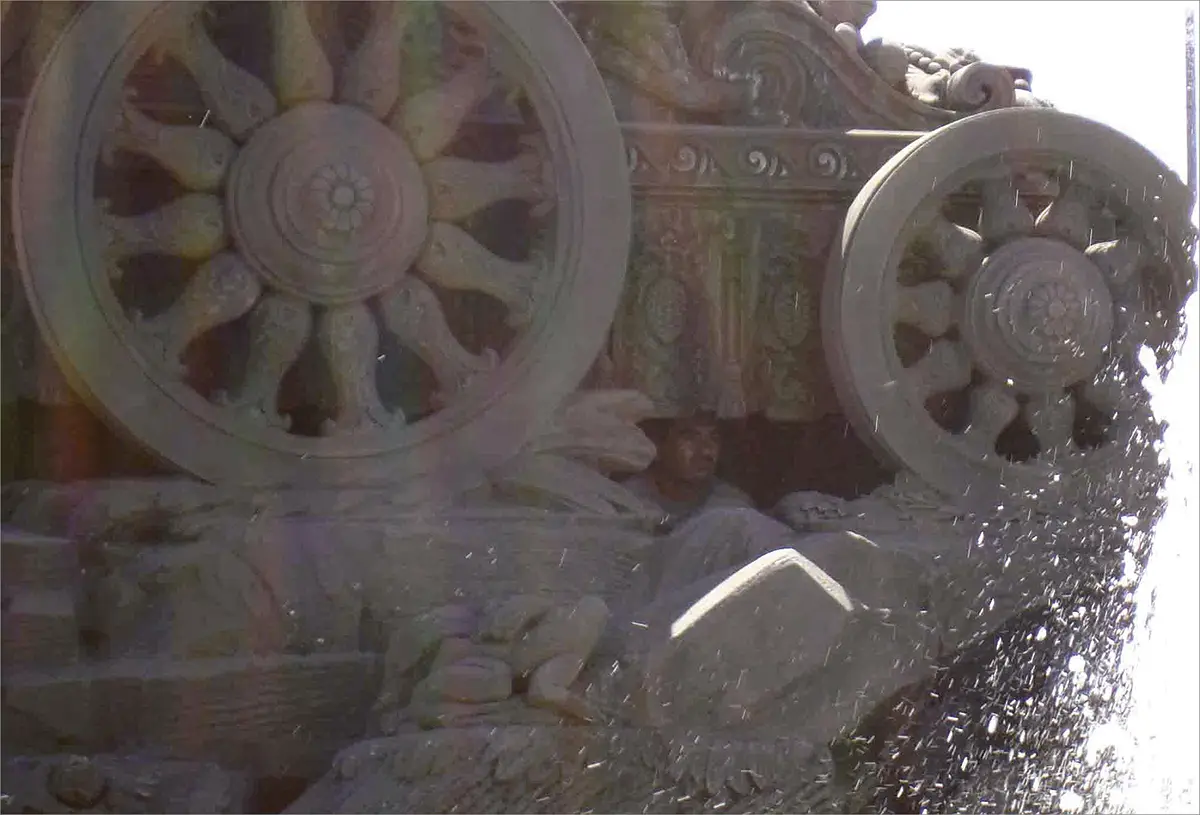
Cibeles, a video about the reproduction of the famous Madrid fountain in Mexico City, was a conceptual bridge between the two shores. Calderón discovered that the supervisor of the Mexican version had installed living quarters in the lower part. In the video, the camera approached the fountain so that the sound of water was amplified, becoming the sound of the surf, while the viewer discovered a figure that perhaps hid under the bronze replica. Unavoidably, one interpreted it as the image of Spain (the “motherland”) as a refuge, as something that protects and oppresses at the same time.
But the final reflection on Calderón has more to do with the title work in the show. This piece presented an array of museum cards with the features of a variety of works of art, all of them by unknown artists. Calderón says that the idea came from a visit to the Thyssen-Bornemisza Museum, where his companion thought that “Anonymous” was the first name of an artist and “German” his last name. Calderón saw that people congregated in front of the “signature” works while the anonymous ones were clearly dismissed, irrespective of their quality or relative interest. It is not a secret that the strategy supporting the artist-as-jester is, above all, that of never falling into anonymity.
ISSA Mª BENÍTEZ DUEÑAS