
Pedro Reyes recent exhibition titled ad usum: To Be Used, was a deft convergence of design, architecture, and art. Rare is the meshing of these disciplines, though there have been some artists who have worked in these registers with finesse and aplomb. Some of these include Liubov Popova and El Lissitzky as well as more recent artists like Helio Oiticica, Vito Acconci, Dan Graham and Jorge Pardo. While the aforementioned artists including Reyes tease out the social dimension of the form where ethics and the aesthetic are undifferentiated, his one-person show extends this into what can be categorized as a social experiment in living not unlike the work of Buckminster Fuller. Reyes is akin to Fuller’s particular approach to the built environment in which architecture and design should ideally engender a sense of well-being; both share what can be discerned as a therapeutic aesthetics that promotes emotional and mental equilibrium in the individual which, in turn, would contribute to the overall good of the social body and body politic.
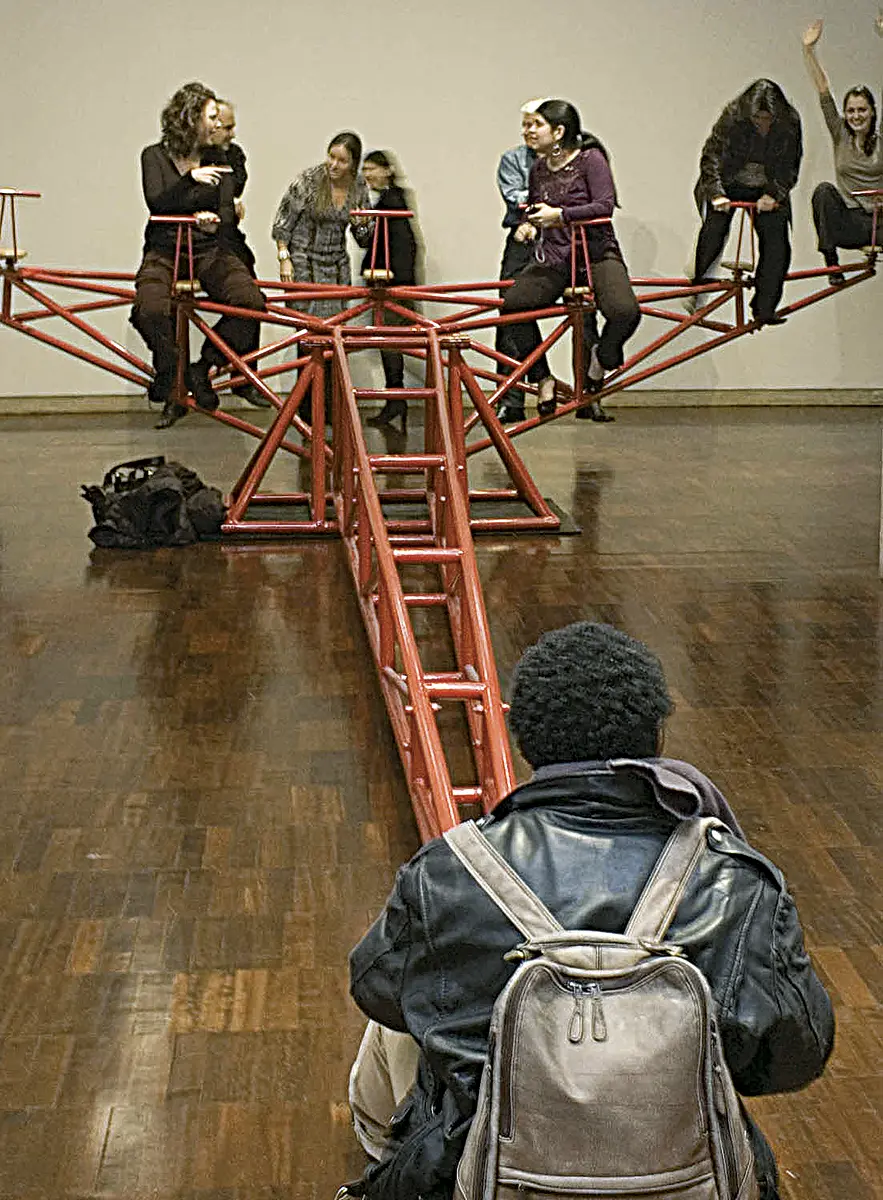
Consisting of a broad range of media including drawings, sculpture, and what appeared to be models or three-dimensional studies, the works were paradoxically infused with an ostensibly utopian ethos, a sublime criticality, a play on the form that was visually poetic, and occasionally an irony that made the exhibition both serious and lighthearted. In Image Advice for Revolutionaries (2005), for example, Reyes takes on the role of publicist and fashionista as well as designer, architect, and sculptor in his tripartite proposal. Directed towards the world renown and celebrity-like Mexican revolutionaries, his advice was both direct and simple: in order to distinguish yourselves from other revolutionary groups you must alter the drabness of your black ski masks by infusing them with a broader palette. While one could easily dismiss this as an iconoclastic gesture, or parody of Revolution chic as well as the trust-funded, jet-setting, politically correct, it also satirized the seemingly blind adulation of Leftist icons. Yet at the same time, it was apparent that a proposal such as this must be taken with the utmost seriousness. Other proposals push the limits of this tongue-in-cheek strategy in equally illuminating ways as was the case with Liability Fungus (2005). Here Reyes proposes a series of chairs, tables and sheltering umbrellas whose collective title is culled from city ordinances that regulate the minimum and maximum height of architectural structures; but his hypothetical constructions are configured in the shape of mushrooms. As such, Reyes attempts to collapse the organic into the synthetic, functionality into ornamentation, as well nature into culture.
The theoretical underpinnings of this project have an interesting and idiosyncratic pedigree by way of Frank Lloyd Wright and Gilles Deleuze. For Wright emphasized the built environment’s merger with the natural landscape to the degree that it not only interacts with it but on the occasion was physically integrated into it. In Robie House (1910), for instance, its extreme horizontality was structured so that the building not only interacted with its (sub) urban landscape, but it was a concretization of Wright’s theorization of radical planarity that foregrounds what he called “open form.” Or, think of Fallingwater (1935), where Wright dialectically engaged the geography of boulders, trees, and a stream of water with the “synthetic” domestic edifice. The chameleon-like quality of Liability Fungus, which vacillates between architecture and design, and decoration and pragmatism is a thread that weaves throughout the exhibition; but even more malleable still is his Studies for Vertebrae (2001), in which a chair is designed in various shapes that allow sitting in seven different positions. Inspired by vertebrae, the chair has other functional lives as well: it can also be a table, a shelf, and a fountain. Flexibility, the power of yielding and adaptation are innate qualities of this work that one could construe as the design equivalent of the Deluezian rhizome. Reyes work, as this exhibition makes quite clear, is edging itself like some amoeba in concomitant directions to the forefront of where architecture, design, and art meet. In the process he undermines modernism’s rhetoric of medium specificity via a playful, postmodern blur of form, content, and context; and the Enlightenment’s master narratives of social progress he attempts to make palpable by way of Foucault-like micro-politics in which the quotidian embodied in a structure, a chair, a table, and a cup can be functional, economical, and beautiful; yet emancipative and critical at the same time.
RAÚL ZAMUDIO