
Known for his low public profile and his reluctance to exhibit, Ricardo Garabito nonetheless agreed to a retrospective of his work at the Museo Nacional de Bellas Artes, curated by Samuel Paz with the collaboration of Victoria Noorthoorn. Paz—who regrettably passed away recently1—was one of the critics closest to Garabito. It was not by chance that the selection of works was impeccable both in collection and presentation, a veritable lesson in curatorial practice.
Garabito was born in 1930 in Trenque Lauquen, a western city of Buenos Aires Province. In the beginning, his paintings were very small. “Since I had no money, I painted on plywood,” he reminisced. At that time, the dominant style was an abstraction, not figuration. Garabito, however, was never influenced by fashionable movements but rather retained a kind of “stubbornness” (according to Paz) that isolated him and contributed toward his characteristic singularity. Not hyper-real or surreal, and not magical realist, his work features a mixture of tendencies and styles, a traversing of boundaries. In part, it flirts with the naive without fully falling into it. Garabito’s personal approach is marked by rigor in execution and a freedom of spirit that make him one of the most original representatives of Argentine realism of the 1970s and therefore one of the most solid and unclassifiable figures in Latin American painting.
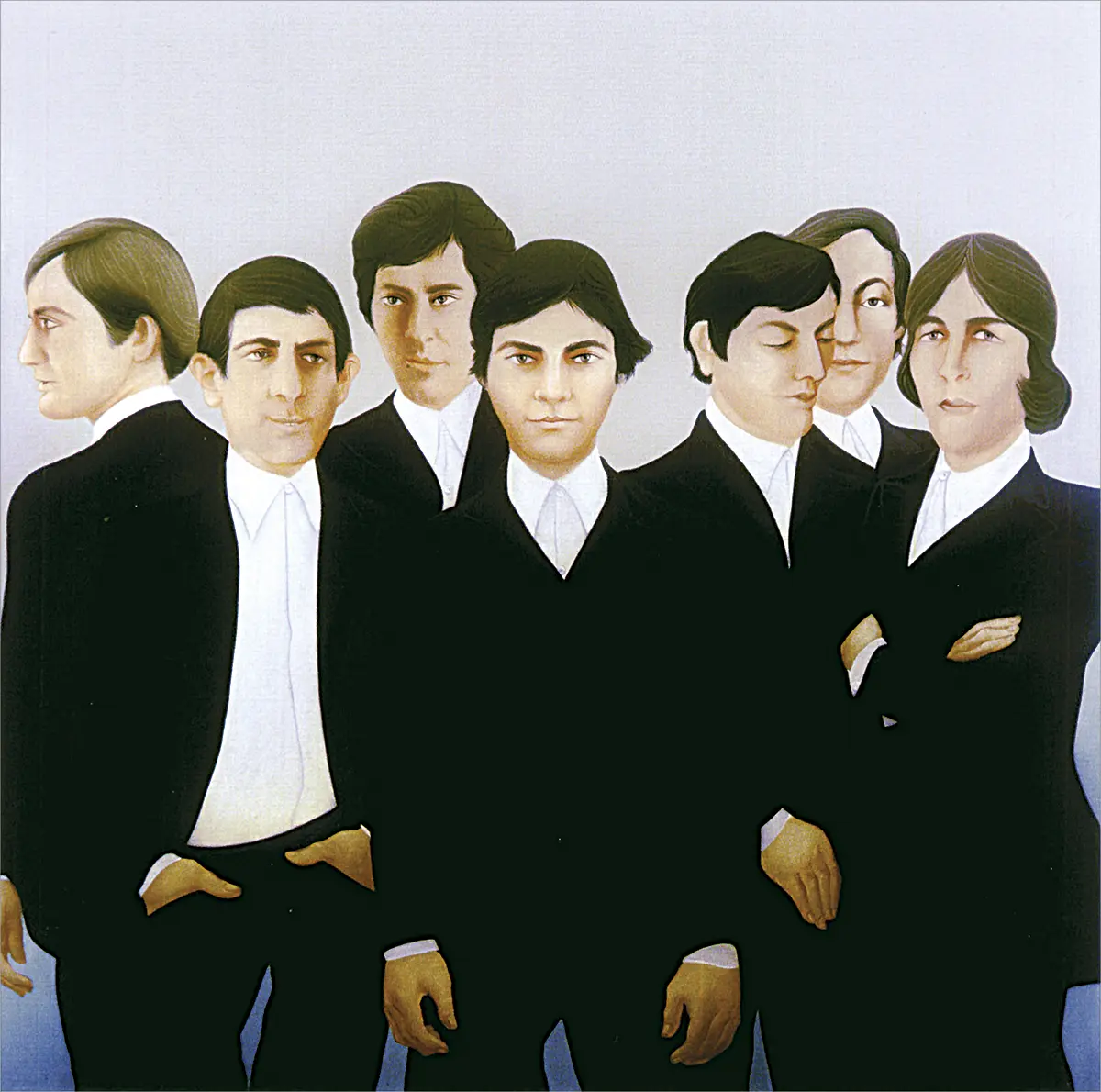
The show opened with works dated from 1963 and continued through Garabito’s most recent production, dated 2007. One surprise in the selection was the interaction between the still lifes and portraits. The objects in the former seemed to have living “souls”—they were portraits of a sort—while the figures in the latter were presented as self-sufficient and hermetic, with the impenetrable appearance of inanimate objects. Also, the still lifes and portraits demanded the same deciphering; each work was an event that spoke to viewers in a special way, stopping them and making them discover the value of the “slowness of mind” that Alberti considered essential to the aesthetic experience.
In the works from 1963 to 1967, one noted the importance of painters like Butler, Presas, or Victorica, as well as that of Schiavoni. It was precisely under the influence of this Rosario artist that Garabito distilled his spaces and simplified his compositions in the mid-1960s.
Garabito’s work of the late 1960s and early 1970s garnered the greatest attention from critics. It was valued for the richly imaginative representation of objects and solitary characters from a close distance, against empty spaces and perspectives that were absent or barely sketched.
The serial element appeared in the mid-1970s: the repetition of the same object (a pumpkin, an apple, a bottle) posited the impossibility of identity. In these works, a unique tension reached maximum intensity in the sinister repetition of a character. This could be seen in the works Los mellizos (1975), Los Rojas (1981), and Pedro y Pedro (1981).
By 1984, opting for a more open technique that referred to his early period, Garabito deployed his drawn lines against white backgrounds. Later, in the 1990s, the object was given pride of place and recovered the aura it possessed in works from previous periods. Examples included Tres jarros, lechera y manzana (1994), Balde anaranjado (1995), and Fuentón verde (1996). On the other hand, characters had a greater quotient of humor and lack of inhibition, features that dominated the series of erotic/vegetal sculptures in cardboard and painted paper, one of the show’s most attractive sections.
The show’s last section, devoted to work made since 2000, offered a calmer quality. “It may be the repose of an advanced age,” the artist says. Whatever the case, Garabito now does away with any exaggerated artifice, exercising a gaze that is more candid, in which modest and somewhat more “natural” presences are reflected.
Despite the observable differences between the various periods of Garabito’s work in the exhibition, something remained constant: the strangeness of the everyday. This was present both in the neighborhood characters—in general, his models come from the working class—and in the tools used daily or the food consumed; mysterious presences were revealed, as were enigmas that needed to be solved. Not the simplest thing was evident in this exoticism of the familiar. Each work promoted a suspension of the accepted nature of things; each work seemed to look at the viewer and demand one’s complicity. The task was gratifying because Garabito’s work presents itself as a celebration of painting and a confirmation of its truths. What one saw was something that began to exist from being painted, and this led to the conclusion that painting is a creator of reality, not merely virtual reality.
Of special note is the excellent 400-page book that accompanied the exhibition. Crafted with the highest skill, it fills a bibliographic vacuum and will become a mandatory landmark for acknowledging the importance of Garabito’s work. It includes a lucid essay by Marcelo Pacheco, careful documentation, and a comprehensive photographic tour through the periods in the artist’s career.
NOTA
1. View the obituary in the News section.
ELENA OLIVERAS