
Roberto Elía (born 1950, Buenos Aires) is the author of a splendid, self-reflective body of work that establishes boundaries but can also question them. Elía’s works traverse, dissect, and transform small objects in order to give them new meanings and in turn construct, paint, and write new poetry that opens a space for the invisible. In the recent series of objects and collages presented at Jorge Mara-La Ruche Gallery, he used clothespins (incorporated into his work in 1969) and frame wedges, small pieces of wood that adjusts and stabilize the canvas; both elements gained new life and achieved new significance.
The images demanded that viewers suspend their conscious judgments and ways of thinking in order to see beyond the predictable. The Jorge Mara-La Ruche space—which was established in 2001 as the continuation of two galleries under the name of Jorge Mara in Buenos Aires and Madrid in the 1980s—was suitable for an intimate contemplation of these fifteen small-format works, in which poetry and a serene invitation to introspection emerged.
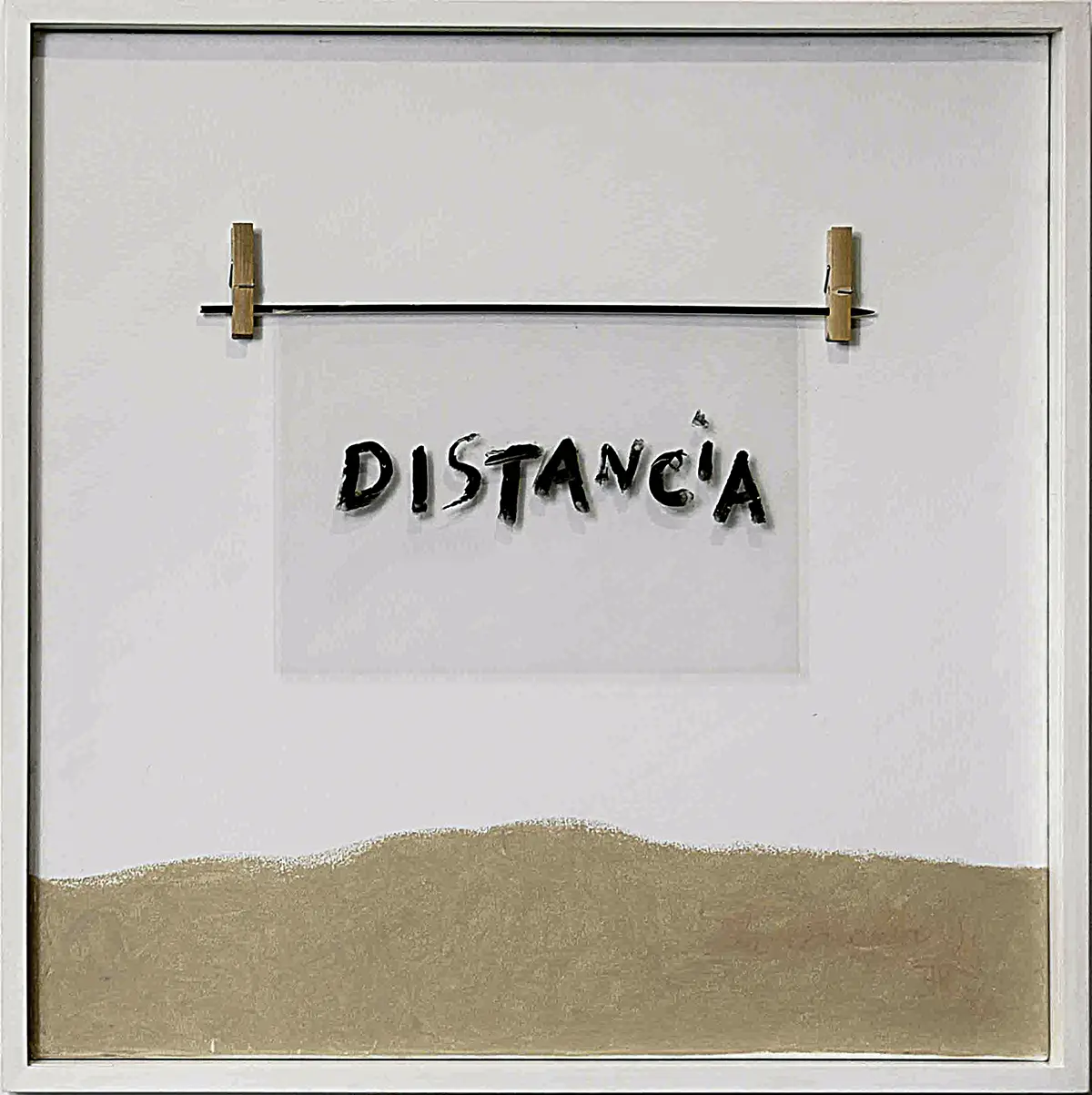
“When someone says ‘Buenos Aire's poet,’ he or she is imagining a series of obvious features that result in ‘a Buenos Aires poet.’ I have nothing to do with stereotypes. What I do is Buenos Aires art, this place is located at the end of the continent and has been the crossroads of many different things, a place that I envision as crisscrossed by contradictory forces, negative and positive forces, by ancestral claims of all kinds,” said the artist, all the while acknowledging the connections between his work and literature.
With minimal, simple gestures, the artist chose to elaborate on the preexisting and created new objects and drawings based on the connection between certain ideas with certain concrete materials (in this case, clothespins, wedges, and small sticks), to which a line was often subtly sketched or transformed into writing, another one of Elía’s great interests. The artist’s predilection for working on paper was evident, as in the mixed-technique works that verged on abstraction with the presence of geometric shapes. As he said: “On the plane, I work in different ways. If I draw or paint on paper, the development is fluid. With paper you always work on a rigid surface; it is a frank thing. It even produces a different physical sensation than that of the canvas. Because I paint on stretchers, the canvas is unstable, it shakes; it is like walking on a floor full of soap.”
Elía continued: “More than working with chromatism, in my oeuvre color is taken from the symbolic, that is the side of things that seems relevant to me.” When he used color, the artist considered its relation to the light above all. While his curiosity about color didn’t appear to be central, a journey through various means of expression and between the spaces of representation and experience did. Between figuration and abstraction, canvases, papers, and objects reflected the artist’s subjectivity. These were delicate works that gained in mystery and generated innumerable lyrical propositions.
Elía, who had his fourth solo show in 1959, won the Guggenheim Fellowship in 1986, and presented two excellent retrospectives at the Museo Nacional de Bellas Artes (1995) and the Centro Cultural Recoleta (2003), was always the creator of his own narrative. When in the 1980s some artists established relationships with international movements and created large paintings with neo-expressionist and informalist undertones, Elía developed a conceptual proposal that followed a path apart from the fashionable trends. The artist said, “Knowledge, feelings, man and his circumstance, death, the struggle to transcend, become part of one’s life, and as I work I note that my activity possesses a fundamental reflective aspect, related to identification and memory.”
The show’s announcement card resembled an x-ray image of a skull, seen from the side. The white subject of the image was Elía’s iconic clothespin, which was featured in seven of the fifteen works on exhibit. It remained as a metaphor, as an analogy, and became the axis of a critical discourse about freedom, literature, and life and death. Roberto Elía’s work captured us, once again.
VICTORIA VERLICHAK