
The romantic association between art, poetry, and music was born in the nineteenth century as artists, writers, and composers explored the realm of emotions and searched for ways to express their innermost thoughts and feelings—spiritual, transcendental, and personal—by cultivating their private experiences. They often sought inspiration in the immense magnificence of nature, and in their poetry, music, and imagery, they found the capacity to translate the natural into the supernatural. It is not surprising that many visual artists were described as poetic, that they often played musical instruments and admired the composers of the day, and that they had a full understanding of the manifestations of words, notes, and imagery and their creative interaction.
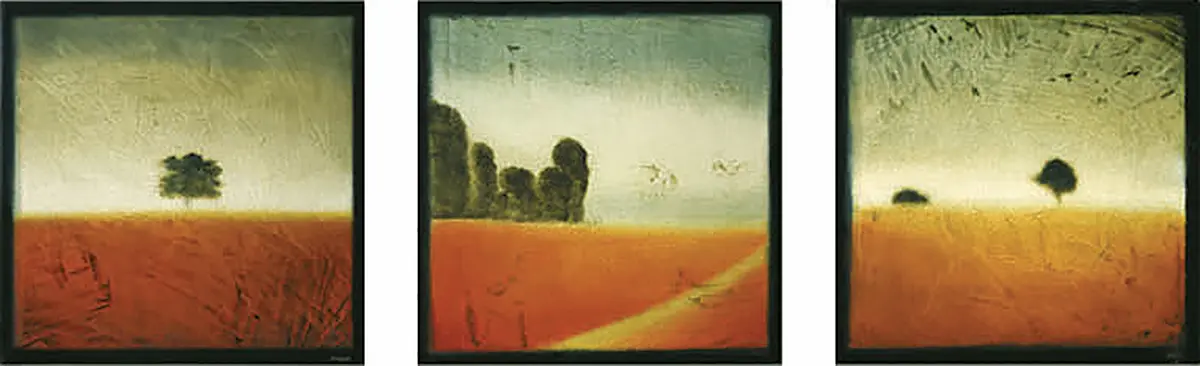
Sebastián Spreng is a modern-day romantic who is as passionate about music as he is about making paintings. He is highly respected as both an artist and a music critic, and he can write as eloquently as he can paint. Although music must inform his creativity as a painter, he seldom overtly combines the two. For this exhibition, he created an installation (which is unusual for him) of forty images on canvas, all carefully placed on the walls of the gallery to work in harmony.
The series was inspired by Robert Schumann’s Liederkreis, Op. 39. Schumann (1810–1856) created 140 art songs (lieder) between the years 1839 and 1840, near the time of his marriage, which include some of his finest works, many based on the words of the romantic poet Eichendorff (1788–1857). Eichendorff’s poems look toward a “lovely distant land” of memories, “beyond the red flashes, that’s where the clouds come from,” with a secret “behind the myrtle trees”; Schumann was inspired to write music to the same effect, especially for these songs. As a pianist-composer, Schumann fully employed the piano to express emotion in his song cycles, and he even replaced his dedication to the musical instrument with a new affection for vocals.
The song cycles, in particular Op. 39 with its melancholic references to a distant land, inspired Spreng to translate these lyrical, emotive works into paintings. Arranged on the wall according to formal qualities, the forty paintings were small abstractions that may be viewed as single “notes” in a musical composition that together form a complete symphony or, in this exhibition, a Liederkreis. On one wall, ten small works called Row of Songs were visually connected by a horizon line that carried the viewer along. These works praised the beauty of nature and the romance of love. The colors of land and sky varied from the verdant tones of spring to yellows, burnt orange, and red, and trees appeared on the horizon like the abstract notations of a musical score. The colors were in the poems, and the paintings became their visual counterparts, traversing the same road of nostalgia and emotion. Other paintings in the series ranged from pure abstraction to long vistas and continuous roads, land, and sea. They were reminiscent of ancient ruins, astronomical occurrences, and mysteries from the past. The songs encompass a full range of emotions and responses, from complex to elemental, and the paintings transcended the musical sounds to enter another realm of sensual response.
Sebastián Spreng’s paintings demonstrate the essence of simplicity in visual abstractions of form and color; however, upon close examination, it is quite evident that technically they are anything but simple. His finely prepared smooth gesso surfaces demand much polishing before the paint is applied in layers that are scratched and smoothed, resulting in velvety textures as elusive as the moods they reveal. This pre-Renaissance technique was once reserved for altarpieces when the pigment was finely ground into tempera and applied to a wood panel. Spreng uses oil on gesso on canvas, and his unique approach to traditional technique lends an ephemeral quality to the imagery that is a modern version of romanticism, with a new means to achieve the sublime.
CAROL DAMIAN