
Viewers unfamiliar with the work of the Brazilian artist Tunga have an opportunity to experience his creativity this summer at P.S.1. Two of the museum’s largest gallery spaces have been filled with recent installations by the artist. Although two artworks may not be considered a proper retrospective, the pieces on view —Laminated Souls and A La Lumiere des Deux Mondes (At the Light of Both Worlds)— have been previously exhibited and collectively demonstrate a sense of the range of Tunga’s aesthetics and themes.
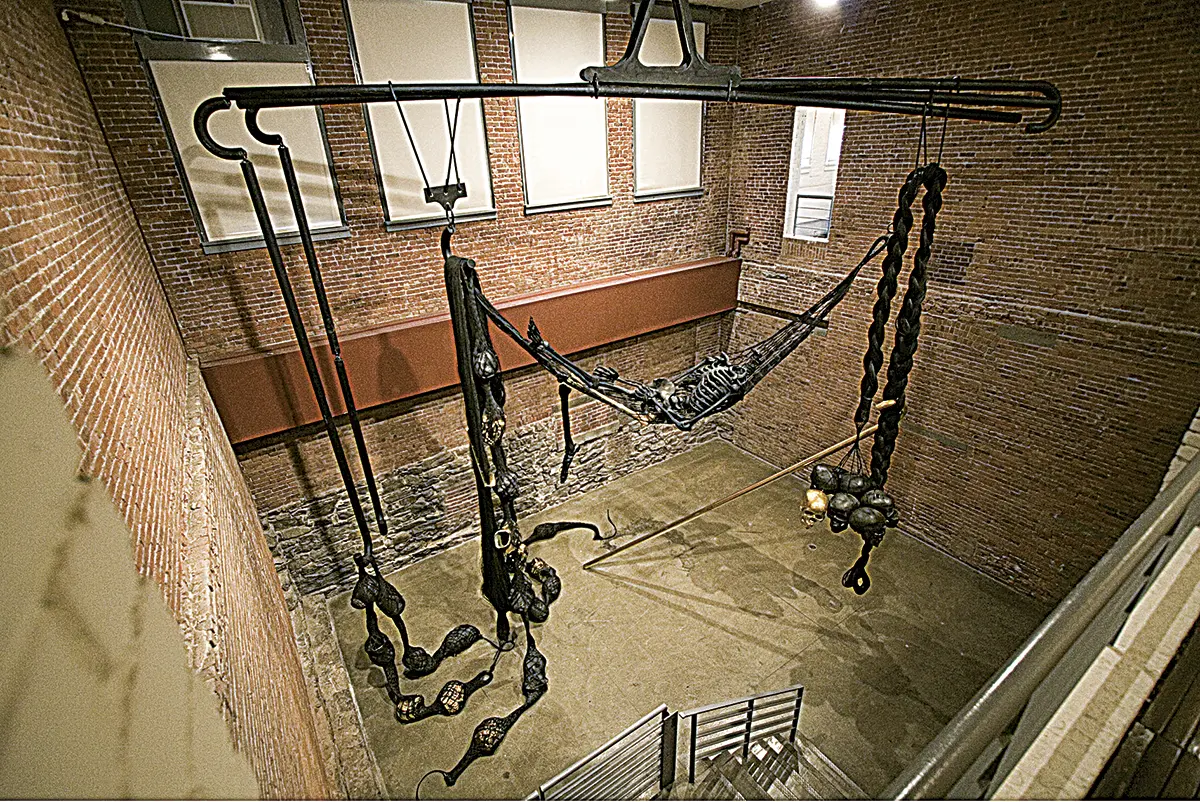
Occupying the cavernous space of the museum’s duplex gallery, A La Lumiere presents an enormous armature of bronze, mesh, cords, and wires that seem to at once be a skeletal construction reminiscent of Dali’s Premonition of the Spanish Civil War and also some sort of pupating bulbous organism. Within the dark metal frames/bones are pod-like forms that house human skeletons, organic biomass shapes, and, along the lower a portion of the work, a series of cast bronze classical heads whose originals come from the Louvre. The dualities of industrial and organic, origins and endings, and starkness and sensuality play off one another in the baroque lavishness of the piece, which can be viewed from above at a remove or from below and up close, where it shifts from object to an environment that threatens to subsume the viewer. The disparate elements range in reference from the memento mori and vanitas of Old Master painting to more contemporary touchstones like the film The Matrix. This is Tunga at his most lavishly Romantic extreme, presenting a post-industrial version of the sublime for the viewer to experience.
In contrast, Laminated Souls offers a different type of experience. Immediately more clear and clinical, Laminated Souls fabricates a laboratory situation, with giant slide trays and metal mesh vivaria that contain live flies. Playing on the scale, the enormity of these constructions situate the viewer as both observer and subject—larger than the flies but smaller than the slides and pins that suggest that we too may become mounted specimens of study. This experiential shift is an interesting idea but not fully or successfully executed; the use of household objects (plastic tubing, table lamps) that ostensibly are transformed when regarded within the context of the work also adds to the artificiality of the illusion.
Both works clearly invite meditation on the cycle of genesis/demise/regeneration. The play of scale, the implication of the viewer, and a sense of the theatrical are also evident. Tunga still displays a talent, shared with his generation of Brazilian peers, of evoking the magical and the metaphysical in the mundane. However, where A La Lumière des Deux Mondes retains a sense of the intuitively unknowable and immerses the viewer in the experience while engaging a sense of the profound, Laminated Souls seems more like a theatre set, with all the expected sense of artifice that this entails.
Years ago, when Tunga presented what was his debut installation in Luhring Augustine’s Chelsea gallery, it was considered a major event. However, many of his followers left the show with a deep concern that he had sacrificed content for form, dazzling though it may have been. These two works at P.S.1 demonstrate that while he is an artist who is sometimes in danger of falling victim to his own excesses, at least he can still grip his audiences on more than one level.
JOHN ANGELINE