
Víctor Laignelet has a long trajectory as an artist, having won First Prize at the National Artists Salon in 1986 and the Luis Caballero Award in its first edition, in 1998. Laignelet’s works, initially paintings, were notable in Colombian art of the 1990s; besides their astonishing technical mastery, they offered thoughtful images that were also pleasing to the eye. The series Vírgenes Civiles and Toreros recovered painting traditions while inserting non-Moorish traditions; these reinventions dealt with issues of the feminine and the masculine. The series Pinturas Suaves para Cintia enveloped kabala-inflected symbols and signs taken from popular iconography. Laignelet also impacted the 1990s for another reason: he wondered about the meaning of images in a country of such acute social contradictions. Ever since, he has explored the relationship between art and culture in his teaching, his urban interventions, and his community actions.
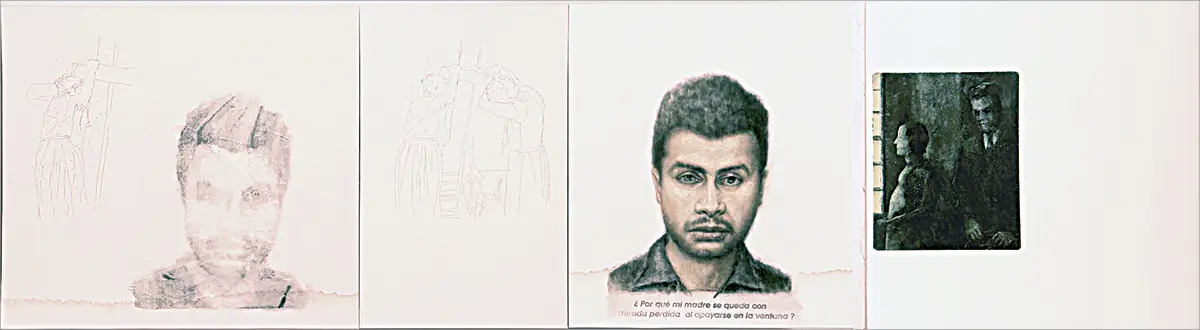
In this new exhibition, Laignelet assumed several methods to recapture the thread of the images. The first and most fundamental of these methods was to make industrial paper into a continuous ribbon that traversed the gallery’s first floor (an atavistic “continuous film”) with images like sentences or small image-based narratives that the viewer was forced to connect. These were somewhat apocalyptic images that revealed discomfort with power. Thus, large political rallies mixed with Lacan, who warned about the image and the power of language on a befuddled, disarmed subject. More than moving toward fragmentation, the unfocused method in this first part of the exhibition was a way for both the artist and the viewer to adapt to a totality of life with random themes—such as the troubled relationships of couples, childhood, adolescence, political discourse, sensuality—without passing definitive judgment. Such promiscuity was visible in the themes and techniques; there were also drawings, pastels, oils, photographs, engravings, and street printing techniques. But Laignelet honored the processes and the jargon of worlds somewhat alien to the history of art—that of comics, film, fotonovelas, and Sunday paintings that resemble manuals for provincial painters. In Colombia, different temporalities coexist.
On the second floor of the exhibition, the artist posited a different method of perception, listening. According to Philip Roth, humanity is divided into two categories: those who listen and those who don’t. Images on the second floor were built on the logic of the image itself, as an exercise of synthesis. In one of the works, the angels of Latin American colonial painting held harquebuses like gallant walking canes and shot themselves, with eyes not exactly vacant but lost, erratic. These images were examples of symbolic constructions with shifting meanings. In that same vein, an architect’s drawing somewhere between Art Deco and Modernist in style was translated into a video; the architect and his work-table were dissolved and reconstructed. The architect, the builder of modernity, played his role of draftsman of the world on a video screen, an unstable surface that made moved from structure to dissolution. The videos in this exhibition were clearly made by a painter who does not take light for granted; he achieves it with modulations of shades and hues, compositions, and experiments with the image. The protagonists were “thoughtful”: androgynous angels; architects who build and destroy their designs for the world; suffering mothers crying for their dead, or simply waiting; plump Buddhas. These were invitations to connect, to establish new links between the viewer and the outside world—a saturated world, in need of rewriting by each one of us.
NATALIA GUTIÉRREZ