Judging from Ada Bobonis’s two works recently on view at San Juan’s El Museo de Arte de Puerto Rico, you might be tempted to describe what she does as “playful,” but that would underestimate the artist’s reach by a long shot. Her sense of play is cagey and rigorous, involving the most basic physical assumptions: balance and proportion, the location of the center and the periphery, and the appearance both of an object’s surface as its deepest part and of the interior an empty but portentous place.
Sobrecielo, a 2000 work which is part of the museum’s permanent collection, was a dense array of pieces of rope intertwined with yarn, floating over the heads of viewers like a trim, inverted English garden. It hung with such colorful verve and profusion that its reversals of the world as we know it did not trouble at all, as if the artist proposed not just a work of art but a perfectly plausible alternative physics.
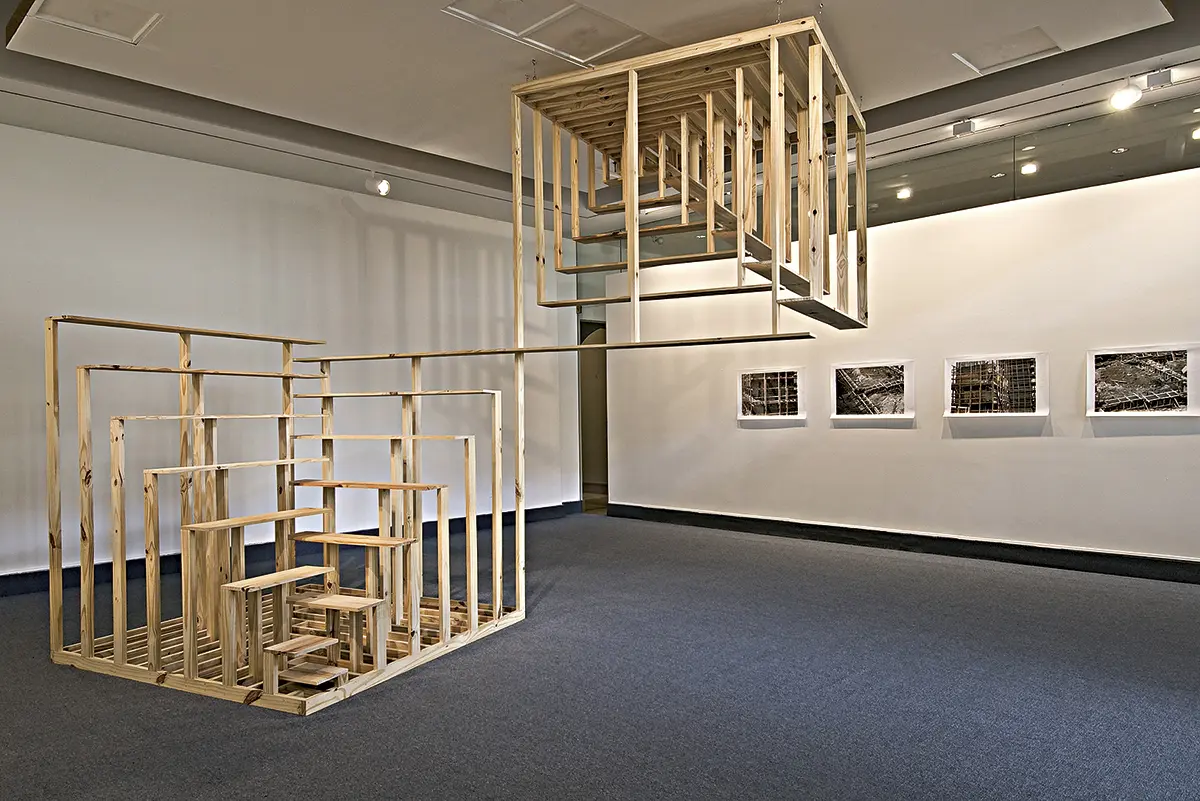
Bobonis’s recent installation in the museum’s project room, Estados sensibles, was likewise topsy-turvy. Its centerpiece was a wooden structure in the middle of the gallery: one part resembled a wall about to be hoisted into position, although this was also the base for a set of rudimentary bleachers. Hanging from the ceiling was this structure’s near-twin, inverted and attached to the floor piece along two axes, as if its clone popped out, made a half-turn, took a step to the right, and did a handstand. The genius of this part of the installation was that it not only closely resembled familiar objects but also didn’t at all. No house could stand with walls made with studs at right angles; the seating design was vertically elongated and squeezed tightly together, front to back, absurdly out of human proportion.
Gazing upon this strangely amorphous framework was like entering a particularly murky Borgesian fable. It was at once weightless, unburdened by the literal meaning of any kind, and thick with paradox and ironic possibilities. One saw a collection of knotty pine boards—the cheapest, most disposable element in any construction project—arranged with no apparent purpose other than to hold itself upright, or upside down, as was also the case. However pointless its worldly intentions, it was designed and built with precise calculations and loving craft, its carefully detailed joints made in a very old-fashioned way, with recessed wooden pegs instead of nails or screws.
Adding to the illusionary qualities of this provocative fiction was the gallery’s gray carpet, resembling a sky underfoot, and the stark white ceiling, as earthbound as the surrounding walls. In fact, the walls held the only means by which the gallery’s visitors could properly orient themselves: seven digital photographs, mostly of construction sites with wooden grid scaffolding. The photographs were pinned up with an informality that reflected the provisional scenes they portrayed: footings being poured, massive concrete walls held in place until set.
The word “suspension”—and its shifty ally “suspense”—hung around Estados sensibles as palpably as its pitchy lumber, like connective tissue for its hidden corpus of meaning. We come to any artist’s project armed with a sturdy suspension of disbelief, of course, since daubs of paint, marks on the wall, and dancing light by themselves are merely the creators’ nervous tremors, requiring our willingness to make sense of them. In Bobonis’s case, the suspension has a very literal meaning since a good half of the work hangs before the viewer. Then there is one’s own sense of suspension in time and space. Is this a half-made thing like those buildings on the walls, or is it the elaborate syntax of an argument about the artist’s place among her fellow artists and other humans? Is the argument personal or political? Is it purely aesthetic, another brick in the wall of Bobonis’s career-long formal trajectory; is it a quest for origins and other deep meanings; or is it—like most artists’ endeavors, especially those who deal in ambiguity and nuance—some alchemical mingling where form and function proceed in volatile proportions, whose exact formulation is unknown even to the artist? In that sense, we are all, artist and viewer alike, in suspense.
Estados sensibles is, like so many thoughtful things, in some manner a linguistic construct. Looking at its physicality, gorgeous and subtle in spite of its simplicity and homely materials, we might view it as a kind of calligraphy with achingly suggestive shapes for a language yet to be translated. The installation had the remarkable good fortune to be on view at the same time as an exhibition of early- to mid-twentieth-century Spanish drawings in the gallery nearby. Like Joaquín Torres García or Benjamín Palencia or other masters of evocative, monumental restraint, Bobonis traced in the air dialectical concerns with vectors that were fleeting and urgent, heartfelt and brainy, precisely articulated and unutterable.
JOEL WEINSTEIN