
Living in Paris for nearly fifteen years, young Mexican photographer Alejandra Figueroa is solely interested in details: fragments of faces and bodies; folds, protuberances, and depressions in all their magnificence; the interplay of light and shadow on the “skin”; lines trapped and caught in flight… stage a new anatomy in each of her works. This artist is determined to find, in the art inside museums around the world, every detail that deserves to be accentuated, and in the process allowing, perhaps, a fresh look into the past. She is primarily interested in the volume of sculpture, where she crumbles the figure as she plays with chiaroscuro and the voluptuousness of forms in order to zero in on that essential part: a fold in the drapery barely covering the naked body; a hidden curve; a delicate gesture… all these fragments reveal a discrete and, at the same time, sensuous eroticism. Without a doubt, Figueroa has imposed upon herself a new challenge as she takes on medieval stained glass. She now is required to deal with a flat surface and a technique that does not trap light but permit it to pass through the transparency of the glass so pictorial density can exist.
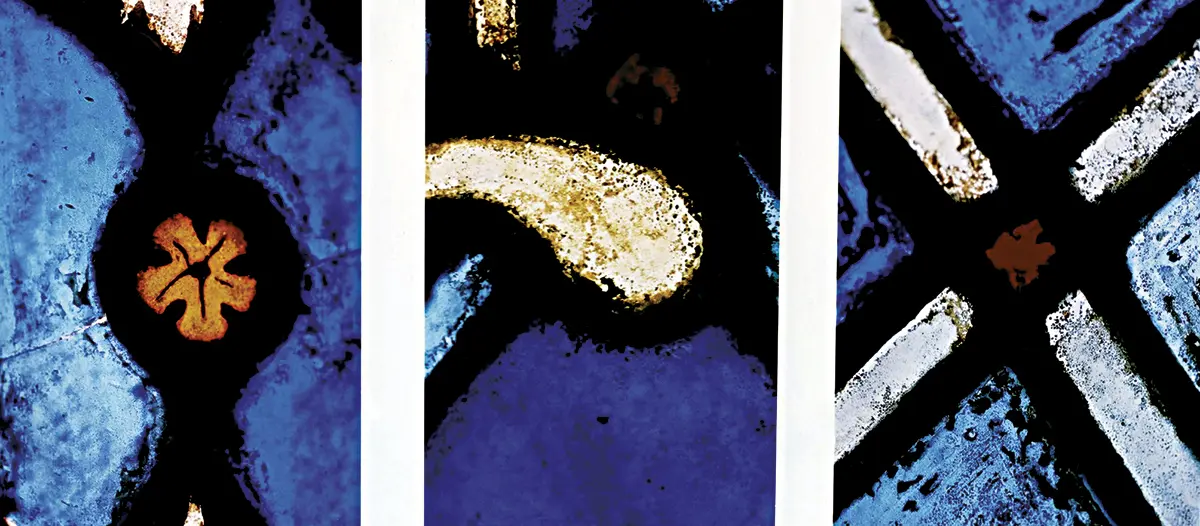
For this exhibit to be presented in a vaulted room at the Cluny Museum, the artist presented a group of twenty-two large-format color photographs (180 ◊ 120 cm). The photographed stain glass (from the seventh to the fourteenth century) has been restored thanks to the patronage of the Gaz Foundation of France. Erected in one of the most beautiful small palaces in Paris, the museum is devoted to showing medieval art: statuettes and tapestries—like the famous Dame à la Licorne (The Lady and the Unicorn)—coins, steles, and the largest collection of stained glass found in France. It will be the first time the museum will show a contemporary art exhibit. On the other hand, it will not be the first time that Alejandra shows her work at historic and prestigious museums, for this is the type of venue where she has presented the majority of her exhibits. In 1997, she presented at The Great Louvre her powerful black-and-white photographs of sculpted body fragments; later, in 1998, she exhibited at The Museum of Orsay, and in 1999, her work was commissioned by the Vatican. It should also be mentioned that her 2002 exhibit Skin of Angels at the San Eustaquio Church was presented as part of the Month of Photography events in Paris.
Different from contemporary art’s White Cube spaces and from old factories transformed into exhibit venues where sobriety prevails, this Museum’s conventional layout packed with works of art is impregnated with history. This type of space is one more unavoidable challenge, as the proximity between the referenced work and that being shown for this particular exhibit could take away a certain strength from the artist’s discourse. Nonetheless, Alejandra Figueroa is not simply about echoing her “models” or responding directly to them. She is interested in establishing virtual correspondence or in creating aesthetic empathy with sculpted or painted figures that human eyes never get to see in their totality.
This desire to prioritize details is not only her aesthetic option but rather a decision that also accommodates each individual’s perceptive sensibility and personal aesthetics. There is no obligated approach to seeing the work of art. There are different ways of seeing, as there are incitements and information that condition our observation. There are also trends favoring attraction or rejection, and perceptions that vary according to cultural backgrounds, exhibit visiting habits, sensibilities, and knowledge. In Alejandra Figueroa’s work, we find an advantageous clue in her decision to approach her work while considering the details of other works. It is to a certain extent a way of forcing the gaze, of guiding it to a predetermined option; but above all, it is about opening new spaces for reflection and perhaps to allow for the discovery of other interpretations that may question historical affirmations. It is not the kind of detail French art historian Daniel Arasse speaks of, which can afford meaning to the narrative of the work that the artist chooses in order to give it a specific place in the pictorial strategy. Details in a work of art are often the leading thread that brings each of the parts together and permits the formation of the whole.
In Figueroa’s work, emphasis by means of detail is, in a way, the creation of a new work that arises from itself. It is about choosing a specific detail—something that photography allows in that it is based on partial vision—as an outside observer. It is the invention of iconographic approaches that permit juxtaposing different periods and styles in art history, creating bridges between ancient and modern art. If macro-photography found its favorite field in nature, then Alejandra Figueroa invites us to look up-close at large-format works of art and to magnify our esthetic pleasure by finding unsuspected approaches and complicities. With the artist, we discover to what extent stained glass, which has erroneously been thought of as a minor art form, is rich in expression, from faces to fauna and flora and decorative motifs. Finally, Figueroa’s photographs of stained glass transport us to the universe of abstractions and able geometries where intense color is used with precision and strength. In this manner, Figueroa invites us to travel through centuries of art and forms, to the modernists, abstract expressionists, or neoplastic artists, in order to create a new history for them.
CHRISTINE FRÉROT