
To what degree does contemporary art interest us, not only for itself but for its ability to capture the contemporary subject—even in not strictly aesthetic terms—inasmuch as it is able to synthesize complex global situations and explore them in greater depth from the periphery?
The Encuentro Regional de Art (ERA 2007) held recently in Montevideo, Uruguay, initiated and generally conceived by Gabriel Peluffo Linari, the director of the Museo Juan Manuel Blanes revealed the ways that these issues can be presented in an ambitious project, under a renewed conceptual, historiographic, and critical density. The intentional abandonment of any unilateral reference to a center once again set in motion questions and caused an intellectual and aesthetic vertigo highly characteristic of this nascent third millennium. It is well known that the contemporary world’s manifold artistic expressions are incapable of producing the “order” of modernity, which overcomes the multiplicity of partial knowledge and covers up certainties. Our culture can no longer measure the world. We live an essentially de-localized experience because we have verified the failure of analogies and similarities. For that reason, the “unmediated interweavings, and horizontal slices,” in Peluffo Linari’s words were amply included in a program of exhibitions, debates, and roundtables presented simultaneously at the Museo Blanes, Montevideo’s Museo Nacional de Artes Visuales, the Centro Cultural de España, the Montevideo City Hall, the Pre-Columbian Art Museum, the Market Upmarket Gallery, the Zabala space, and the city’s own urban spaces.
The “center” was a mutating, shifting non-place throughout Montevideo. The artists’ works were precarious, transitional relationships at the limit of a vacuum, of a bottomless bottom, of unbalance and disruption. Lacking a utopian verticality, there were no fixed references because metaphorical verticality vanished as well. A visitor to ERA 2007’s various exhibitions situated oneself at the same time inside and out. The formalized rejection and delay of centrality was better fitted to the idea of nomadism, the quintessence of this mega-event, as it imposed the “horizontal” movement emphasized by Peluffo Linari: the mental wanderings in images that were concretizations of such an ambulatory interest.
An example of provisional interplay with firm geography with variable borders was the Imágenes Sitiadas exhibition, curated by Roberto Amigo from Argentina. With an exhaustive analysis of visual art between 1830 and 1870, it proposed a contemporary curatorial approach that presented the visual and political traditions of the River Plate area. An abundant repertoire of works, among them paintings, prints, engravings, drawings, documentary photographs, and textiles brought together such loaded (and at the same time, hollowed) notions like “transit,” “frontier,” “violence,” and “sociability,” in order to re-formulate the “traces” of nineteenth-century regional art, which opened up a dual strategy, one of dissembling and of “re-writing” each country’s previously untouchable official history. A highlight was the testimonial space reserved for the Triple Alliance War, at the Museo Nacional de Artes Visuales, with supplementary sections based on the National Library’s collection of patriotic photographs. Even in the nineteenth century, the practice of art was unthinkable without the infiltration of the photograph as a memento mori and “medium of the fleeting instant.”
Equally felicitous was the selection of paintings that rescued the idea of the original and the aura. They boldly displayed the conventions, traps of style, descriptive temptations, underlying content, and references to aesthetic and emotional delight, questioning the universality of certain pictorial codes in vogue during the formative period of certain national identities as countries with mass immigration. Amigo, as a curator and historian, offered the simultaneity of opposed tactics, a cross-breeding of languages between the past and the present, in which he superimposed the study of the representative the function of those bodies in testimonial works to the self-reflective, post-utopian part of our knowledge.
In the large exhibition La Cuadratura del Cono (Border Jam), Gerardo Mosquera continued his practice of teaming up with different curators, theoreticians, and local critics throughout Latin America. This was followed more recently by his project Transpacífico: Un encuentro en Santiago, held at the Centro Cultural Palacio de la Moneda from May 17th through July 22nd, 2007, for which Mosquera organized an encounter between artists from the Asian Pacific region and Chile.
In Montevideo, Mosquera’s exhibition continued the notion of the encounter, which reconfigured the ideas of investigation, expansion of residences, common interests, and respect for differences. For the Cuban curator, the term “encounter” has gnostic value related to knowledge and also signifies “adventure, doubt, a polyhedral mirror, and trigger for the future” for new proposals and projects. The selected artists were José Damasceno and Cildo Meireles (Brazil); Miguel Angel Ríos and Amalia Pica (Argentina); Luis Camnitzer, Ricardo Lanzarini, and Pablo Uribe (Uruguay); Santiago Sierra and Teresa Margolles (Mexico); Mónica Bonvicini (Italy); Mona Hatoum (Lebanon); Lucía Egaña and Claudio Correa (Chile); Osvaldo Salerno and Claudia Casarino (Paraguay); Shilpa Gupta (India); Fernando Sánchez Castillo and Cristina Lucas (Spain); and Vibeke Tandberg (Norway). Mosquera decided to carry out a series of “intromissions” of contemporary works in the space of the show curated by Amigo, while inviting the latter to exercise the same de-territorialized operation—the point was a fluid dialogue between different times, conditions, and signs. Being a branching, labyrinth-like that appropriated dissemination for itself, La Cuadratura del Cono moved from the Museo Nacional de Bellas Artes to the Centro Cultural de España, to the Museo Municipal Juan Manuel Blanes, and to City Hall. It didn’t have a fixed fulcrum: it advocated nomadism and exile, as if it were a road movie.
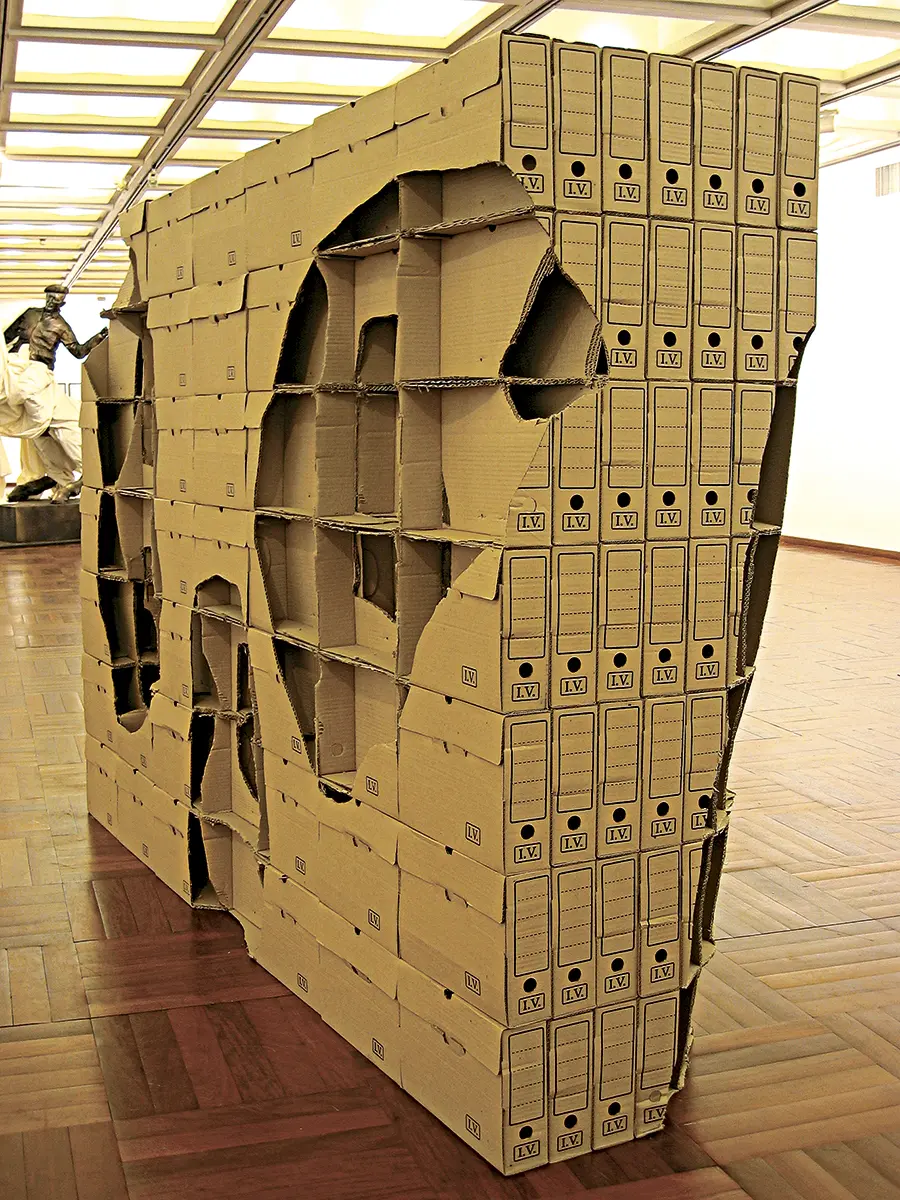
The Brazilian artist José Damasceno’s Archivo Vivo was a very large site-specific cardboard object with perforated surfaces, displaying the “degree zero of the materials” of the post-Arte Povera sculpture. This work generated subtle vertigo, a delicate convulsion, alluding to the estrangement or discomfort created by his most recent works made with utilitarian objects. Archivo Vivo was a “living body” that spoke of many highly destructive and degrading histories of the Southern Cone nations.
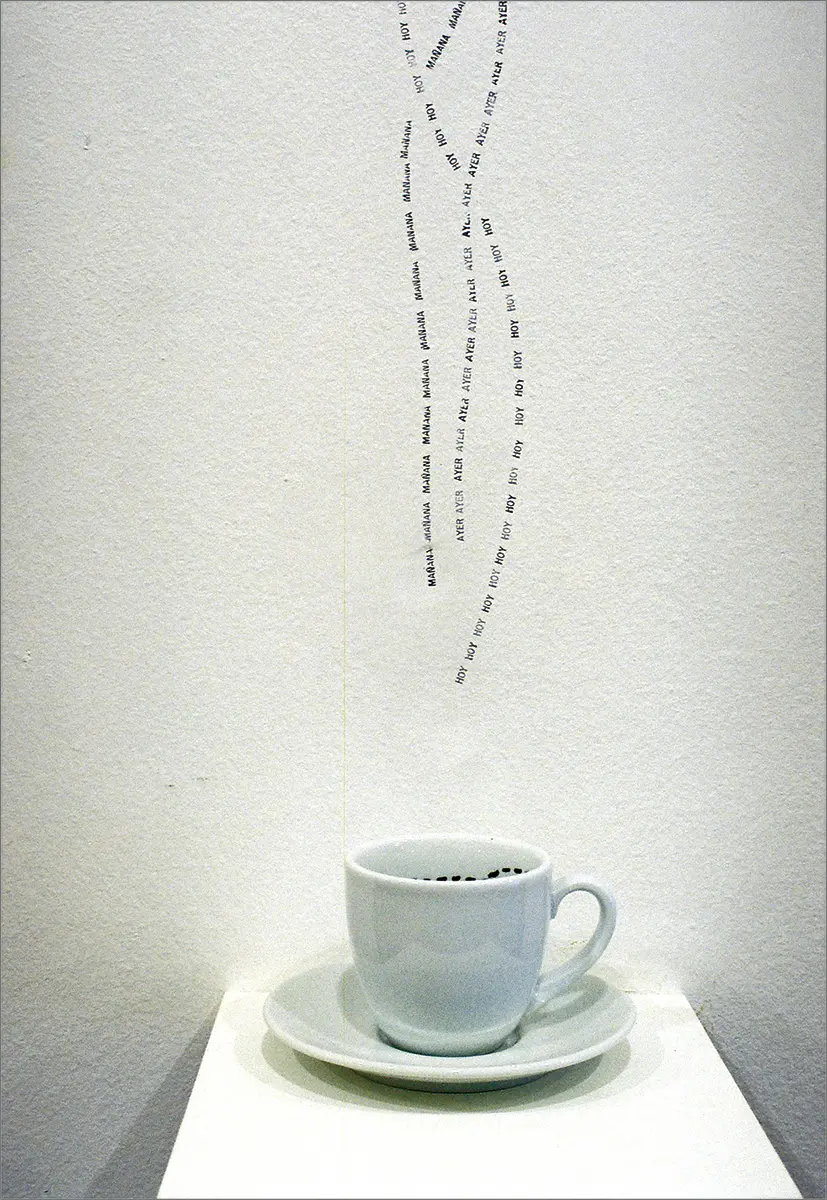
Another work by Damasceno, Organigrama, was a rhythmic and receding spiral and fold, a site-specific work created for this occasion. Its ironic allusions appeared as residues not absorbed by calculus or reason. At the threshold of the evanescent, it seemed to dissolve before one’s gaze, inebriated by lightness and sophistication of expressive media, mixing rigor and sensuality.
With his video selection based on movement and accumulation, A morir (2003), Miguel Ángel Ríos offered the frenzy of a vision that rejected all models, one consciously orphaned and defective and in absolute synchrony with the tension of the unfinished and the unending.
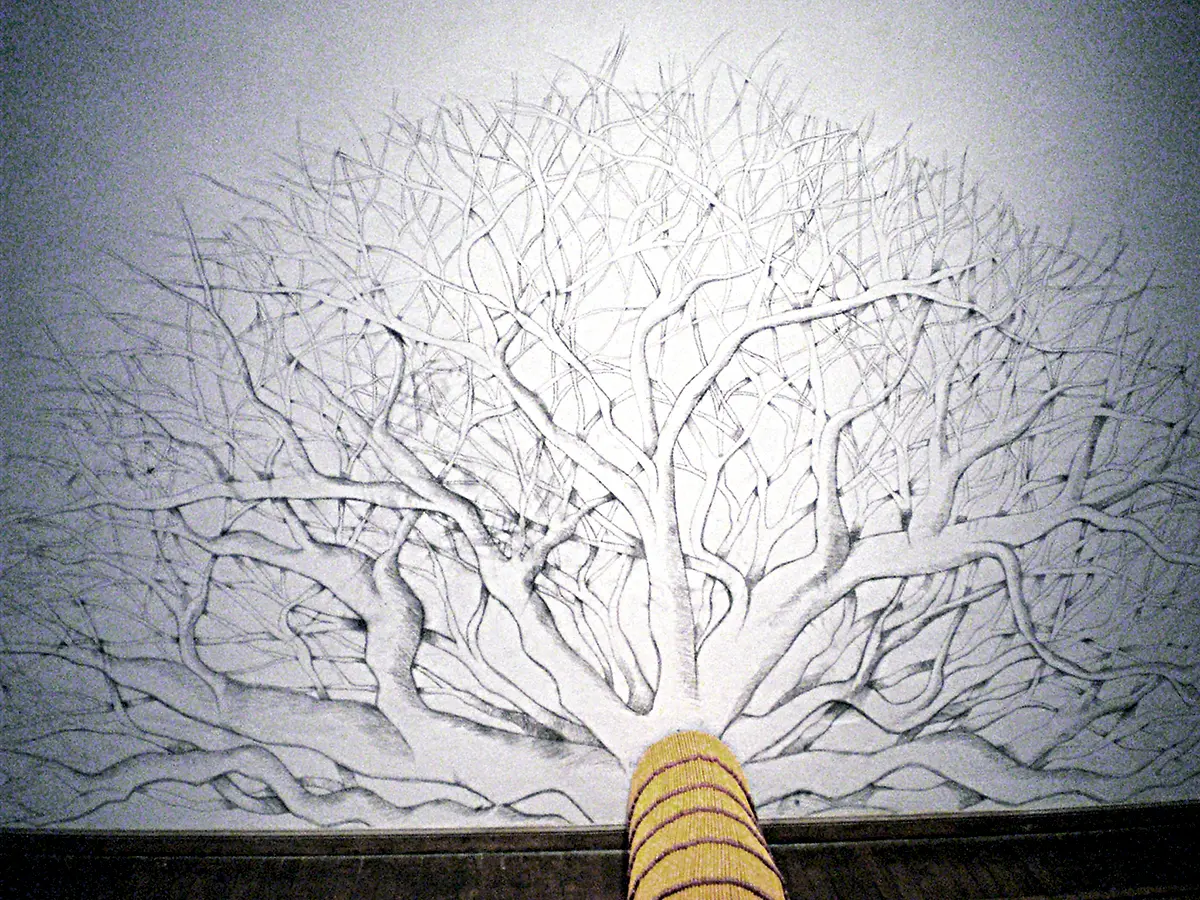
Luis Camnitzer presented a substantial installation, which Mosquera “relocated” to the exhibition space of Imágenes Sitiadas. But he also executed a large-scale mural drawing directly on the wall with a tree-like structure that echoed the rhizome-like spirit of La Cuadratura del Cono: a kind of giant ombú tree that expanded along the gallery’s white wall. In this work, the drawing was abundantly filigreed and inseparable from the idea of absence, a component of emptiness and gratuitousness that is always present in the graphic gesture.
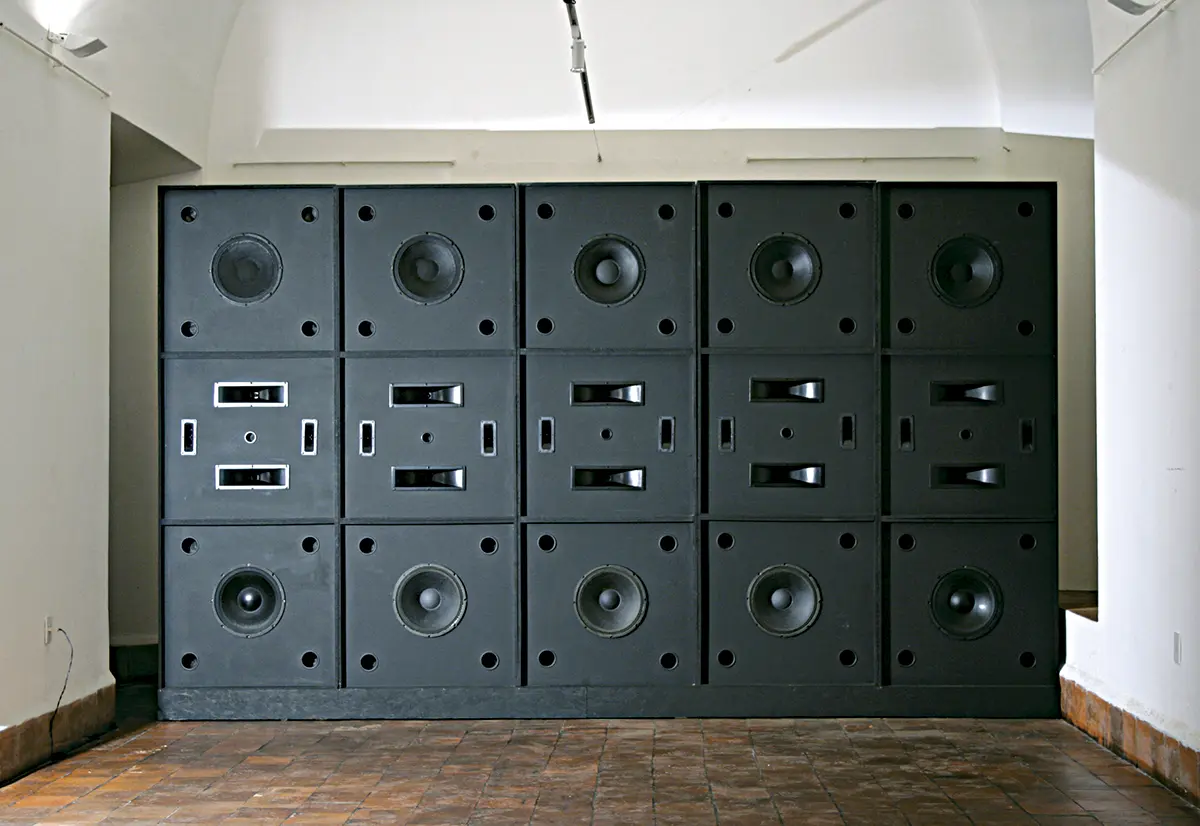
Sin título, Santiago Sierra’s monadic object in the shape of a colossal minimalist black structure broadcasted an incomprehensible, Babel-like soundtrack that mixed the national anthems of Argentina, Uruguay, Brazil, Paraguay, and Chile. The sound produced was very much like John Cage’s random noise, as each solemn chant became a reiterative soliloquy. Sierra’s enigmatic work postulated the inflexible ritual of the obsessive.
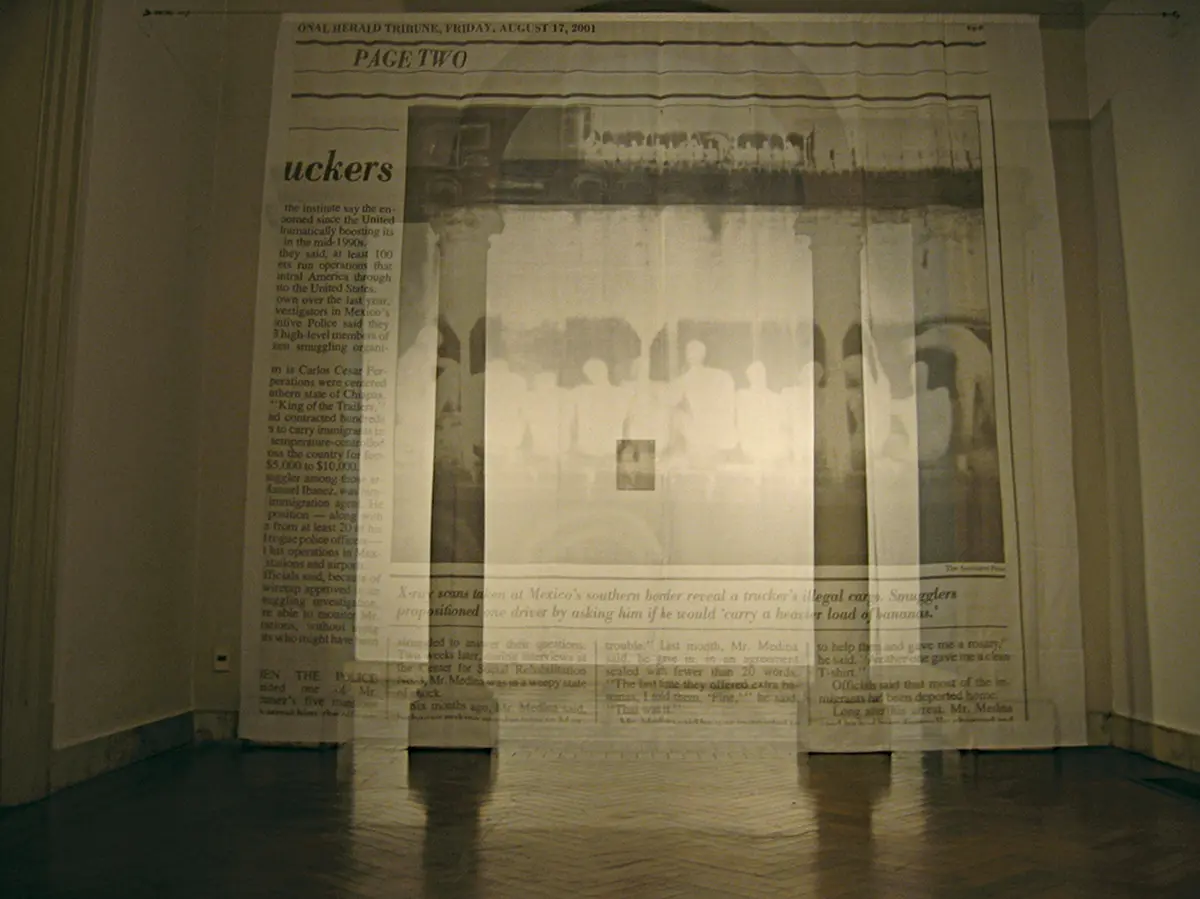
In Every Door a Wall (2003), Mona Hatoum proposed a form of visual and physical tangibility that allowed the moving and breaking of barriers. Light cloth curtains were printed with news stories: tensions, deaths, and conflicts of all kinds—the limits that fuse but also distance one from another.
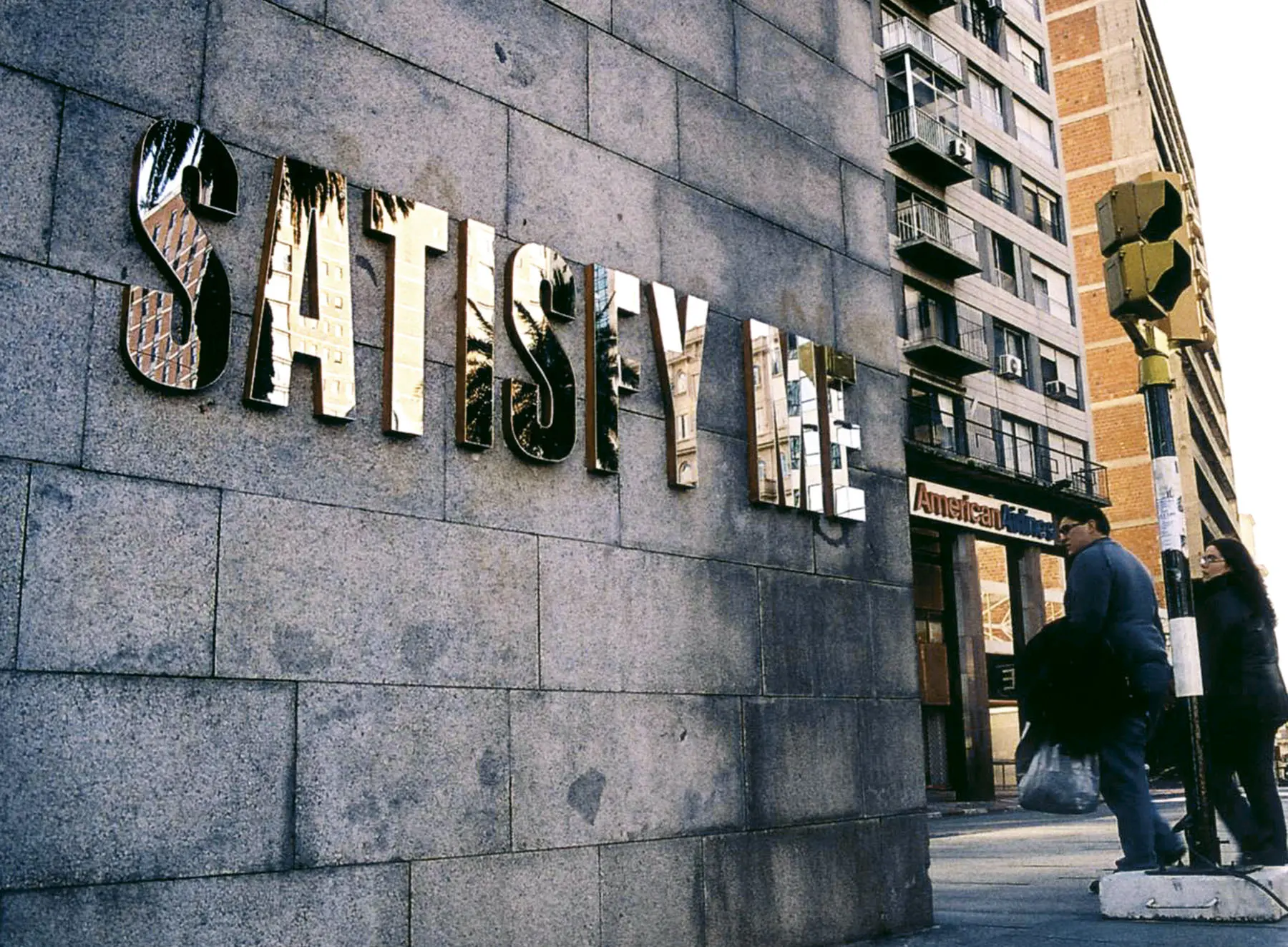
The Italian artist Mónica Bonvicini manipulated advertising spots and neon signs in Satisfy Me (2007), superimposing the image of an idealized female body on a historic façade in the city of Montevideo; the door, in turn, was sealed or “blinded” by Pablo Conde. Bonvicini works with language in her art, and her titles are often imperative. Without the title, the work would have lost its intrinsic and contextual meaning.
Pablo Lanzarini’s irreverent gesture in his installation La Pescadería del Sur (2007) charged against Joaquín Torres-García’s famous drawing of a fish. Torres-García was the father of Constructive Universalism, and his drawing, being avant-garde and a novelty in its time, became an icon and fetish. But Lanzarini, who is interested neither in rupture nor modernism, transformed it into an object and presented it as an oversize, ironic, kitschy, and mordant toy: an environment of transparent plastic curtains, like a fish restaurant on the coast.
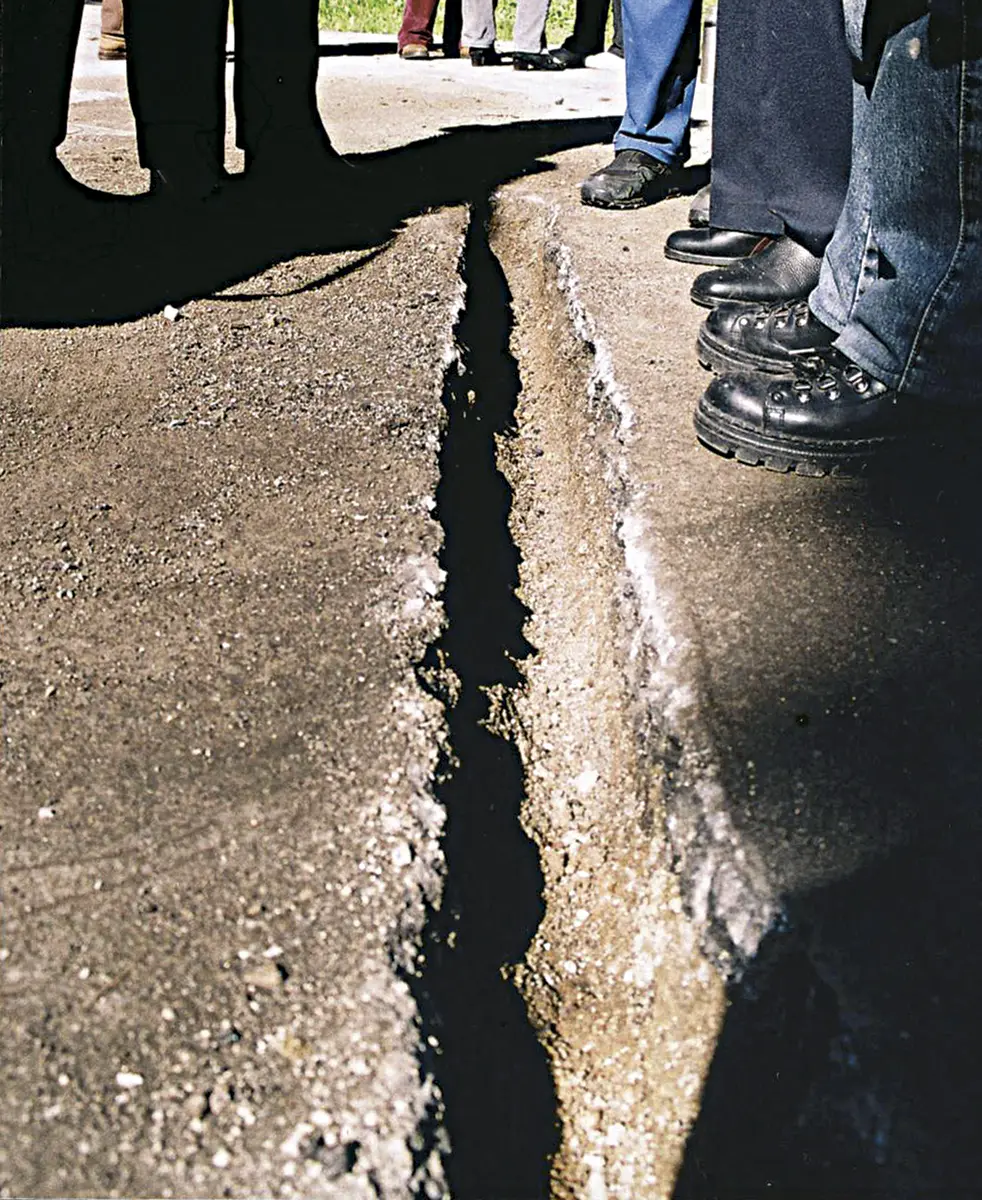
In Herida (2007), the Mexican artist Teresa Margolles revealed the on-site process of a situationist work, a mixture of performance and intervention of the urban space. Herida was a narrow and long channel cut into the earth, where Margolles placed objects used by the victims who disappeared during the military dictatorship. In this work, the border between the abject and the sinister was blurred and mournful. Margolles’s work grew from the abyss of silence and a retrospective look at the years of oppression in the Southern Cone in the 1960s and 1970s.
Uruguay’s Pablo Uribe, in Dos Coronas (2007), relocated two commemorative, anthropomorphic sculptures by Juan Manuel and Nicanor Blanes from their original site in the upper part of the façade of the Blanes Museum.
Besides presenting Flag (2007), red in color and containing a self-referential love poem embroidered with yellow ribbons, the Indian artist Shilpa Gupta wove the space of the private into the symbol of a standard and adopted the Situationist street-intervention model, festooning buildings with ribbons that read: “No limit here.”
CLAUDIA LAUDANNO