
Recently, Casa América presented Art, Satire... Subversion! Five Ibero-American Views in Madrid, under the curatorship of Dennys Matos and Lorena Pérez Rumpler. The show gathered works by artists as important as Martín and Sicilia (Spain), Marcos López (Argentina), Elio Rodríguez (Cuba), Rubén Ortiz-Torres (Mexico), and Santiago Echeverry (Colombia). With their respectively unique languages and modes of representation, the artists conveyed their imaginations as soaked in the unsettling reality that surrounds and inspires them, inviting the viewer to satirize it and to laugh with full awareness of the penetrating and incisive critical content in these works of art.
Deploying parody and satire as strategies to ironically and humorously dilute the problems of the world, this group show concentrated the gaze returned by each artist to his or her surroundings, making it possible for the viewer to find in their works the critical acuity with which they have dissected contemporary society’s limitations and vices, engaged it in diverting ways, and brought us closer to understanding the visual, socio-cultural, and political imagination that supports them.
Sarcasm is responsible for the subversion of any logical, moral, and political order and provided these works with meaning—works that were inevitably associated with idiosyncratic phenomena. All of them used sources like the popular imagination, advertising, and mass culture, which to a greater or lesser degree they all took from their countries of origin in order to thread their discourse.
To understand the process of creation and production for these artists who lean on the hilarious and the ironic, it is important to take both capitalisms, linked to the consumer society, and socialism, linked to a social-justice project, as coherent social structures, and to realize that the struggle between these two antagonistic forces depends in large part on pacifying or subversive images, as they impact the depth of our consciousness and behavior on a daily basis. Loaded with strong doses of transgressive humor, these images supported the different works gathered.
Martin and Sicilia (born 1974 and 1971, Santa Cruz de Tenerife, Spain) have presented their work in Europe, Latin America, and the US and they are included in important collections in Spain, Luxembourg, Germany, Mexico, and Italy. Their work is indebted to Spanish and European realism of the eighteenth and nineteenth centuries and opts for the neo-figurative in order to recreate contemporary narrative parodies and everyday-life images while subverting their logical order. Appropriating the compositional canons and depth of field characteristic of realism, this duo has replaced the traditional themes behind still-lifes, marinas, court portraits, and palace interiors with powerful current narratives within public or private spaces.
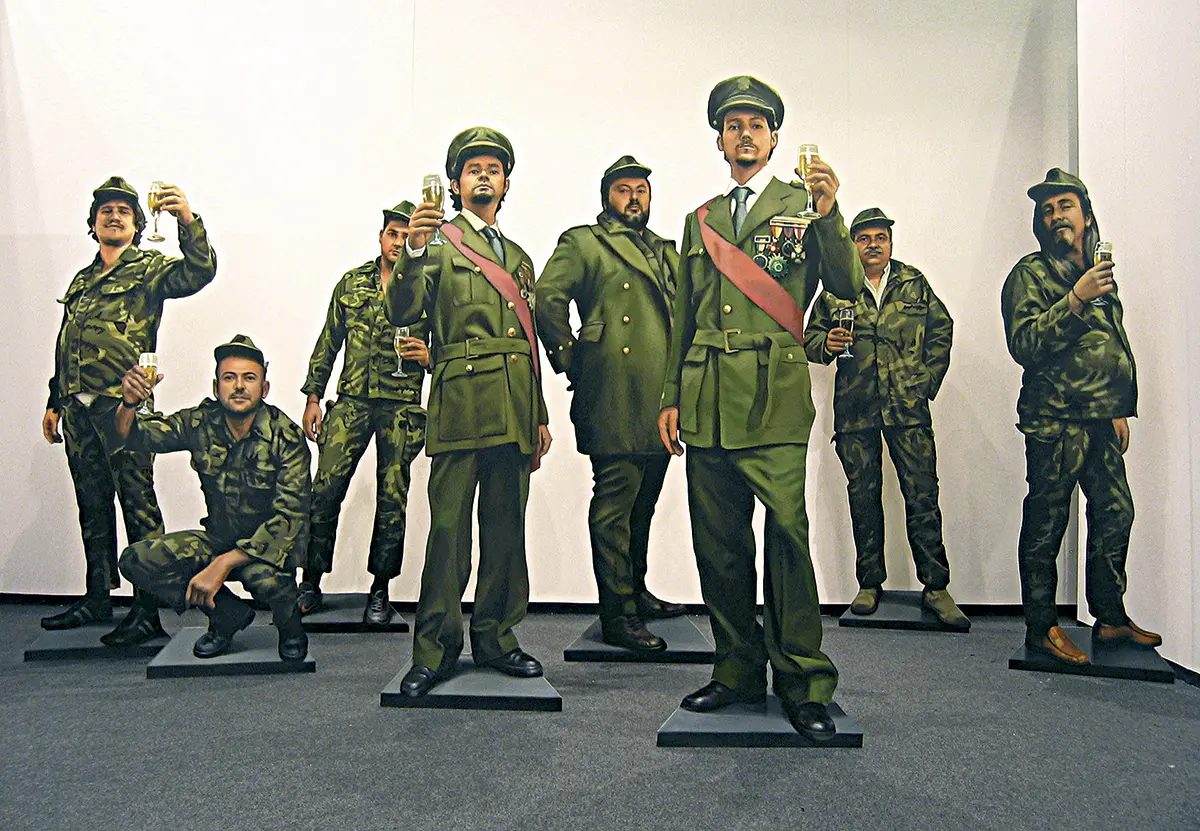
Occupying one of the galleries in its entirety, El Brindis confronted the viewer with wall-to-wall life-size images of soldiers and civilians on two sides with reversed roles: while the attitude of the soldiers having a champagne toast moved away from the martiality implied by their medals and uniforms, the civilians displayed aggressive attitudes and aimed assorted firearms at the viewer. What could be interpreted as an image of national identity embodied in this group of military men was confronted with the image of members of the national bourgeoisie, who would be the usual attendants to a cocktail party.
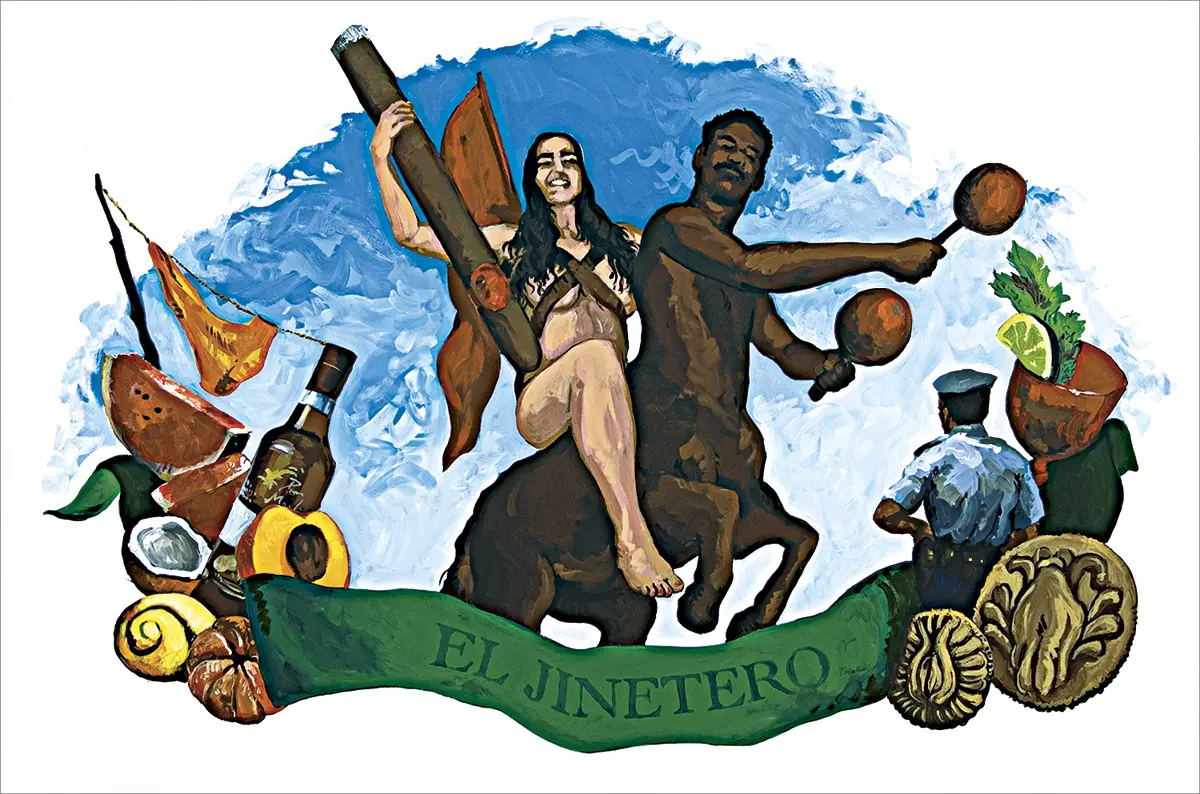
The work of Elio Rodríguez (born 1966, Havana, Cuba), who has exhibited widely in the United States and in Latin America, is also part of important North American, Cuban, and Latin American collections. Rodríguez used his alter ego El Macho for an in-depth, sensual/Caribbean, and subversive exploration of the established concept of Cuban syncretism. From a reinterpretation of the seals used on cigars in the late nineteenth century, Rodríguez leaped to the American graphic arts of the pre-revolutionary period. The works Idilio Tropical, El Jinetero, El poder del trópico on the one hand and El Asalto on the other were prime examples of how the Spanish tradition, along with the African and indigenous influences of the colonial period was confronted with the overwhelming The American presence in post-colonial, pre-revolutionary Cuba. Cars, tropical fruits, rum bottles, palm trees, cigars, music, lust, and movies were sarcastically parodied by the artist. His compositions, resembling advertising labels, reminded one of the whole cultural compendium and the Cuban/Caribbean hybrid as a product that has been reduced to its commercial condition and has lost its true identity in order to acquire a new face that makes it negotiable.
Marcos López’s photographs have been exhibited in Latin America, Europe, and the United States, and important Spanish, Venezuelan, Argentinean, Cuban, and North American collections have recently acquired his work. In an intellectual way, the Argentinean artist (born 1958, Santa Fe, Argentina) displayed a markedly black sense of humor in cynically entertaining, hyperrealist photographs that revealed the advertising world, which engulfs all that is related to superficiality in our consumer society. It appeared as an aesthetic of emptiness taken to its maximal expression, with poses, fetishes, and a cult of the body and of pleasure, the culture of kitsch, and stereotypes that ooze enchantment and distinction. All of that was the premise for Picada en la Terraza de la Fundación Proa, in which the artist neatly combined and composed each one of these elements. Attentive to their place in front of the camera, his characters were indistinct in terms of social class and immersed in their corresponding roles as innkeepers, bodybuilders, swimmers, models, and intellectuals. Time stopped in order to immortalize them in the photograph. The contrasting use of yellow and cobalt blue, as well as the spatial arrangement of the characters, gave the composition an impeccable advertisement-like finish. In works like Boca Junior, Perón y Evita, el Che, and Gardel preocupado, López underscored the importance of dislocating these typically Argentine national symbols in order to ridicule and demystify their expressions. In these photographs, the artist emphasized the function of painted-in moles, rosy cheeks, and deliberately forced poses. A special mention should be made of Asado en Mendiolaza as the excess of satires, in which the most diverse social types recreated the Last Supper scene, with the apostles and Jesus sharing an authentic barbecue in a theatrically magisterial feast.
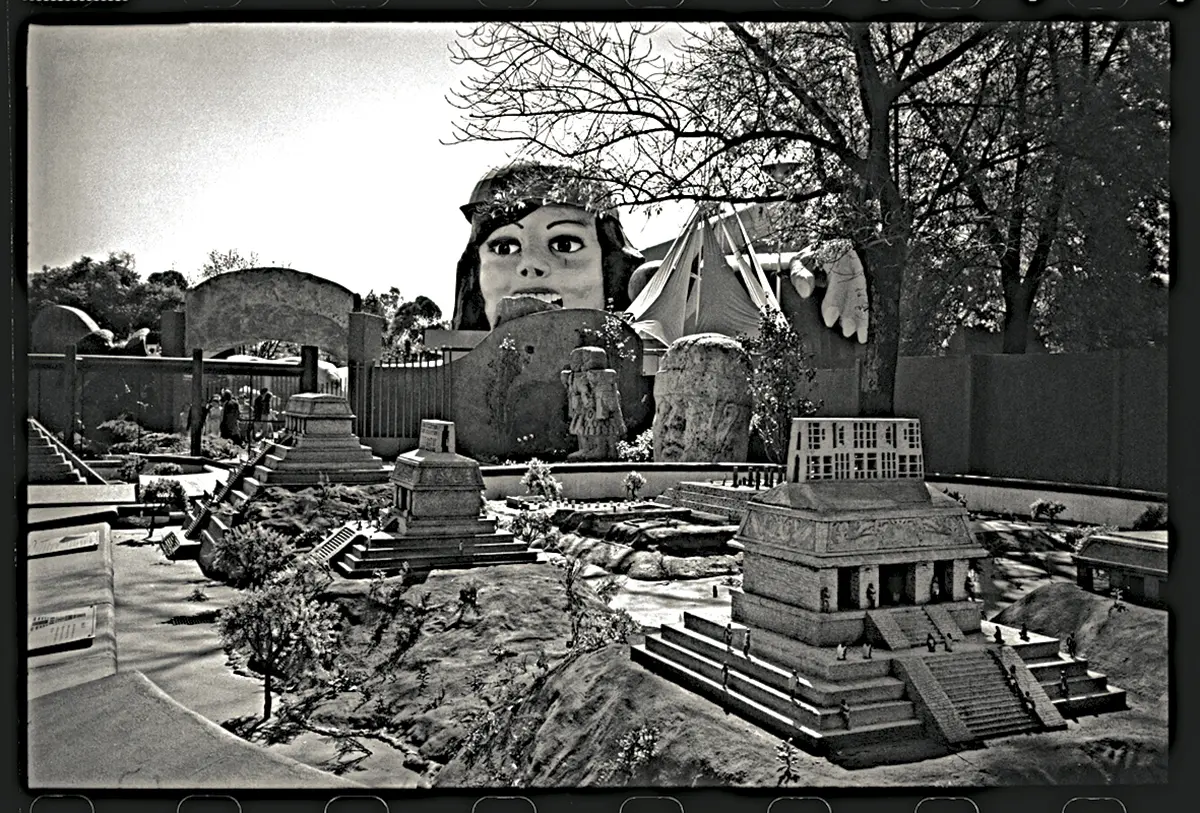
Rubén Ortiz-Torres (born 1962, Mexico City) creates photographs that describe and denounce the way that Mexican culture, its myths, and its traditions are systematically invaded by elements from different groups and cultures; typical examples of cultural contamination can be seen in Sacrificio Humano con Tiburones and Sex Goddess. In the series The Past Is Not What It Used to Be, the artist manipulated posters and photographs with an apparent ethnological rigor to aesthetically investigate the inclusion of various elements and discourses, signs, and out-of-context objects. Ortiz-Torres studies transculturation, not only in material but also in spiritual terms, and fuses iconographic elements alien to the initial compositions exploring realms of recycling and pastiche, in order to underline the tension that exists between the object and the adopted scene. Works like the one showing the colossal Olmec head in Mayan ruins or Atlantis point toward this relationship. A special mention should be made of a photomontage that exploited the color red, in which a supermarket appears to have been excavated inside a pre-Columbian pyramid. Appearing not only typical but also visually striking and monumental, in the best American style, this work responded to a critical view of socio-cultural transformations in the context of globalization. Ortiz-Torres is well known for his multi-media work, especially in the United States and Latin America.

The work of Santiago Echeverry (born 1970, Bogotá, Colombia), renowned for his videos in Latin America, Europe, and the United States considers the social ubiquity of sex and reflects on the impermeable, exclusive categories of masculine and feminine. Using audiovisual images, Echeverry reappraises the Colombian capital’s gay subculture with strong autobiographical content. In Manifiesto Pattytetikko, the artist untangled his discourse in a nihilistic, subversive fashion, in the best style of the last century’s avant-garde, reconstructing and ironizing the ideology that lurks behind anatomical, anthropological, and biological classifications of the masculine as opposed to and complementary to the feminine. The parody extended to sexual and social performance, which is closely linked to men and women. In an effective double move, sarcasm, while legitimizing homosexual realities in Colombia, on the one hand, denounced and on the other exploited the entire visual imagination that is associated with gay culture to explain its content and translate it into easily assimilated statements for the viewer.
In Lover Man (Where can you be), this contraposition of the masculine and the feminine was made patent through the satire that subverted the role of a man in his process of transformation into a drag queen, displaying in detail the psychological and physical processes implied in this metamorphosis. In this work, the main character confessed feeling rejected for being part of a collective that is subject to the intolerance and fierce violence exercised by Bogotá (or any Latin American city) regarding the issue of homosexuality. Billie Holliday’s Summertime, the anthem of Bogotá’s gay community was included in the work, in which the main character sings and speaks directly to the viewer, turning us into privileged spectators of his vulnerability.
Art, Satire... Subversion! reflected the aesthetic use of parody without disconnecting itself from the sociocultural content at the foundation of the works. The artists admit, question, legitimize, and subvert situations, stereotypes and icons in order to reassert and revise them with a humorous wink. Each of the proposals presented here shared the need to transform the univocal representation of images, a struggle against the power granted them by representation itself. It was a collective effort to come together in laughter and jest, which rendered more manageable assimilation of Ibero-America’s social, cultural, and political reality—the reality to which we are subject and which we have decided to assume in the best possible way: laughing at it. These five artists used humor and jest to provide entertainment, alongside profound reflections about the current issues affecting Ibero-American societies in the cultural race toward globalization.
ELISA RODRÍGUEZ