
After studying two recent two-person shows featuring works by the Cuban artist Carlos Estévez (born 1969, Havana, based in Miami since 2004), one noticed that each show was a cyclical response to questions that one poses daily to oneself. Not all have the courage, or the audacity, to proffer responses to these questions. I believe I know why Estévez has the courage, that audacious bent: it is because of his humility.
Like a religious person confronted with the omnipresent magnificence of a “divine representation,” be it an altarpiece, a cathedral, a sacred book, a totem, or an Orisha, Estévez faces the blank space that is the threshold of any artistic activity as a believer facing his God, as if he knows that all that takes place there—the dialogue of forces and energies therein—is transcendental, essential, and of radical importance. At the same time, he ends the dialogue that concludes only with works of art, as if he knows that—despite the works’ later promotion, distribution, commercialization, and even financial speculation—their real value resides in the secret of healing, either of his personal self or of those who approach the works as idols. This purification is one that, even if it is needed with a certain urgency in order to kill, neutralize, annihilate, or extirpate the pain of absence, doubt, fear of death, loneliness, or hopelessness, only takes place in the slow litany of he who places his fate in God’s hands. On this occasion of these exhibitions, that the subject was the audience.
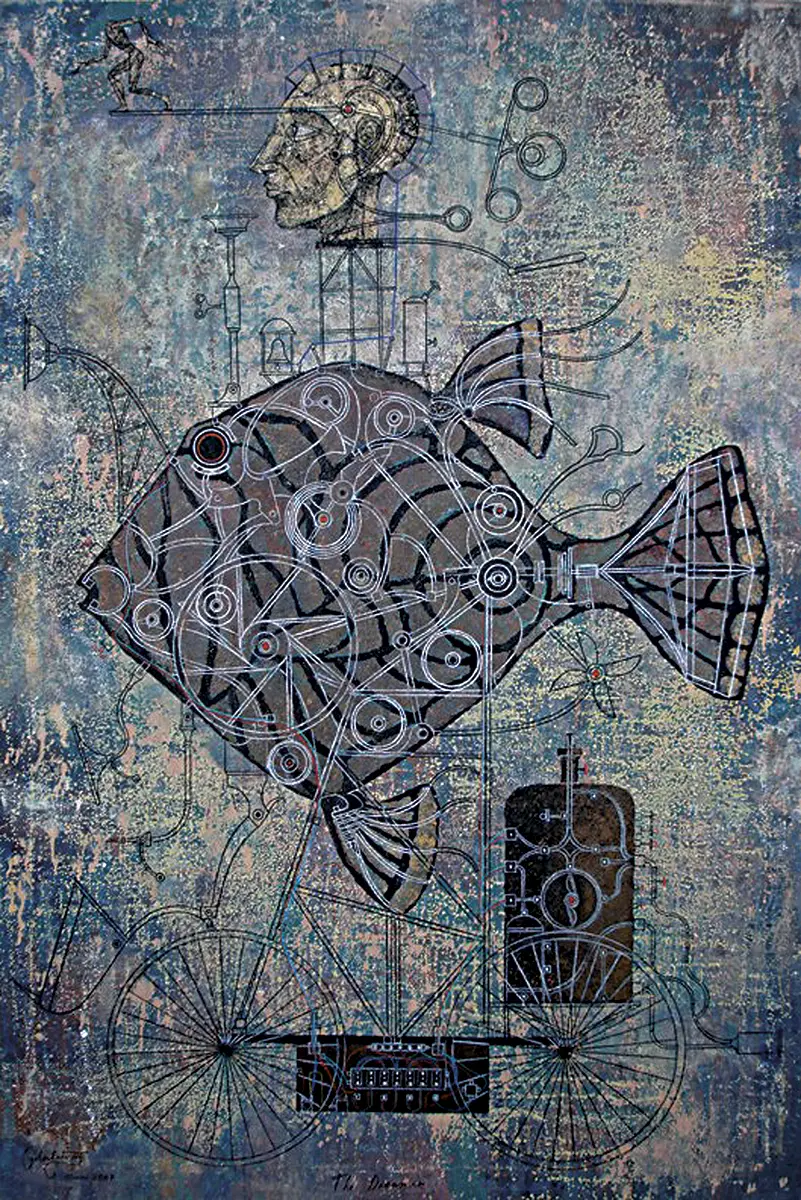
And therein lies Estévez’s greatest achievement. From a different perspective, if one looks critically at his varied and intense career, one can understand it as the evolution of a structuralist method, a spiral that reinterprets the world based on a structural system of observation. Estévez’s education as a sculptor in the old style has served him in articulating a body of work erected from sculpture, drawing, collage, installation, and, more recently, painting. In his recent work, it is as if he is mixing the findings of each one of his formal investigations into a single narrative, obsessively built around his idea of individual and collective memory.
As could be observed in both shows, Estévez’s reductionistic drawings have drifted toward narrative spaces in which the pictorial plane avoids obvious illustration of narrative and becomes metaphorical, poetic, and prosodic rather than didactic, lyrical rather than aggressively rough-edged, subtle and whisper-like rather than vociferous. One example is the splendid installation Botellas al Mar (2000), exhibited in Speak (Again) Memory (alongside works by fellow Cuban artist Mario Petrinera at the New Orleans Contemporary Art Center); this work made at the end and the beginning of a millennium partakes of the risk of reciprocity, of giving and receiving from the sea. The byzantine The Warning or the revealing, graphic, and enigmatic Vivarium (both dated in 2007), shown in Estévez’s exhibition Labyrinthus (with works by Maysey Raddock at Pan American Art Projects in Dallas), throw away the dialogue or the binary relationships of man/God, female/male, human /animal, body/soul, image/word.1 I have always wondered about and constructively envied the syntactic capacity of Estévez’s titling system. For him, the idea equals “the word,” constructing the image with the speed of a perfectionist Italian watchmaker and with the patience of a wise man. A conversation becomes a work of art, between what takes place inside an artist’s head and what he expects from the spectator, as both judge and jury in a relationship of seductions, enchantments, confessions, and hatreds.
Because we all expect a conversation, a nexus, from art, Estévez’s hidden greatness is his establishment of the dialogue from the humility of one who knows that any possible dialogue must occur based on knowing that we all possess equal human matter; we are all the essence of the same God, made of the same clay. But his the greatest achievement is to contain that knowledge as a healing language that gradually immunizes us against ourselves.
NOTE
1. Both shows were two-person shows, something that one could understand as symptomatic or characteristic of Estévez’s convivial spirit and practice, which are so distant from the competitive impulses of contemporary artistic society. For instance, one recalls his collaborations in the 1990s in Havana with artists like Luis Gómez or Santiago Rodríguez Olazábal or more recent collaborations such as Two of a Kind with Maureen McCabe at Alva Gallery in New London, Connecticut, January–March 2007.
OMAR-PASCUAL CASTILLO