
The
expressive power that characterizes the work of Clemencia Labin (born 1946,
Maracaibo, Venezuela) was present from August 5th through September 16th in the spaces of Alternativa, Elvira Neri
Galería de Art. Texture, volume, and color are the attributes that help this
artist achieve a forceful visual impact that transcends the limits of the
perceptual. Her proposal begins with a given format that later becomes a
volumetric hybrid overflowing the margins of the plane. The artist creates
solid, high reliefs in order to break the conventions between the
two-dimensional and the three-dimensional. But Labin sees herself above all as
a painter who wants to liberate painting from its traditional structure; this
is why her work is not circumscribed to the canvas, but each work becomes a
flexible piece that can be hung on a wall, placed as a sculpture, or become an
installation.
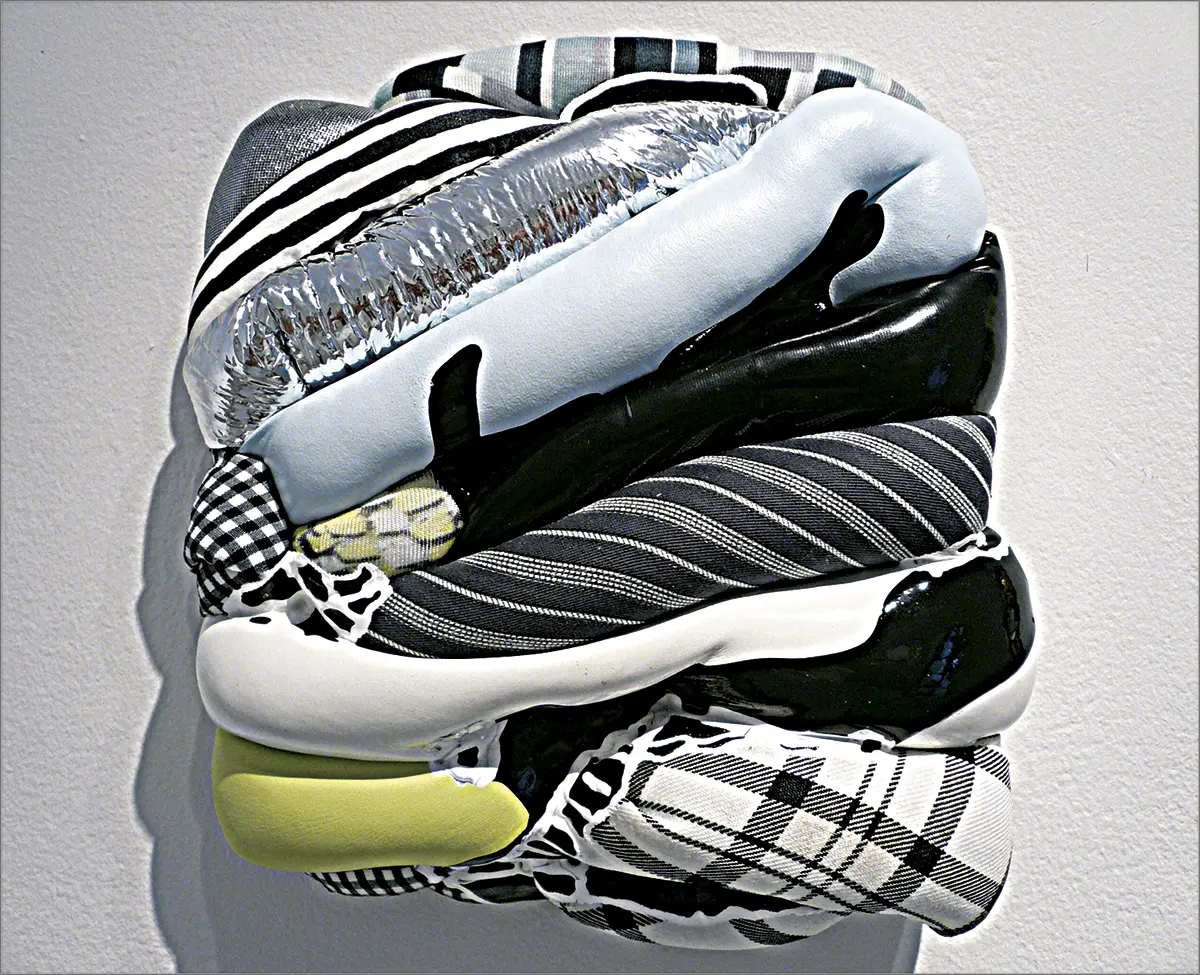
In the exhibition, her organic compositions alluded to suggestive connotations whose modulations, segmented and piled up, seemed to seek an accommodation with their context. Shape and color offered surprising clashes in the coverings of industrial canvas in different shades, which formed a conglomeration of entrants and salients with irregularities that contrasted vividly with the satined, opaque, ruled, dotted, or flowery surfaces. The group offered a panorama of chromatic stridencies that captured and seduced the viewer’s gaze, as seen in the series Pulpitas (2006) and Mini Pulpas (2007). In other works, like Mega Pulpa, Lote (2006), the saturation of the elements generated a baroque multicolored composition formed by superimposed canvases, anime balls, and acrylic pigments. In turn, in the series Pulpa Múltiple (2007), the artist built a symmetrically divided grid, similar to one face of a Rubik’s Cube, and inserted padded cloths that resembled minute pillows lined with prints in various colors into its cavities. Dynamic associations between randomness and geometry, the pictorial and the rational, and the ordered and the disordered were thus conjugated. This work invited the viewer to move the pillows in order to attain a different version of the composition; in that sense, one was in front of an “open work,” a work of art that unfolded randomly over time. On the other hand, the artist conceived her show as a large-scale installation: besides the twenty-five works it comprised, it incorporated the architectural space with the intervention of the ventilation duct, turning this object into an integrated part. However, Labin’s work went beyond the form itself and expanded toward the gestures of the body and interaction with the community. Thus, for the opening, the artist had prepared a performance in which she simulated being a part of the duct, using extensions that joined her to the object. In this position and with the help of a fan, she imitated the movements of the wind attempting to envelop all present. So, the exhibition’s title, Quimeras de viento, was the metaphor that connected viewers to the world of sensations the artist wanted to communicate through the aesthetic experience. In terms of her work with the community, one must mention Velada de Santa Lucía, a project occurring over the past few years in which Labin has worked on one street in her native city, incorporating curators and artists to create exhibitions in the neighborhood homes.
Labin’s entire oeuvre exalts the visual, the tactile, and the comfortable, but it also corresponds to the gustatory, the agreeable, the enveloping, and the sensual. These sensations are nested at the bottom of bodily memory, like the touch of a plush toy, the softness of a pillow, the taste of candy, or the voluptuousness of the female form. “My intention,” the artist says, “is to reveal something that produces delight, for one sensorial stimuli to bring forth another. These works are to be touched, they must be touched...” In our highly globalized society that pursues the accumulation of intellectual and technological knowledge dubbed the “information and knowledge society,” Labin’s proposal opens a path for a renewed encounter with our own senses—a way to access the joy in these works of art.
GLADYS YUNES YUNES