In the last two decades, there has been a renewed international interest in the figure of Diego Rivera. It is suggestive to think that this phenomenon has similarities with the impact that the Mexican muralist had in New York seventy years ago. In order to think about Rivera's recent popularity, it is pertinent to look back at that episode from the 1930s.
While the Great Depression was a difficult period for American artists, it was then that Diego Rivera became the most celebrated figure in the U.S. art capital. Besides his achievements and his talent, Rivera’s good fortune was determined by the Rockefeller family patronage: during the first half of the 1930s, the Rockefellers were his main sponsors in the United States.
Rivera’s relationship with the Rockefellers, which has been variously judged unprecedented, opportunistic, deplorable, and laudable, was a complex association, with diverse interests and forces in play. If a single motivation was to be ascribed to each of the parties, one could say that Rivera saw in the Rockefellers and their institutions an ad-hoc platform for the projection of both his artistic career and his political ideology into the international arena, while the Rockefellers saw Rivera as an opinion leader who could function as their mediator with the Mexican and Latin American intelligentsia in a region where their investments were subject to constant criticism. This is why Rivera’s Communist background was not an obstacle but an incentive for the Rockefellers’ interest. In fact, Frances Flynn Paine, the family’s Mexican art advisor, recommended granting Rivera artistic recognition, so as to neutralize Latin America’s most powerful “red.”1
It was within this context that Abby Aldrich Rockefeller, co-founder of the Museum of Modern Art (MoMA), invited Rivera for an individual show at the Museum during the 1931–32 exhibition season. The show, held between December 26, 1931, and January 27, 1937, had a retrospective bent and included some 150 works, among them eight portable murals. This was a true honor. Rivera was only the second artist to present an individual show at the young Museum, the first having been Henri Matisse, a few months earlier.
Once the show was underway, its organizers launched a strategy for the appropriation of Rivera, based on the minimization of his politics and the maximization of his creative genius. Such ideological scrubbing produced a Rivera tailored to the needs and preferences of American public opinion: a poet rather than a revolutionary, a folklorist rather than a nationalist.
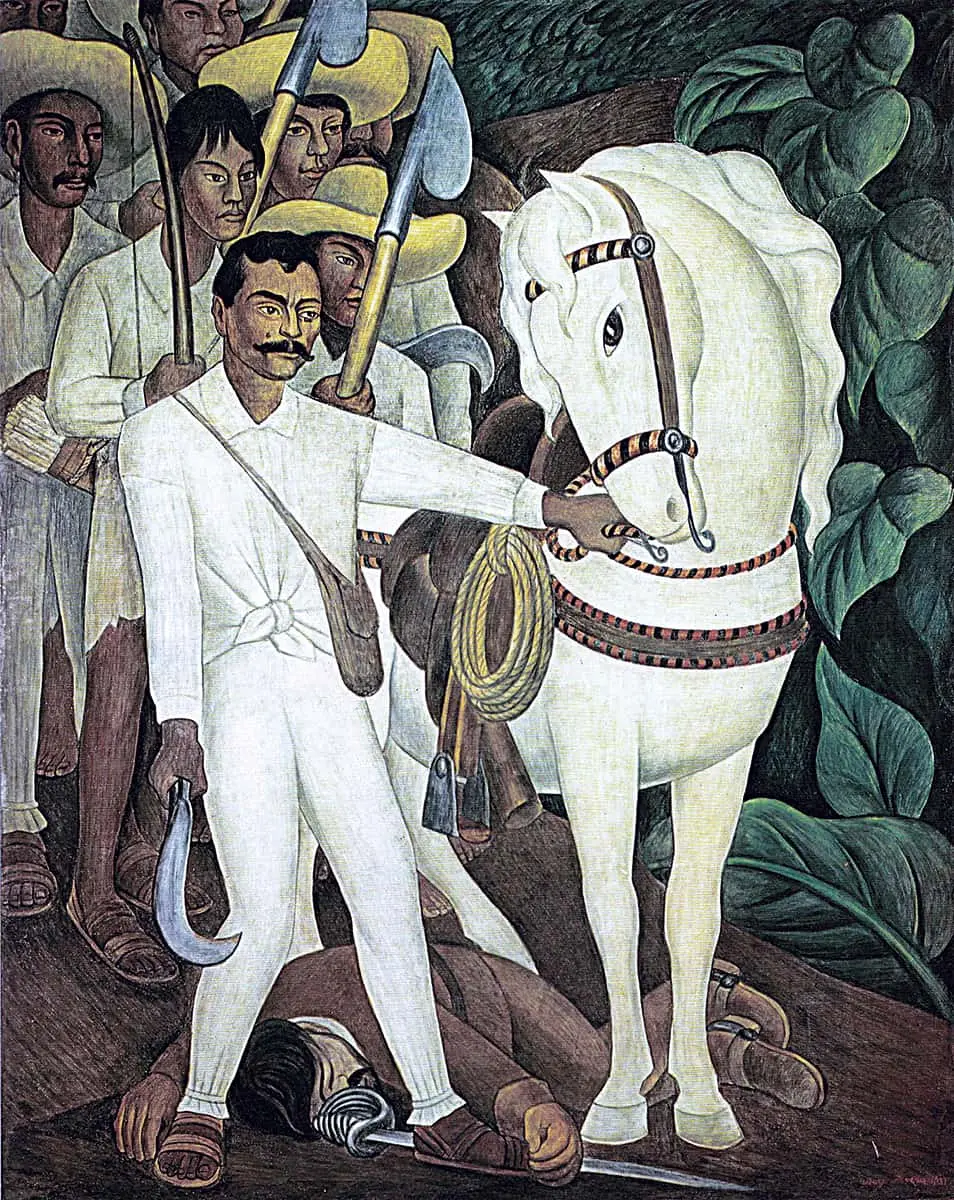
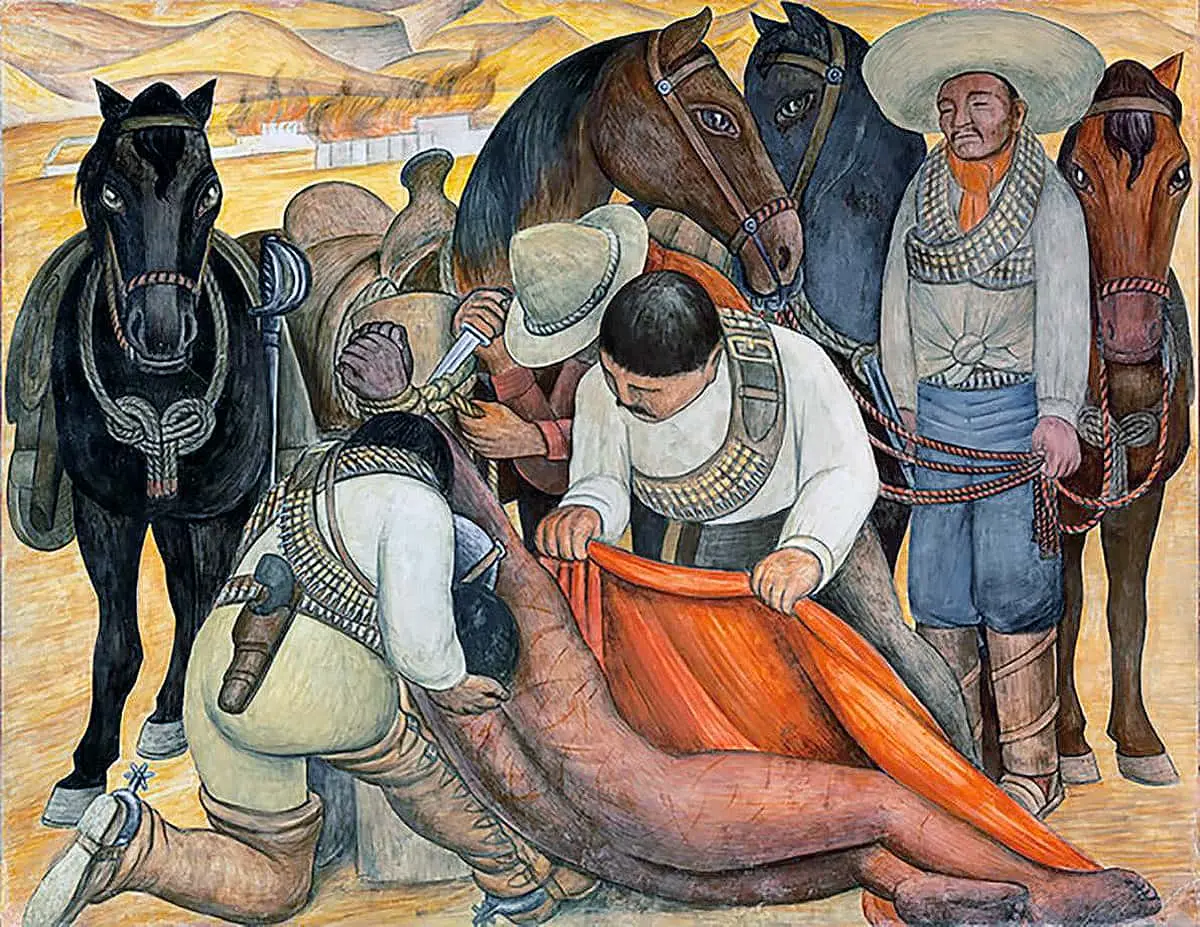
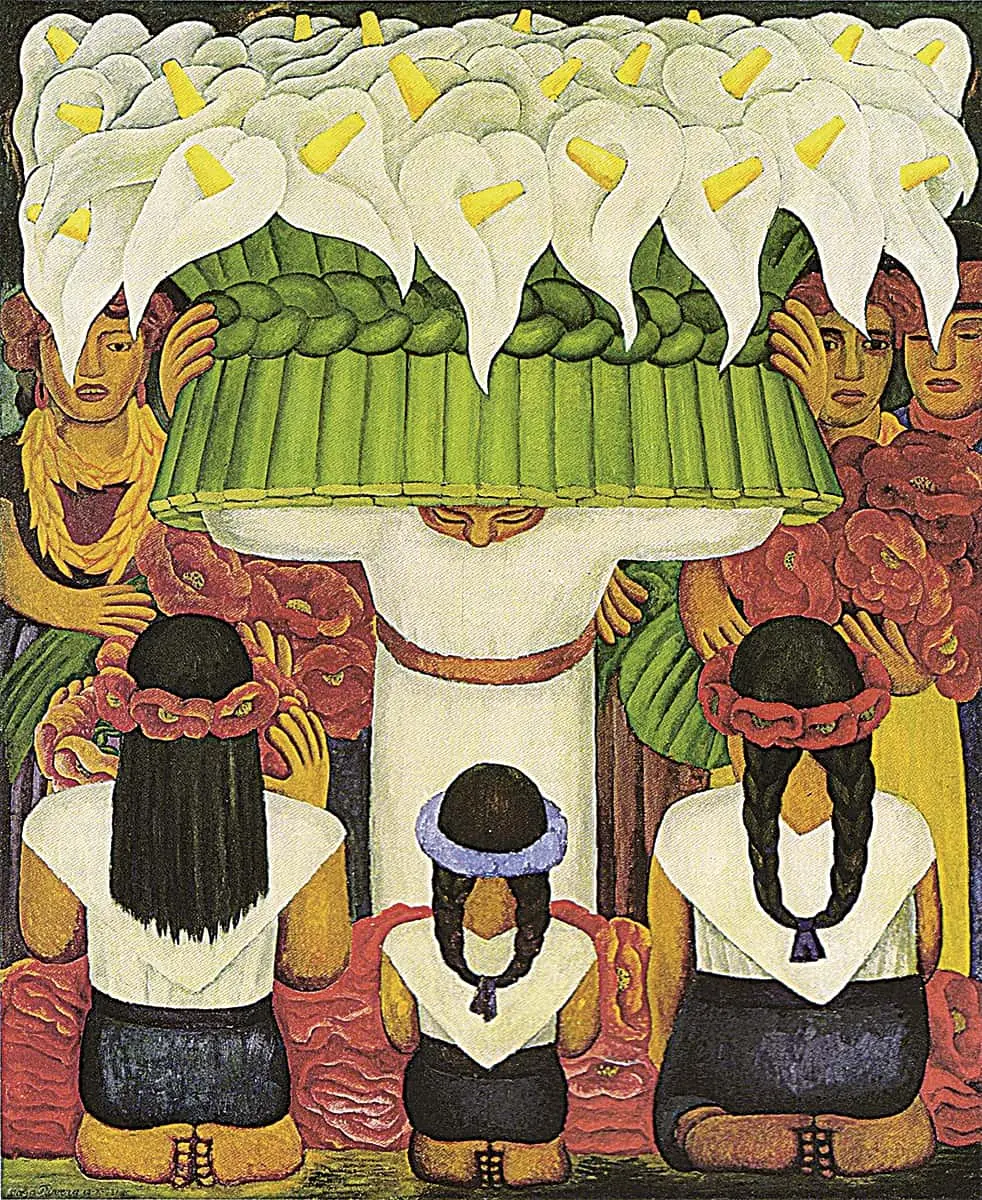
Given the circumstances, the interpretations made of the works on exhibit, particularly of the so-called portable murals—fragments, reproduced by Rivera himself, of his famous frescoes at the Department of Public Education and Cortés’ Palace—should not come as a surprise. Interestingly, although the selected segments denounced the exploitation of the indigenous workforce during Colonial times and the government of Porfirio Díaz, the New York critics focused on their formal achievement, as they noticed the exquisite way that Rivera had represented the horses in the scene. In the same vein, critics praised Country-side Leader, Zapata for the character’s elegant poise and the “majesty” of his white horse, without noting his role as a champion of the Mexican poor. Ecstatic critics praised the visual rhythm of the peasants working the cane fields in Sugar Cane, a work that alluded to the workers’ subjugation in sugar plantations.
Such de-politicization of Rivera was also on display in the show’s catalog, which included a text by Frances Flynn Paine and a comment by Jere Abbot, then the Museum’s assistant director. In her essay, Paine emphasized the romantic aspects of Rivera’s life and asserted that his “vertebral column” was “painting, not politics.”2 In turn, Jere Abbot attempted to legitimize Rivera’s work by highlighting its connection to the best of Western artistic traditions, both classical and modern, and concluding that “not since the Renaissance” had an artist reached “Diego’s mastery of fresco painting.”3
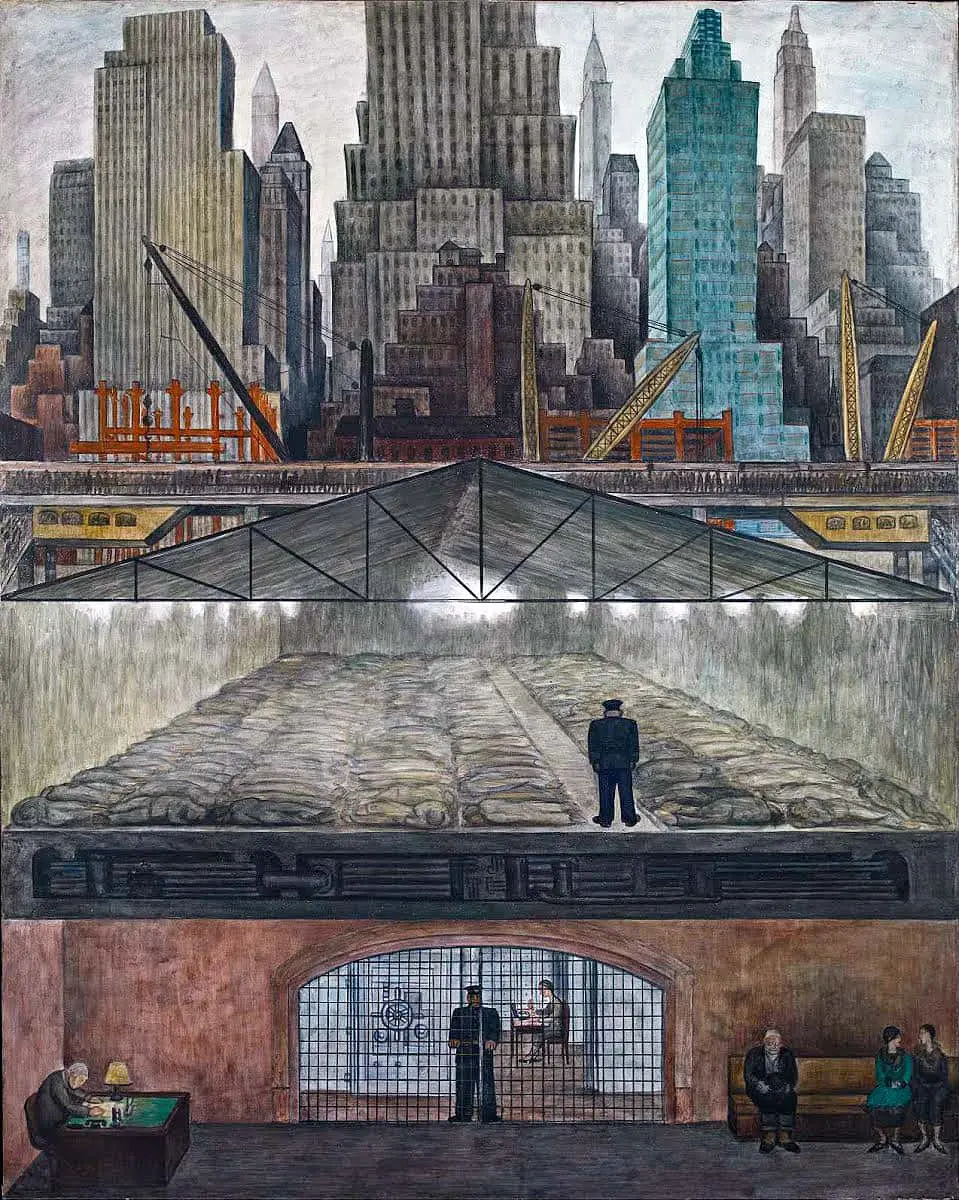
While Rivera didn’t object to any of these characterizations, he did demonstrate that politics remained important for him. This was expressed in Frozen Assets (1932), a portable fresco in which Depression-era New York was presented as a cold and dark place erected on the inert bodies of the poor and the homeless. The political message was so evident that when the work was included in the exhibition, protests were sparked. The press pointed out that, as a foreigner, Rivera had no right to comment on U.S. domestic problems. And there were those who accused him of being an opportunistic communist who was betraying and insulting his benefactors.
Frozen Assets was also criticized from a formal point of view since its gray and brown hues were not what Mexican art was supposed to be. In the words of The New York Times’ Edward Alden Jewell, “the eloquence of color that, always allied to form, made Mexican stories so moving and attractive to the eye” was nowhere to be found in this work.4 Comments like this only confirmed the stereotypes regarding Mexican art that dominated New York in the 1930s.
The public was undoubtedly in tune with this romantic and primitivist approach, which is one reason why the Rivera show broke all attendance records at MoMA. Its 56,575 visitors far surpassed those who saw the Matisse retrospective in 1931.5
Ironically, after several weeks of honors, Rivera fell ill. By mid-January, he was in bed and missed the closing of his show, but even then his room at the Barbizon Hotel continued to attract the attention of the Rockefellers and an assortment of friends and admirers. In early February, a recovered Rivera sold his portable frescoes to the Weyhe Gallery and put up for sale a series of five lithographs, four of them based on details of the frescoes at the Department of Public Education and the other the Zapata portrait at Cortés’ Palace.
Rivera’s unqualified success had an impact on the New York scene. The most visible effect was a growing interest from younger artists in mural painting; this explains how MoMA came to organize, that same year, a show of American mural painting.6 The interest was also reflected in the offer of mural-painting classes in art schools and universities.7
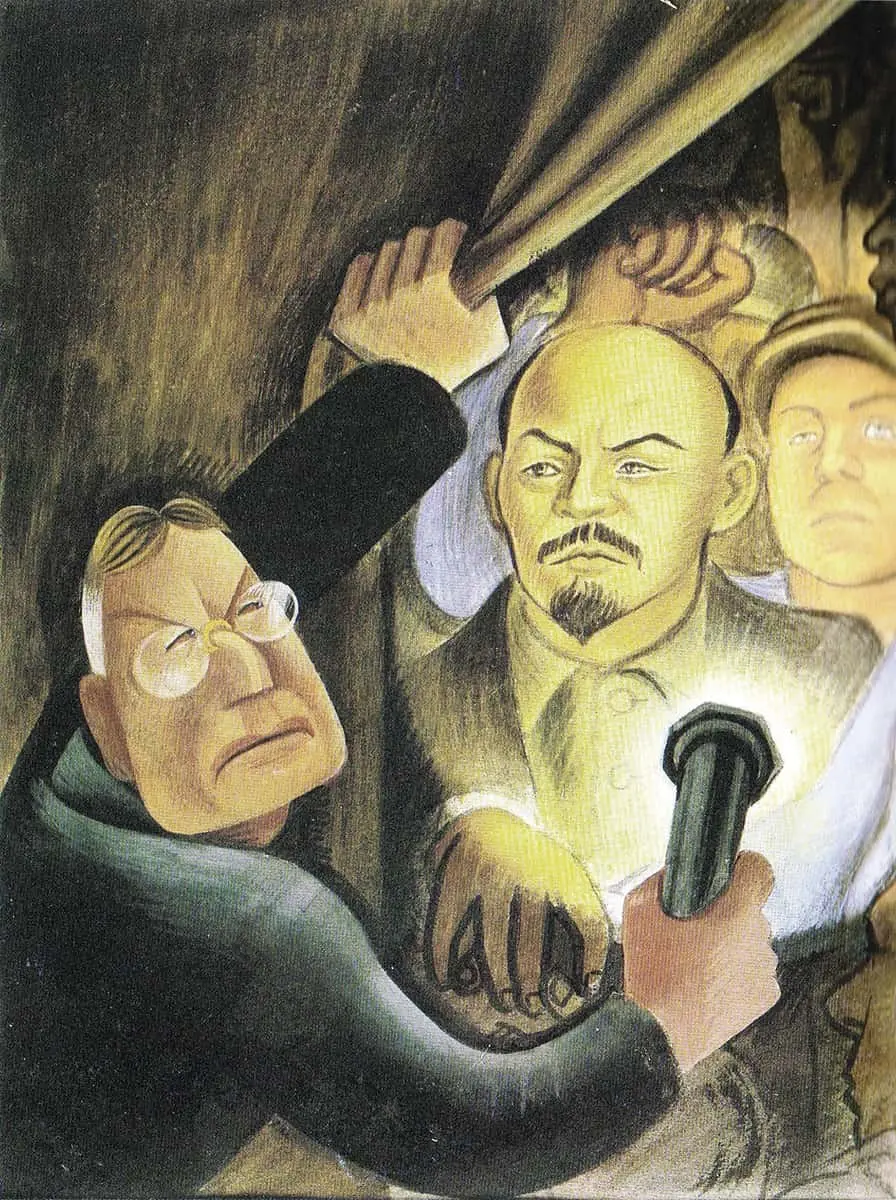
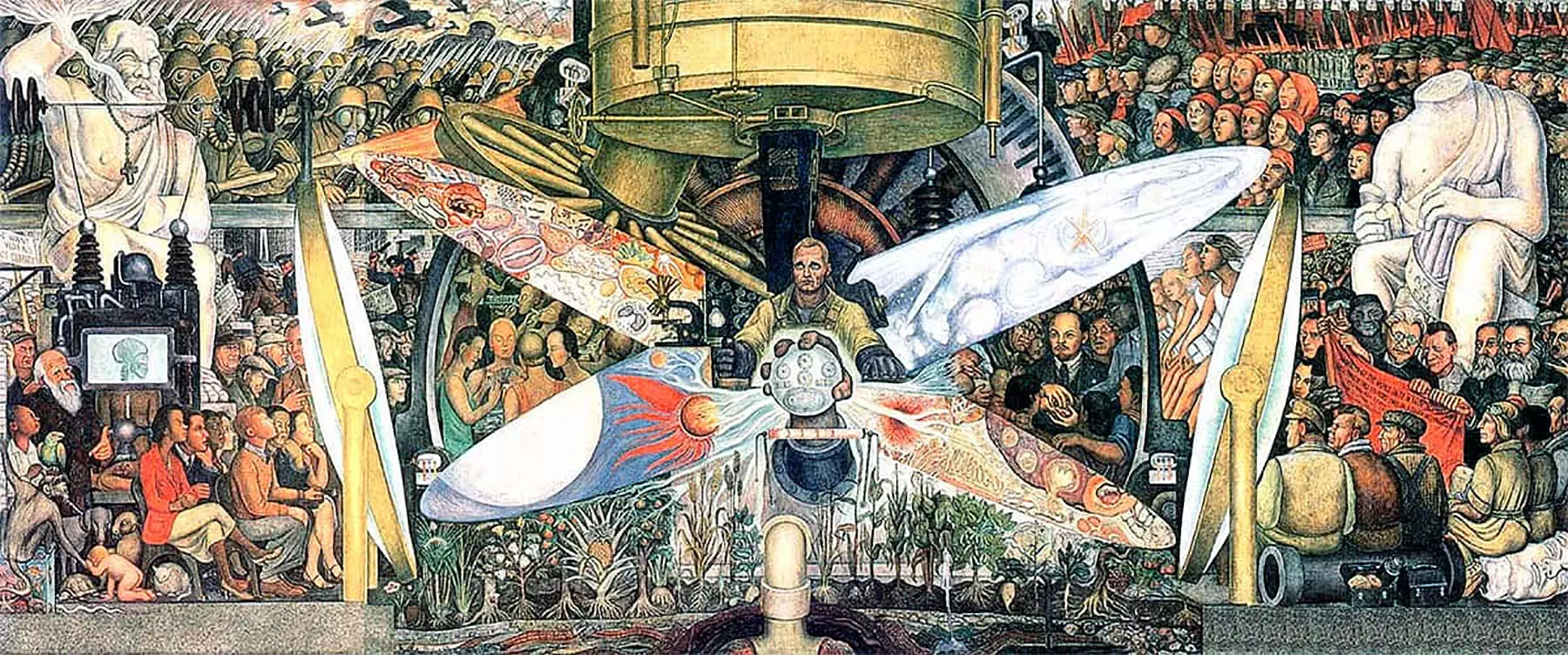
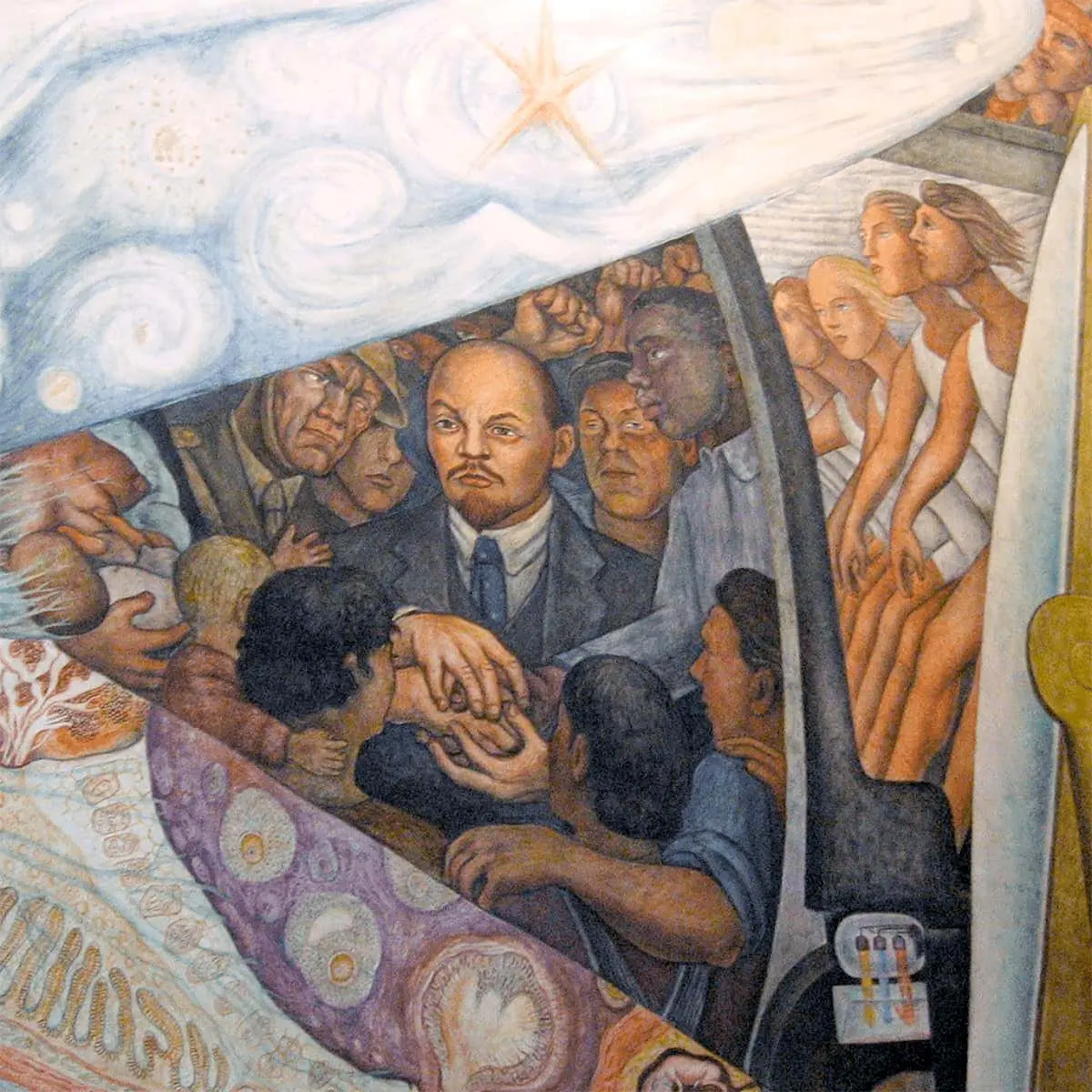
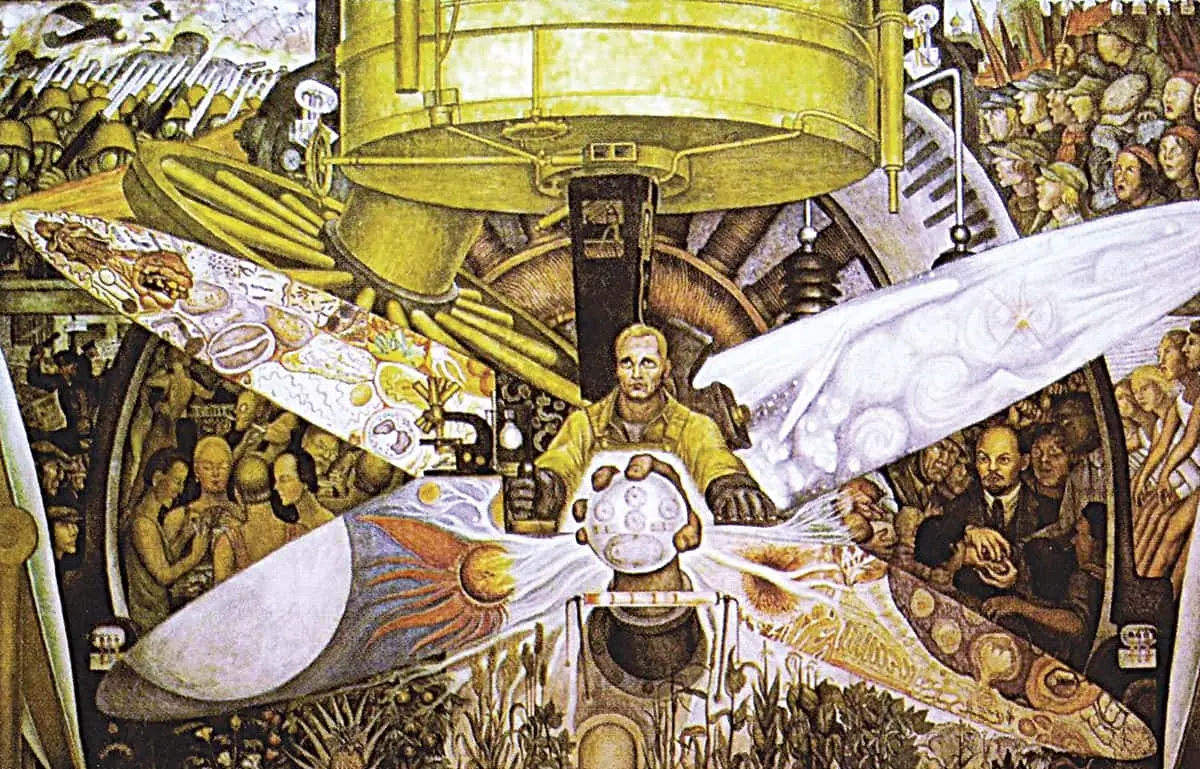
Prompted by the success of the show, the Rockefellers invited Rivera to paint the mural that was to decorate the lobby of the RCA building (the main structure in Rockefeller Center). Rivera, in turn, interpreted this commission as an opportunity to leave the Mexicanist margins behind and to create a work of art with broader horizons and radical content. Thus, in Man at the Crossroads (1933), Rivera represented contemporary Man as confronted with the dilemma of having to choose between an unjust, decadent life under Capitalism—threatened, moreover, by Fascism—and solidarity, health, and harmony of life under Socialism. Rivera’s proposed answer to this dilemma was obvious; his addition of a portrait of Lenin to the composition was just the icing on a Marxist cake. Such a mural was counterproductive for the Rockefellers; the project was canceled in May of 1933, despite being near completion.
Since the public controversy provoked by the cancellation was bad publicity for a business building like the RCA, the removal—that is, the destruction—of the fresco seemed the only alternative. This decision, carried out in February of 1934, solved the business issue but worsened the artistic and political controversy. Rivera and scores of American and Mexican artists denounced it as “cultural vandalism,” while the press—led by The New York Times—accused Rivera of having provoked the situation by trying to impose on New York his grandiose views of Mexicanness, especially of the Revolution; for that reason alone, the newspaper ventured, patronage of Mexican muralismo needed to stop.8
And, indeed, the Rivera affair had a negative impact on Mexican art in New York: after 1933, commissions dried up. Nevertheless, Mexican muralismo continued to influence American artists intent on expressing their social concerns, as can be seen in the public murals sponsored throughout the decade by the Works Progress Administration’s Federal Art Project.9
To conclude, one could say that the main issue regarding the appreciation of Diego Rivera in the 1930s and his resurgence today is that in both cases the metropolis (New York) attempts to neutralize the cultural and artistic idiosyncrasy of an artist from the periphery. As Edward W. Said has explained, such processes of appropriation function by reframing the peripheral object’s cultural, aesthetic, and historical values, and its traditions and narratives, in accordance with the interests and beliefs of the metropolitan centers.10
NOTES
1. Frances Flynn Paine in a letter to Abby Aldrich Rockefeller, August 13, 1930. Cited in Bernice Kert, Abby Aldrich Rockefeller: The Woman in the Family (New York: Random House, 1993), 348.
2. Frances Flynn Paine, “The Work of Diego Rivera,” in Diego Rivera, exhibition catalog (New York: Museum of Modern Art, 1931), 9–35.
3. Jere Abbott, “Notes on the Style of Diego Rivera,” ibid., 37–39.
4. Edward Alden Jewell, “Brisk Activity Succeeds Holidays,” The New York Times, January 10, 1932.
5. Art Digest, February 15, 1932.
6. Murals by American Painters and Photographers, exhibition catalog (New York: Museum of Modern Art, 1932).
7. “Mural Painting,” Art News, October 14, 1933.
8. See Editorials, “Mural Painting,” The New York Times, February 18, 1934.
9. On Rivera’s influence after the Rockefeller Center incident, see Francis V. O’Connor, “The Influence of Diego Rivera on the Art of the U.S. During the 1930s and After,” in Diego Rivera: A Retrospective (New York: Founders Society; Detroit Institute of Arts; Norton, 1986), 157–83.
10. Edward W. Said, Orientalism, New York, Pantheon Books, 1978; on the de-contextualization and aestheticization of works from the periphery, view James Clifford, The Predicament of Culture. Twentieth-Century Ethnography, Literature, and Art, Cambridge, Mass., Harvard University Press, 1988.
ALEJANDRO UGALDE
Ph.D. in History from Columbia University. His most recent work has focused on the study of artistic diplomacy and cultural exchanges between Mexico and the U.S. during the twentieth century.