
Words seem feeble, sometimes desperate, against the impact of Emilio Perez’s orchestrated visual maelstroms. His swirling biomorphic forms result from some kind of syncopation between Baroque ceiling paintings and crazed animé: Peter Paul Rubens joins the Wachowski brothers. Call me old-fashioned, but I love it when visuality trumps words, daring art reviews to go beyond the adjunct position of mere description. And with these works, there is plenty to describe.
The abstract forms and multi-leveled dynamics in these paintings come from many sources with Perez’s process as the crux. Wooden panels are painted with black acrylic and then covered by multi-colored and multi-directional strokes of latex paint. Perez then meticulously cuts away the overlaid latex gestures to not simply reveal the acrylic underneath but also to design its use. The skill supports Perez’s claim to a woodcutting influence as the crisp black edges that surround each colored latex stroke shifts the personal expression inherent in an abstract gesture to the more removed realm of graphic art. Pop art, and Lichtenstein in particular may have been an influence, but Perez pushes the contradiction of cool removal and heated presence into a different realm.
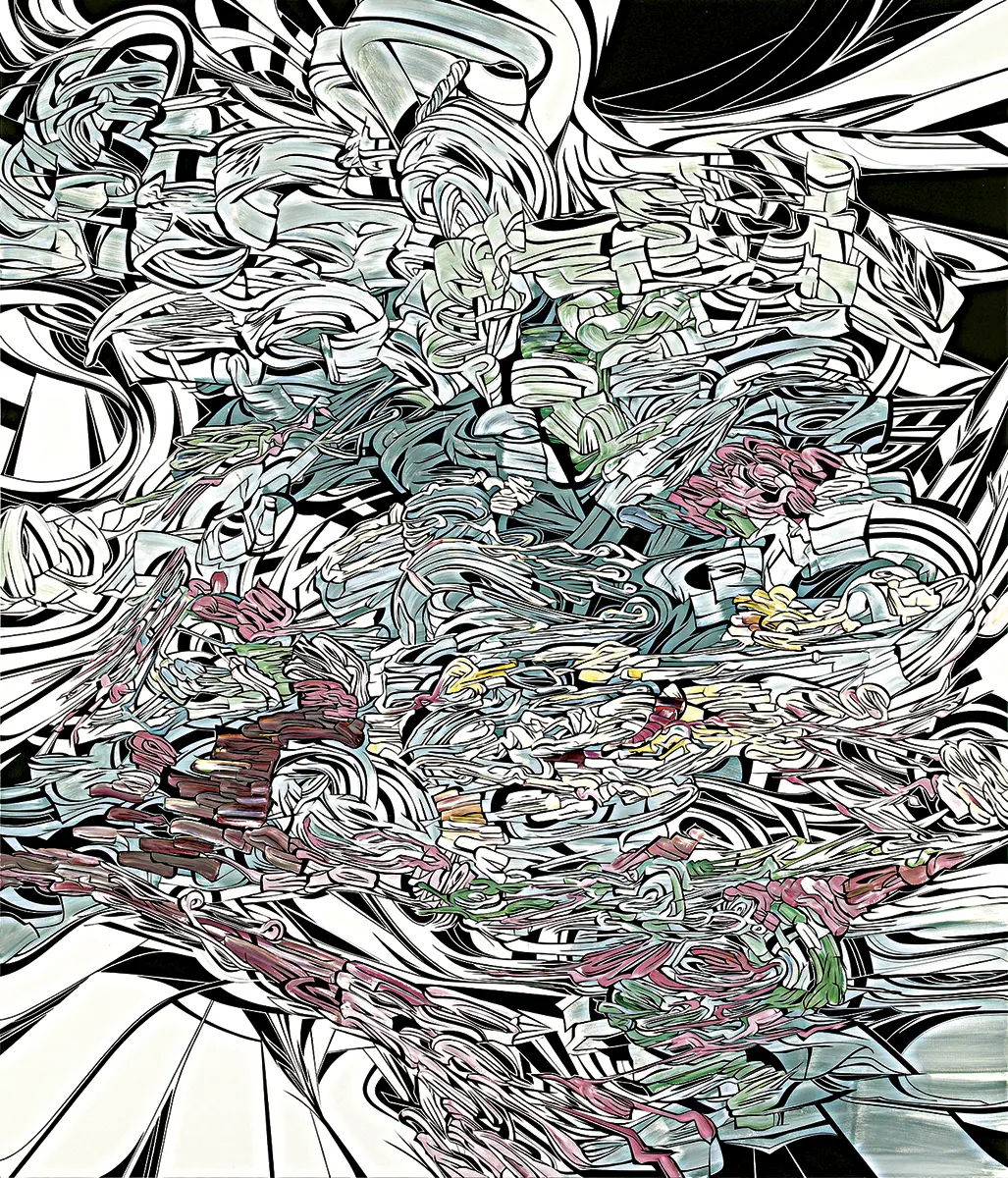
The orchestration comes in various ways. Sometimes the black enforces the direction of the layered strokes, and at other times it serves as a counterpoint. Perez sets contrasts against stark blacks and whites at the edges and moves them into the colored monotone compositions to give the painted panels the feel of a snapshot of a coexistent reality, some inferno raging just out of visual range but constantly articulated. Colored latex is grouped into sections of variable widths to alter the scales of emerging, energetic forms and create tornado-like vortices of illusionist space.
Perez’s process also merges concepts of figure-ground and questions traditional relationships between abstraction and figuration, line and paint, figure and form, optical surface and depth. But what does it mean? Perhaps “what” is not the issue? The titles frequently refer to time—All we have is now and The time of your own—and use verbs of action: fishing, drowning, heading, doin’. Both concepts have their correlation in the general, but not the specific, experience of the works. Can we say more, and where do we turn?
To those in despair over the tone of the current times, perhaps Perez’s work is an analog for our national disorder of “irrational exuberance” that has characterized thinking in foreign relations and the financial markets. More extremely, the work can be read as illustrating destructive cataclysm or dystopia. There is plenty of despair embodied in the arts today, along with a sense of dislocated transience. To those happier with life, the visceral experience of Perez is sufficient: the return of beauty, or synesthesia, perhaps? Young painters today explore old concepts like creativity and originality, albeit in their own terms, through a media-saturated culture. There remains much to say about such relationships because Perez references popular culture and so many older critics miss the point of what it means to be contemporary. But I’d like to open, briefly, a different reading.
What I see here and in much young art today is an attempt to mine the past not simply in new terms but as a turn to a kind of semiotics of social intelligence; not “what” but “how” the world takes meaning. It’s not the unique individualism of some existential and heroic creative act but more an improvisation in a complex age that currently disempowers specific articulation. It is a generation displaced to transience through the realization that one person is currently insufficient, but there is a group- or systems-intelligence: the formation of coherence within complex systems. Do the dynamism and carefully constructed chaos in Perez’s work present an emotional intelligence as a metaphor for the new social intelligence we now need for survival?
RICHARD LESLIE