
It may be said that artists and art
historians forge the master keys that open the mysterious locks to our senses,
to which originally only Nature held the key. They are complex locks.2 Enrique Martínez Celaya is an artist who
thrives on such complexities as he explores the media of painting, photography,
and sculpture from the perspective of a scientist, philosopher, poet, and
intellectual. One may also be tempted to describe his search for the answers to
life’s meaning as that of an existentialist, an analytic philosopher seeking
“truth” in human existence through artistic expression and creation. The work
of Martínez Celaya is informed by his intellectualism and by his sensitive
responses to the world around him, especially to nature and family. He studies
with the intensity of a German thinker and makes fine distinctions in his work
using the critical theory that he has mastered as an artist and teacher. These
serious pursuits have even resulted in the establishment of a publishing company
to create texts and guides to assist his students in understanding the primary
sources of theoretical literature.3 A combined commitment to the production of art
and the history of art is what elevates Martínez Celaya’s work above the mere
application or fabrication of materials.
The quiet intensity with which Martínez Celaya approaches the making of art is best understood after learning his biography. Born in Palos, Cuba, in 1964, he first studied art at the age of eleven with an academic painter. In 1972, his family left Cuba for Spain, where they suffered the extraordinary trauma of exile, a dark experience that would never leave him. After another move to Puerto Rico, the young Martínez Celaya quickly demonstrated his precocious talent as a scientist and earned a scholarship to study applied physics and electrical engineering at Cornell University. He then continued his studies with graduate work in quantum electronics at the University of California at Berkeley, where he was supported by a fellowship from the Brookhaven National Laboratory. He also published poetry, built a laser, and received awards from the Department of Energy and the National Congress of Science. He explains his proclivity for science as an escape from the chaos of exile and displacement, as a refuge of precision and order within a world of confusion. Science appealed to him because it was a constant search for truth, the same search that is so evident in his work as an artist. After Martínez Celaya’s years of scientific investigation, however, the artist in him finally emerged when he left the Ph.D. program to pursue a Master of Fine Arts degree and follow his passion. After living for many years in California, where he taught and pursued his career as an artist, he moved with his family to Delray Beach, Florida, and now enjoys quiet village life and a view of the sea. It is impossible to discuss the work of Martínez Celaya without recognizing the dual nature of his genius (what is often referred to as “left brain/right brain” sensibilities) and the effects of his life experiences, from the past to the present.

Martínez Celaya uses the process of creating art to understand these life experiences and their effects on his everyday reality. Often, as he begins to layer paint, tar, photographs, drawings, words, and other materials on the surfaces of his canvases, he is not sure what will evolve, or how. He can work on a painting for months, reworking, adding, scraping, and layering—sometimes destroying and beginning again. Some of his most powerful works involve the application of tar and feathers, materials that imply history and violence. Tar is like blood; both are natural, viscous substances, yet Martínez Celaya gives them new meanings as life substances with dark overtones. He also uses blood as a medium with its own unique characteristics. His faith in the medium and the process results in what he describes as “projects” or “cycles” rather than “series”.
The publication of his most recent book, Martínez Celaya: Early Work, presents an opportunity to focus on some of his latest works (2004–06) within the context of his career (1977–present). The book is divided according to his projects, which have been compiled from his studio archives of photographs, sketches, and reproductions of the works, and they reveal that, for the artist, “The urgency of certain interests and methods always had their moment. The projects follow the rhythms of life, often mapping my inadequacies more than my strengths.”4 In the book, the images are organized in reverse chronology and this decision encapsulates the work ethic of Martínez Celaya, who explains that: [in] conventional chronologies a linear progression is assumed: early activities seem inevitable and almost deterministically to lead to subsequent or later activities that tend to fix the meaning and significance of the past... The organization suggests something else. The past is not causally linked to the present, but is alive, active, and a source of continued reflection and interpretation.5
This is an important statement that suggests an evaluation or discussion of his work from a conceptual rather than linear perspective. Certain subjects appear again and again: the boy, children, the sea, trees, mountains, animals, and birds. However, in each project, they take on new meanings with a wide range of emotions and aesthetic expressions.
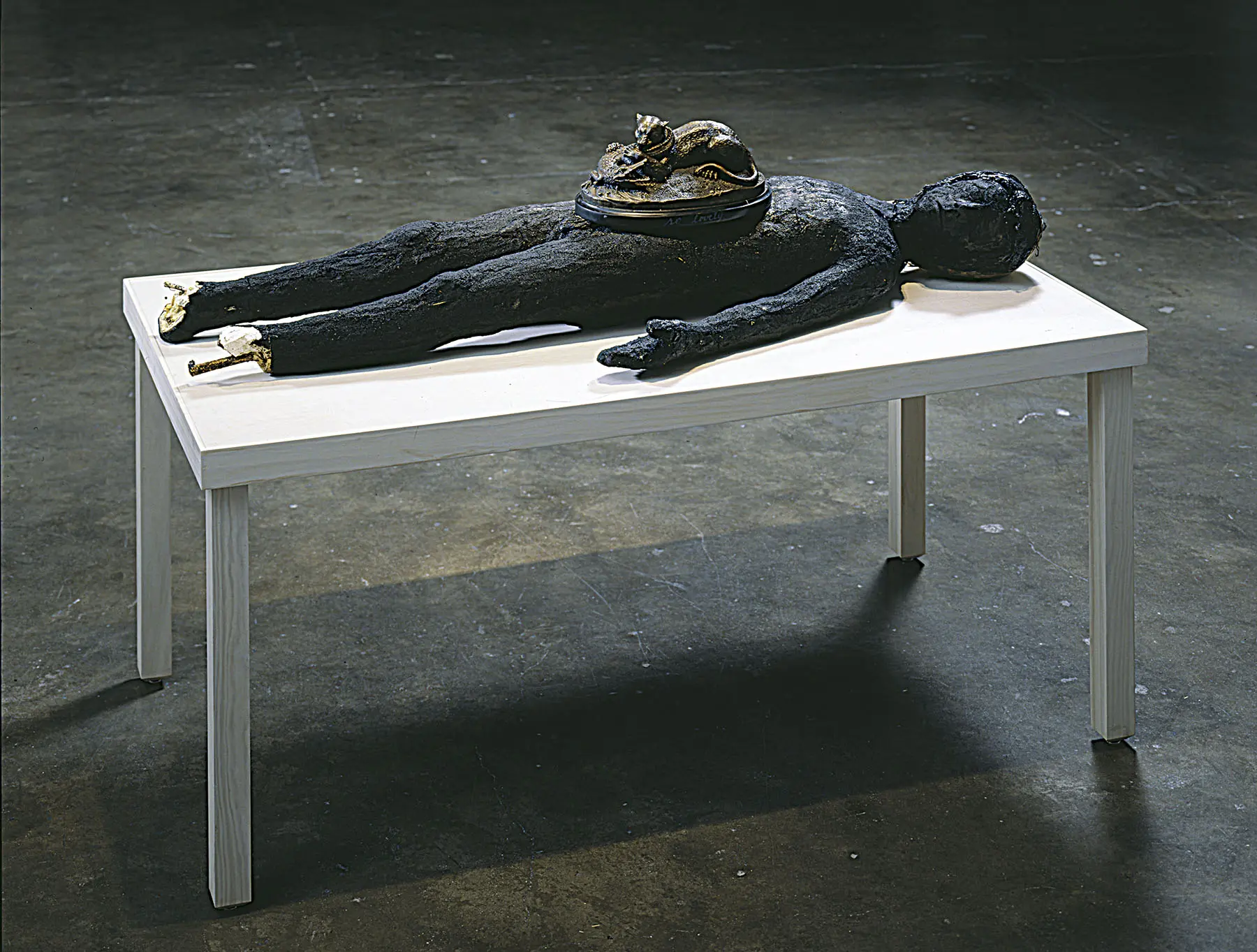
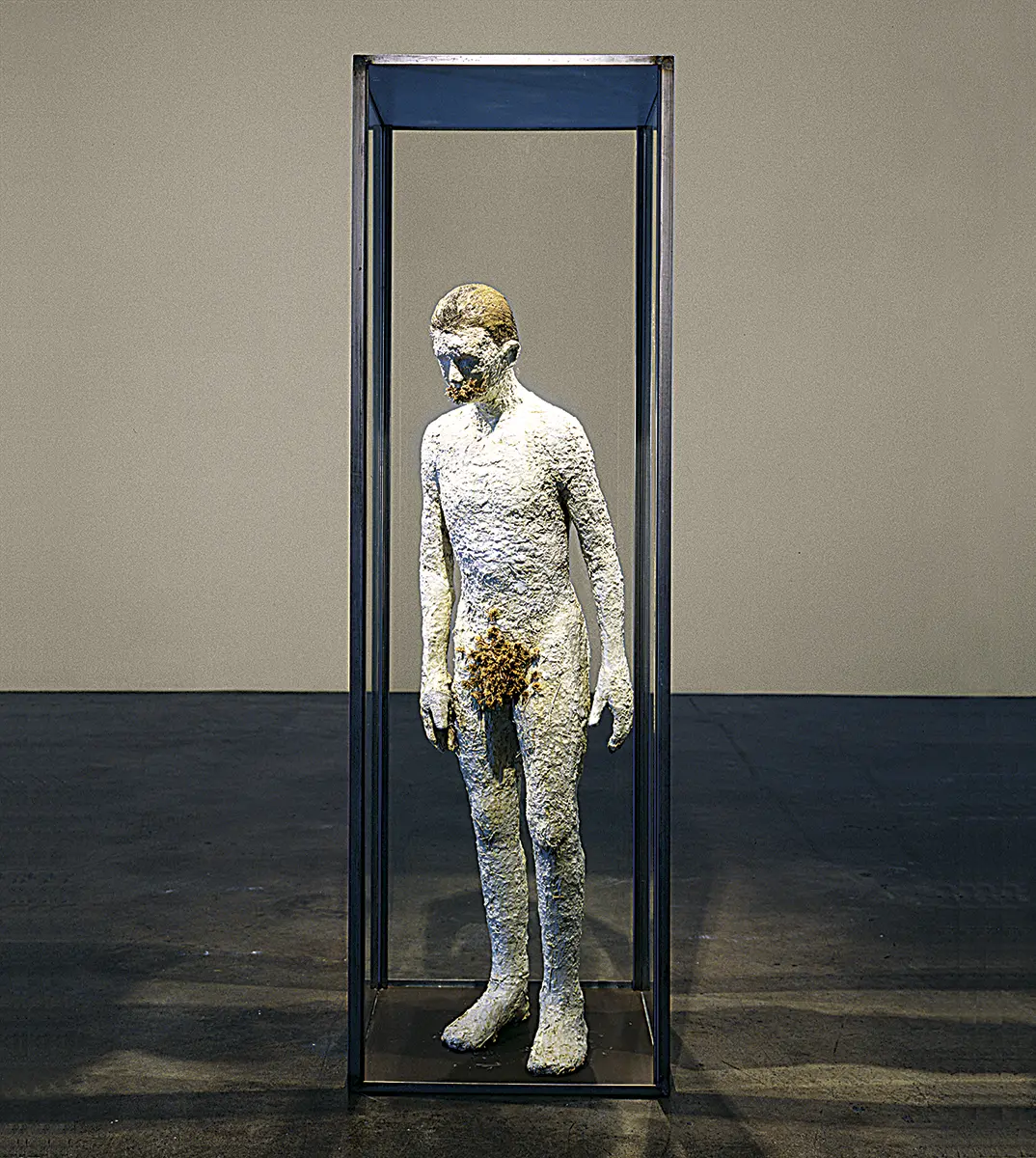
The boy who appears so often in Martínez Celaya’s work may be seen as the artist’s alter ego, a vision of self-exploration. He is a monumental presence as a life-size sculpture made of paint, dirt, tar, straw, steel, glass, and flowers (Boy in Vitrine, 2004); he is a subtle reflection of the child coming of age (Boy Raising His Arms, 2005); and he floats above the ice-blue sea, as rapturous as he is brooding in other works (Boy and Iceberg, 2005). The boy appears often: solitary, in shadow, in photographic reality, in paintings, drawings, and installations. Is he the frightening tar-covered vision in bronze on a marble table in The Leopard (2005), who lies there with a gavial in the process of being devoured by a leopard?
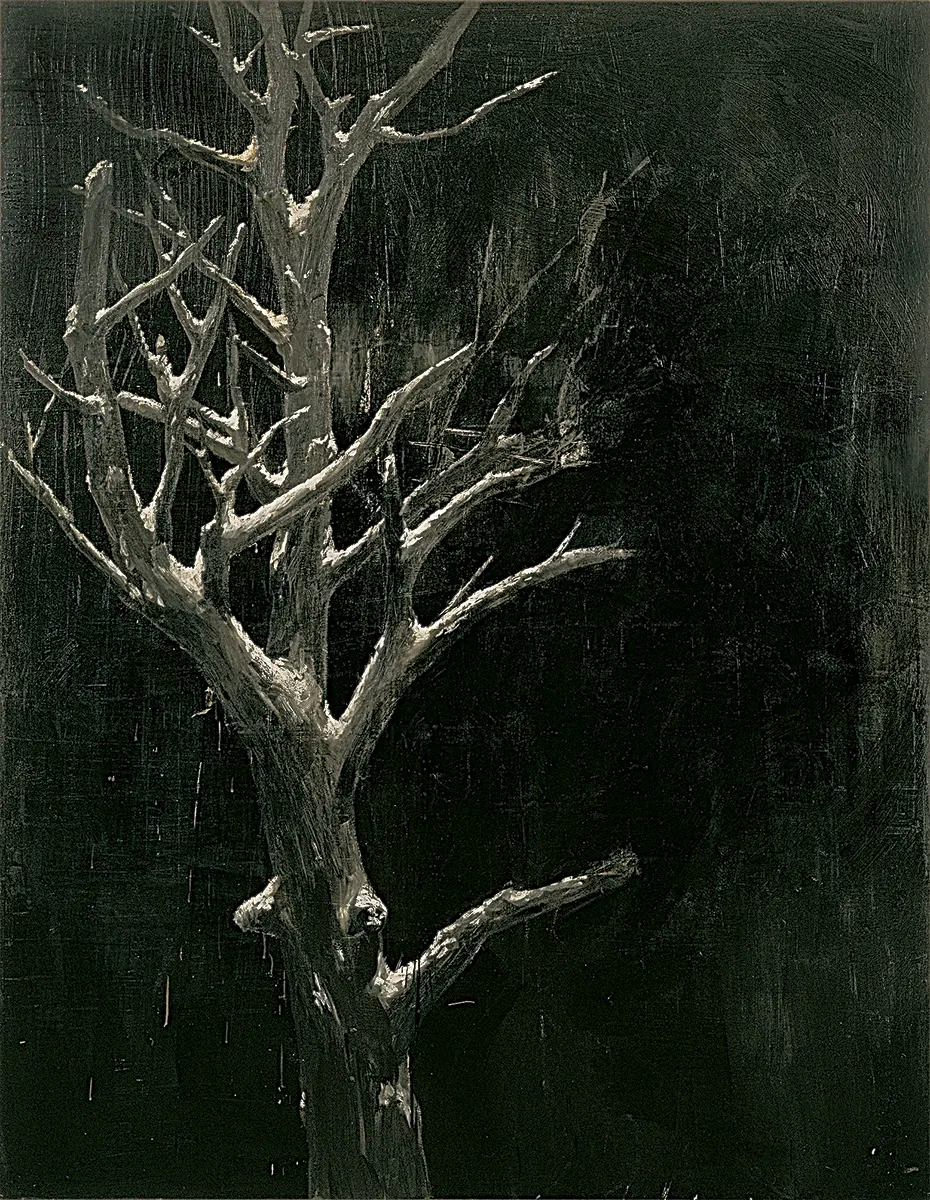
Such dark imagery once earned Martínez Celaya the nickname “Prince of Darkness.”6 His October Cycle (2000–02) with its origins in philosophy, poetry, and complex life experiences, was meant to “function as icons, an aesthetic form that invites contemplation of the transcendent through the immanent.”7 Martínez Celaya describes it as: [an] extended metaphor exploring the relationship between the seasons and the transition in human life. The large paintings are covered with emulsified tar combined with oil paint and solvents to generate a compelling surface with colors ranging from blacks and browns to warm, rich tones of amber and rose. The imagery of trees, figures, and falling snow emerge as notations of experience—and traces.8
What at first may appear as dim and mysterious, as in Man and Sky (2002) and Tree in Snow (2002), upon close examination reveal traces of white and rainbows beneath the surface that speak more of hope than of darkness and evoke a mood of scientific inquiry transformed into an alchemical ritual. Has the scientist/artist now become the artist/scientist? Martínez Celaya is and has always been both; now, he has substituted instruments of precision for the rituals of a shaman. Art is an act of transformation, like science, poetry, photography, and music— each is significant to Martínez Celaya’s aesthetic.
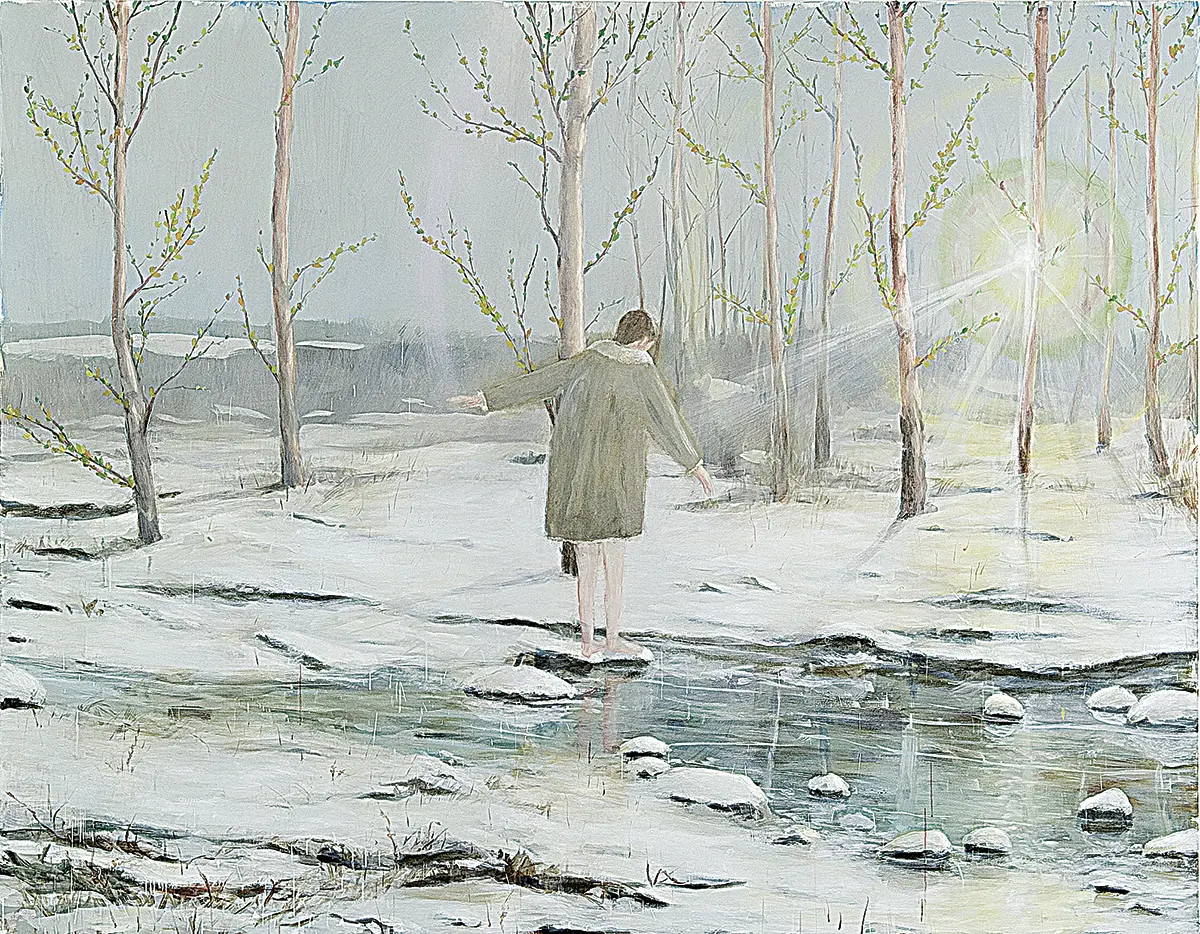
Music is the subject of one of his most provocative projects: Schneebett (2003–04) was inspired by the death of Beethoven and reveals the artist’s fascination with the genius composer. The project involved an intense period of research and work that concluded with exhibitions in Paris, in Aspen, at the Berliner Philharmonie in 2004, and at the Museum der Bildenden Künste Leipzig in 2006, where the work was installed in a bed of snow. The installation of Beethoven’s deathbed at the Philharmonie was based on drawings of the actual bed. It was a refrigerated bronze bed, with its pillow and sheets made of frost; it was placed against a large painting of a snow-filled birch forest, and the horizon line was meant to symbolize the view from the composer’s room and the transition from life to death.9 Dead birch branches from the nearby Berlin Tiergarten completed the effect of a cold, contemplative environment. The cold climate of Nordic places, which has appeared in Martínez Celaya’s images of romantic mountain landscapes and floating icebergs, was brought inside: death is winter.
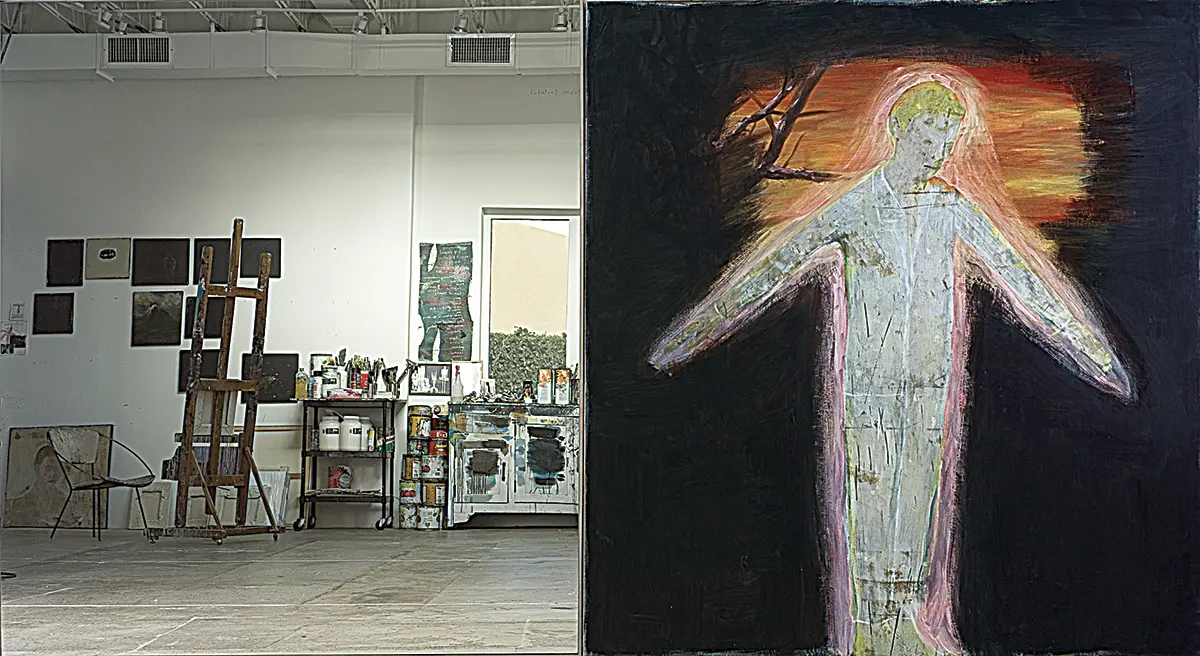
In Florida, there is no winter, and the past few years have forced a change of mood in Martínez Celaya: a lighter palette interrupts the brooding tar paintings that continue to be part of his oeuvre. Two projects, The Atlantic (2004–05) and Shore: “Is Today Yesterday?” (2004–05),10 are the first to be presented in his new book, according to his reverse chronology, and may be seen not only as a new direction for the future but also as a summation of the past. Shore was inspired by a question asked by Martínez Celaya’s three-year-old daughter and by the transitory experience embodied in a camphor tree that he saw one day as he biked along the shore road. A visual commentary on the illusion of permanence, the project is “an environment of works in which children and the landscape articulate concerns of identity, displacement, and mortality.” His children play a significant role in his life and his work. However, they are never simply objects of the artistic invention or fatherly pride but important participants in his creative process. In Shore, the minimal work has a quiet intensity that marks Martínez Celaya’s aesthetic of absence. Figures emerge from beyond a ghostly presence to become phantoms integrated into new environments, with the sand and sea. Boy in Sunset (2005) is a large diptych with a mirror. A boy, with arms outstretched, stands against a dark background created from oil and tar; the glow of a sunset forms a halo. He is about to fly and appears like a mythical figure surveying his territory. A mirror disrupts the space, forcing the image into an ordinary space, a studio or gallery, and breaks the reverie.
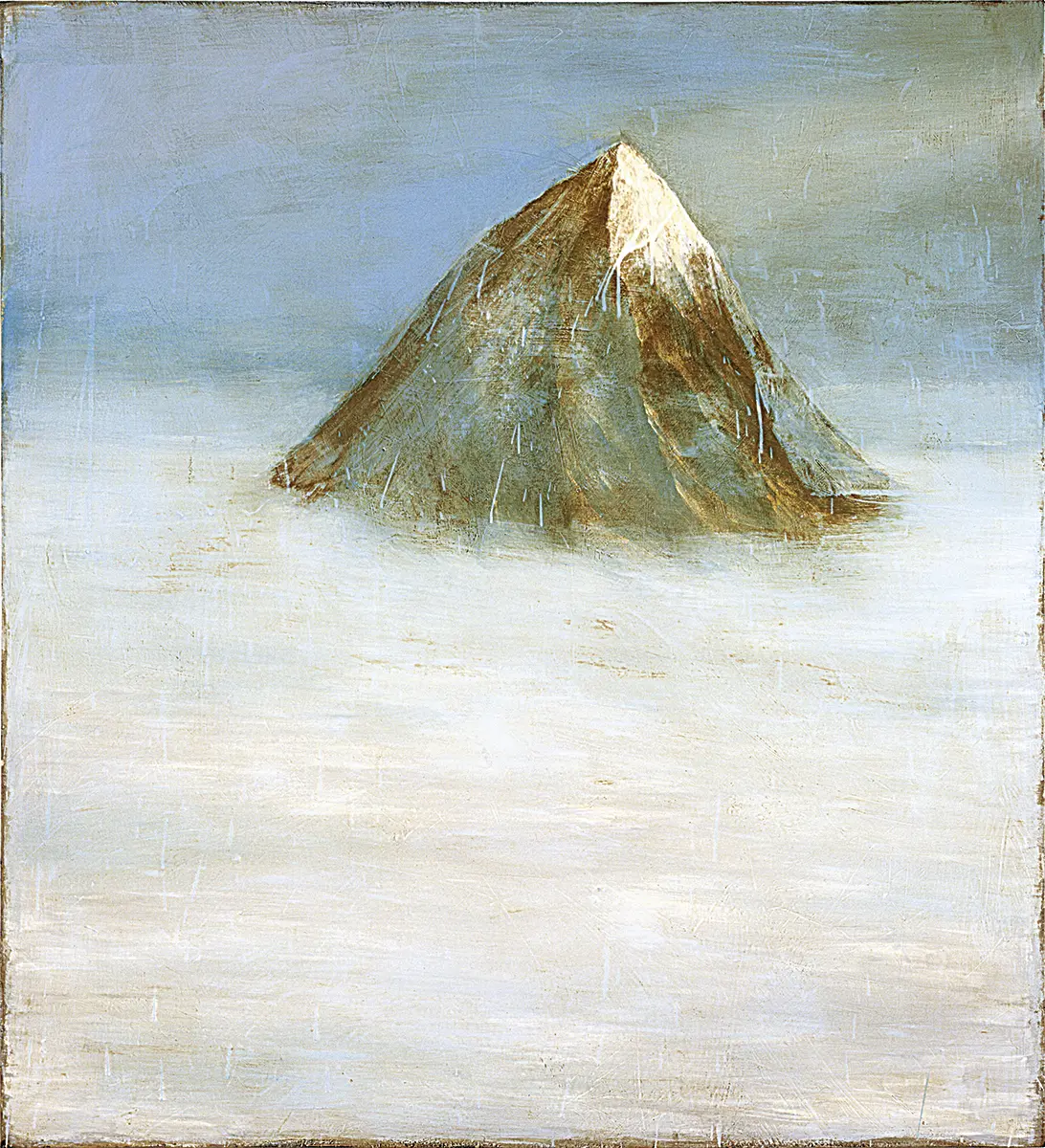
In The Atlantic (2005), Martínez Celaya reveals his relationship with the tropical landscape of Florida, its blue sky and seas, and exotic trees that thrive in the warm moist air. He describes the smell of the place as “a complex Southern mixture of death and melancholia that some around here call excitement.” The haunting presence of a small boy appears often in this project. In Boy Against the Horizon (2005), a life-size figure made with ink on canvas, the photographic quality of the figure is a counterpoint to the painterly background of the sea. This figure appears again in The Water (2005), an elegant abstraction of the sea and human form. The juxtapositions of time and space and disparate media lead to a different perception of Martínez Celaya’s ideas, which he uses to create a total concept.
A huge diptych, No Title (2006), commissioned for the exhibition The Missing Peace: Artists Consider the Dalai Lama, dominated Martínez Celaya’s studio in recent months. Besides the large painting, a mirror of equal size reflects the viewer and his/her space as much as it serves as a dislocating element that visually invades the wall and space itself. The image of a storm dissolves, with lightning as a metaphor for conscience. It is streaked with a substance that turns out to be blood, which expresses the temporal, yet there is a strangely sublime and calming effect as Nature shows her power. It is not a violent image but rather an oasis of calm and peace amidst the drama of nature.
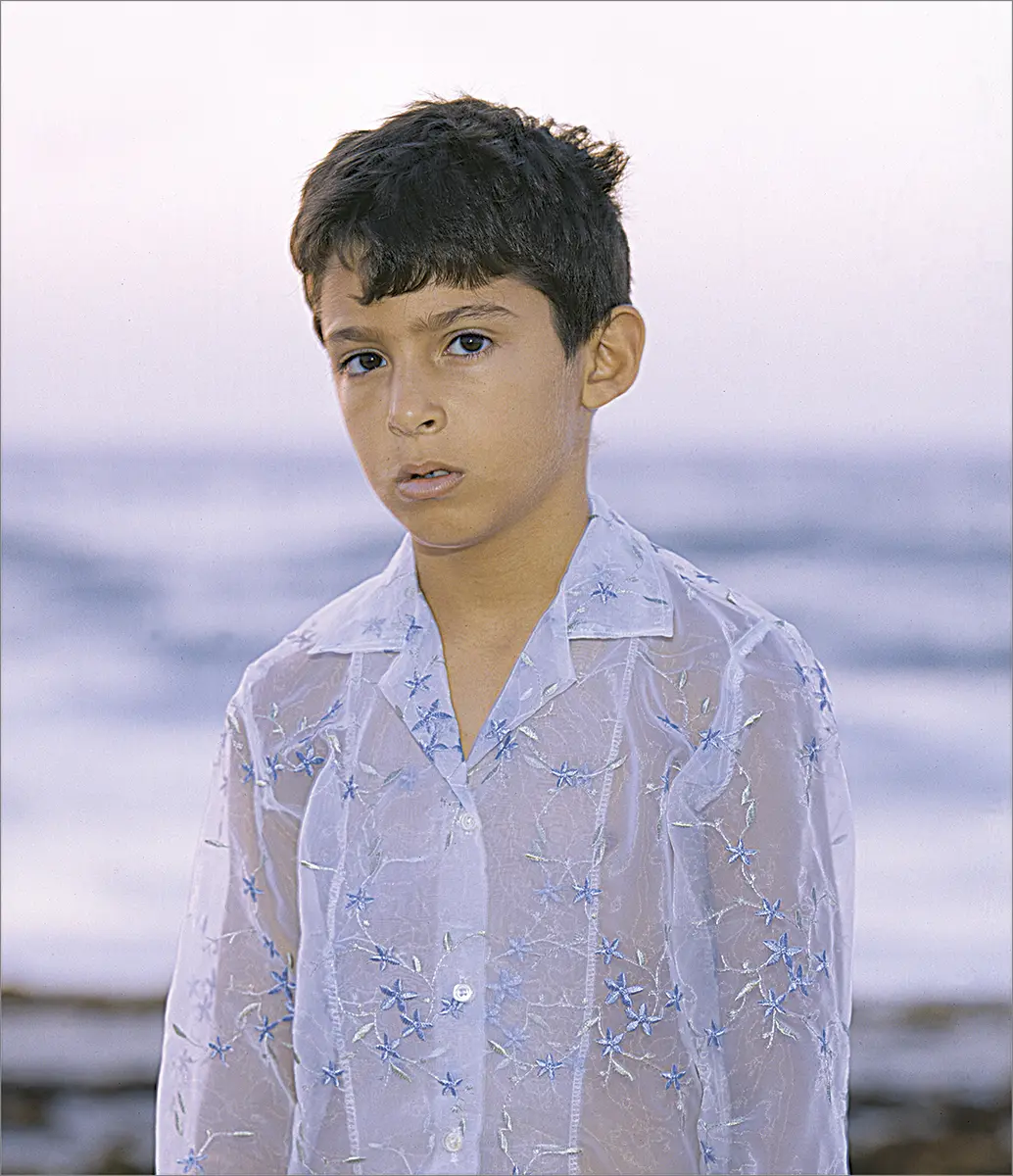
While he was preparing for exhibitions and residencies in Europe, Japan, and the United States, Martínez Celaya embarked on another project based on the work of the Russian poet Osip Mandelshtam for the Sara Meltzer Gallery in New York City (May–June 2007). The exhibition’s title, Awaiting a Second Plan, simultaneously confessed failure and hope. This hope was of interest to Martínez Celaya as he explored the philosophical and the poetic through memorializing Mandelshtam’s wife as the metaphor for solitude in The Two Worlds (2006).
Inspired by the cycles of nature, the works of Enrique Martínez Celaya follow the rhythms of life as sensual references to the illusions of the real and the imaginary. They proclaim the right of art to soar and to invade the territory of the intellect and the scientific with a material literalness that ranges from the luminous and ephemeral to the depths of the obscure.11 I am grateful to Enrique Martínez Celaya for the opportunity to interview him at his studio and to preview his new book and work in progress.
NOTES
1. Aristotle, Politics, 1340A, in E. H. Gombrich, Art, and Illusion (Princeton: Princeton University Press, Bollingen series, 1956), 359.
2. E. H. Gombrich, Art and Illusion (Princeton: Princeton University Press, Bollingen series, 1956), 359.
3. Enrique Martínez Celaya, Guide (Los Angeles: Whale and Star, 2002), and Sketches of Landscapes (Readings on the Philosophy of Art) (Los Angeles: Whale and Star, 2002). Whale and Star Press is the artist’s publishing company.
4. Enrique Martínez Celaya, in Martinez Celaya: Early Work (Delray Beach, FL: Whale and Star, 2006), 11.
5. Daniel A. Siedell, in Martínez Celaya: Early Work, 5.
6. Elisa Turner, “The Prince of Darkness,” Miami Herald, March 7, 2004, 3M and 5M.
7. Daniel A. Siedell, Enrique Martínez Celaya: The October Cycle, 2000–2002 (Lincoln: University of Nebraska, 2003), 21. Catalog for an exhibition at Sheldon Memorial Art Gallery and Sculpture Garden. The exhibition, curated by Daniel A. Siedell, traveled to the Museum of Art, Fort Lauderdale, in 2004.
8. Siedell, artist’s comments, 82.
9. Schneebett: An Installation in the Green Room at the Berliner Philharmonic, Berlin, 2004–05. Comments by the artist, New Work, 104.
10. Shore: “Is Today Yesterday?” has been exhibited as Part I in Berlin and Part II and Santa Monica, California, in 2005.
11. Collection of the Sammlung Rosenkranz, Berlin, Germany.
CAROL DAMIAN
Art History Professor. School of Art and Art History, FIU.