
A
fascination with the desert landscape of the Peruvian coast has inspired the
visual investigations of many notable artists, for whom the Andes is not the
only national geographic referent. Thus, we have seen Reynaldo Luza’s
landscapes, Jorge Eduardo Eielson’s knots and installations, Fernando de
Szyszlo’s abstractions, and, more recently, Ricardo Wiesse’s register of a
historical and natural patrimony unified by the textures of the sand expanses
and the cultures developed there. The work of Esther Vainstein belongs to this
artistic lineage.
In Ofrendas de barro y viento: cadencia y variaciones 2007, Vainstein gathered representative works of her twenty-seven-year career for a show conceived as a largena-scale installation adjusted to a particular gallery space. The show, curated by Jorge Villacorta and Paulo Dam, encompassed several visual languages: drawing, installation, painting, and video projection; some of the works were recent versions of previous pieces, as was the case with some installations (Biombo de zafiro, for example). As Villacorta put it, “This is not an anthology show in the strictest sense, because it does not review a career by looking at the past. On the contrary, it celebrates the present already from its articulation as a single large installation.” The diversity of expressive media was unified as the artist’s work has a persistently coherent theme. That is, the radical austerity of Peru’s coastal landscape became an inexhaustible source of aesthetic possibilities for Vainstein. Eielson already noticed the paradox: for his 1977 show Paisaje infinito, he wrote, “I always thought that such a geography could never have generated any optical enthusiasm, any effusive mood, and, in consequence, any visual thought.”
To this austerity was added Vainstein’s will to experiment, validated both by the rigor of her material solutions and her distance from any formal mannerism or any subordination to the cultural discourse. For example, Paracas II (1983, drawing on paper, 1.2 x 17.9 meters), which was exhibited at the 17th São Paulo Biennial, constituted a record of the landscape’s overwhelming immensity with a subtle intervention on a surface of heroic format. In other cases, as in Paracas IV (1985), the different media were brought together: the abstract representation of the desert and the physical presence of its essential texture, sand, resulting in a drawing-installation in which the fixed the two-dimensional format was set in relation to the random and transitory nature of the triangular “little desert” on the floor.
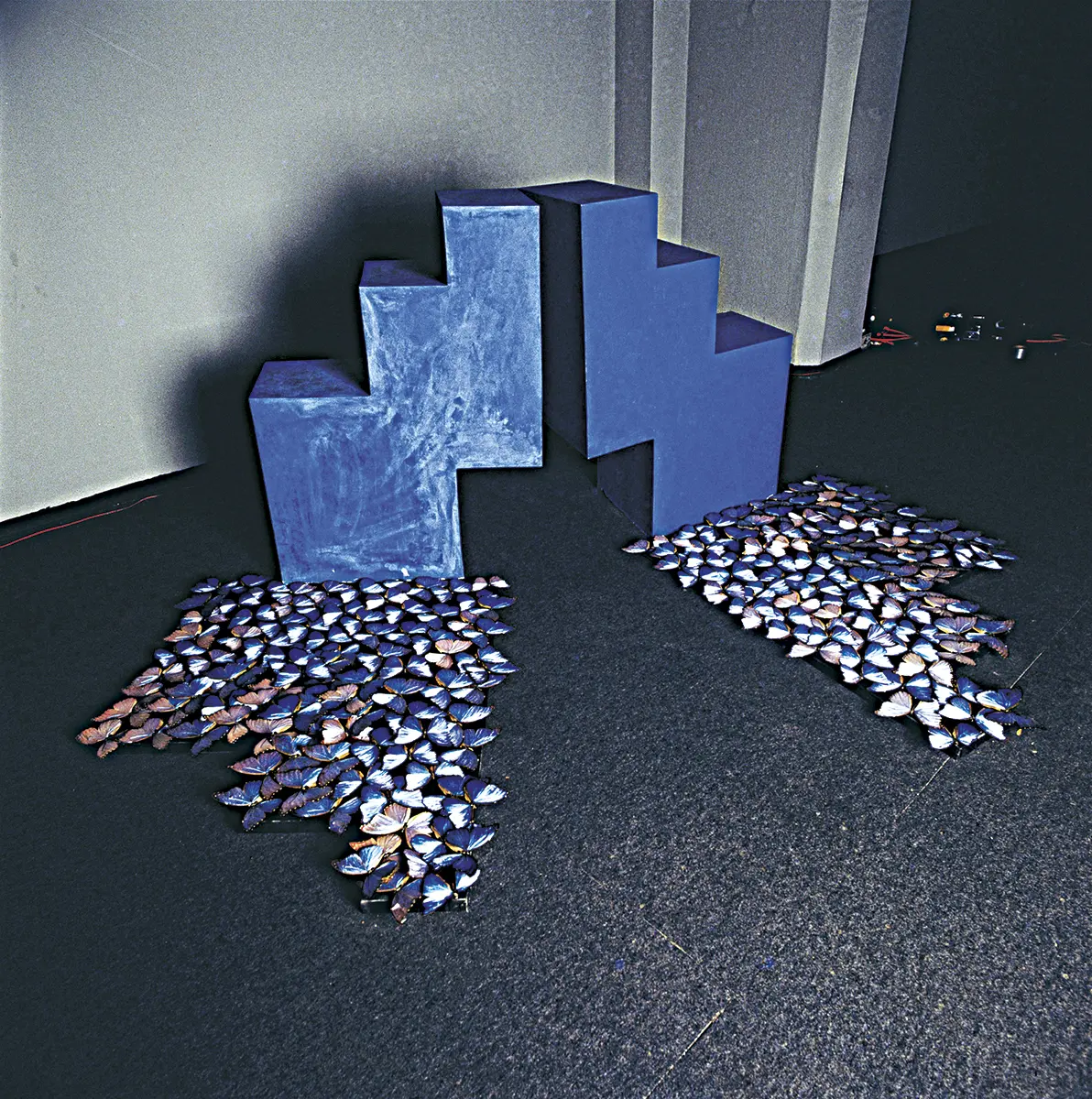
Vainstein also integrated rhetorical devices in Biombo de zafiro (1993, 2007 version shown), an installation in which sculptural blocks—paired, severe, and geometric—cast on the floor a shadow of butterflies. The work’s title alluded to the intensity of the color blue, which was deployed as a chromatic gesture that stood out, along with El beso (a resolutely red 1993 installation), from the earthen tones that presided over the exhibition. Indeed, the colors of the desert were seen in Adobes cónicos (1986, 2007 version shown) as well as the rectangular structures of Huaca en Duna Negra, an architectural construction erected specifically for this exhibition. In the latter work, with bundles arranged in a pile, the artist ignored the literalness of archaeological discourse and inscribed the space of Paracas in the more profound realm of subjective reverberations.
The rhetoric of discretion was also articulated in two-dimensional works like the minimalist painting titled Pasamayo (1996), in which Vainstein’s diluted oil paint delicately evoked the linear rhythms and the desiccated texture of the gorge on the edge of Lima’s sea. The same rhetoric was found in the drawing that referred to the sectional views of a llama skull—a reminder of a life, perhaps a metaphor of its ephemeral character—that was consonant with the pervasive sensation of temporality in permanent dilution. Estaquería (2007), comprising seventy-three eucalyptus wood pieces suspended from the wall, also alluded to a life that ends (or becomes the desert itself). Any ecological commentary was inscribed within the aforementioned rhetoric—suggestion sufficed, with no need for explicit anecdotes.
Esther Vainstein, a notable member of the 1980s generation, rose to the challenge of looking retrospectively at her accomplishments, exploring them within the vitality of the current work. This is what Ofrendas de barro y viento: cadencia y variaciones 2007 was about: the reassertion of a visual and material poetry that is coherent, lucid, stable, and experimental by an artist who remains alert to the wondrous majesty of Peru’s coastal desert.
LUIS AGUSTI