
The most recent project presented by Alcuadrado, the well-known mobile exhibition
space, was Severa Vigilancia, by the Berlin-based Cali artist François
Bucher. The show, comprising a series of photographs and one video, was
displayed in a dilapidated house in one of Bogotá’s fanciest neighborhoods, a house that had been raided in the 1990s by the National Drug-Enforcement
Directorate is one among the many properties of a drug lord whose activities
marked a tempestuous period in recent Colombian history.
The series of photographs, which were mostly large and black-and-white, described another raided building, the property of the famous emerald merchant and Medellin trafficker Gonzalo Rodríguez Gacha, a.k.a. “The Mexican.” This building is located nearby the site selected for the show; it would have been chosen for the show if it were not in such a dangerously devastated state after years of neglect. Scavengers searching for hidden treasure destroyed its interior structures, and indigent squatters invaded it. The photographs showed the passage of time on what must have once been a majestic mansion filled with outlandish luxury and clandestine excess. In the photos, only traces of that cartel world remained. There was evidence of crossfire on the walls and on the bulletproof windows of the automobiles, and there were public-transport vehicles that were likely used to conceal the capo’s illicit activities.
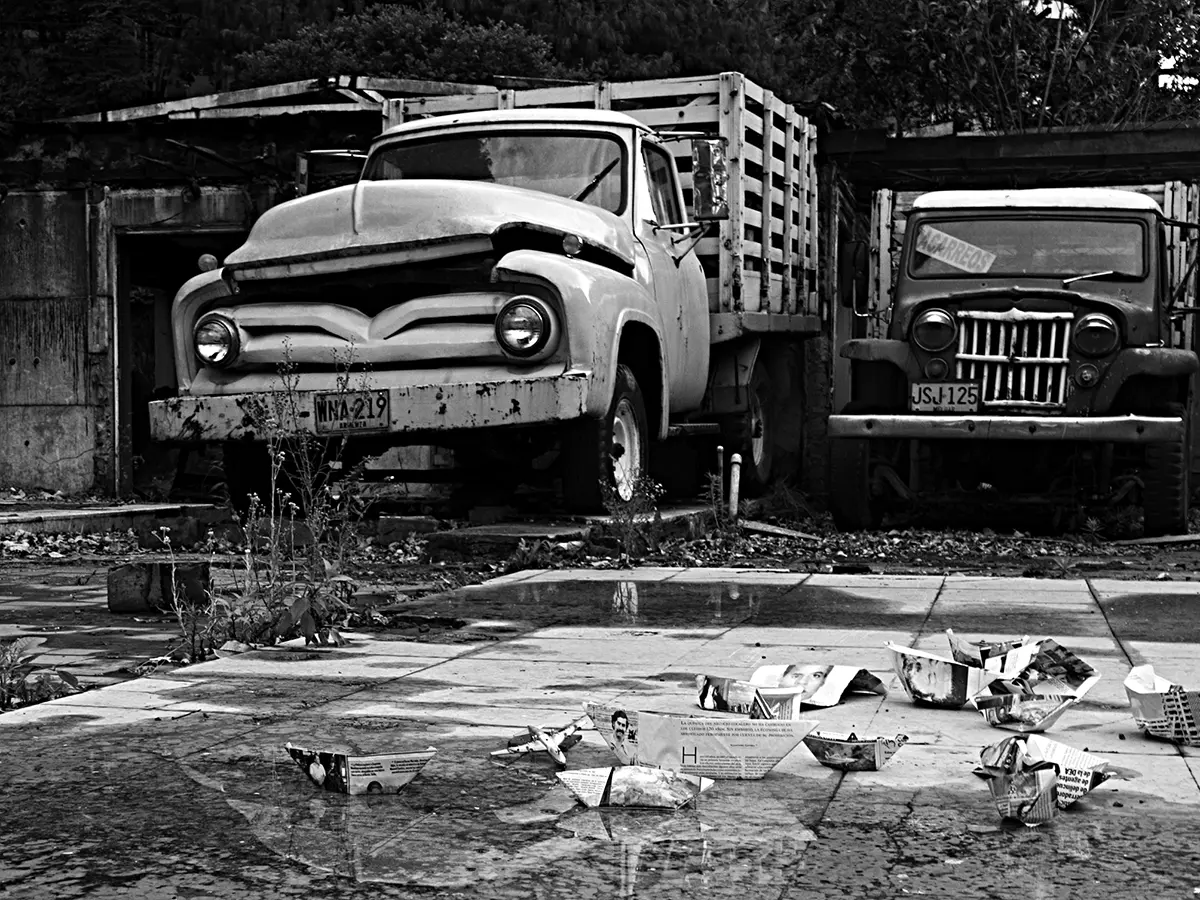
The house, where these photographs were displayed, has also been gutted, and, not knowing that it was not the same house presented in the images, the viewer sought correspondences between the former and the latter: the room’s peeling paint, the now-feral patio, the broken windows, and the splintering doors. One did not need to be in the original location depicted in the photos; just knowing that the exhibition’s building had also been taken by eminent domain, the scenes at Gacha’s house—site of excess, murder, parties, and orgies—were recreated and recontextualized within it. It was like stepping into the scene of the crime and imagining all that might have taken place there, hidden from public view, and being struck by the force of inescapable reality. As a parallel dimension, recreating a moment and its implicit history, photography is effectively a means of severe vigilance, and it conferred great force on Bucher’s work by making the spatial-temporal dichotomy explicit. It confronted the viewer with an underlying truth that many thought distant from our everyday lives but which became tangible in an area of the city believed the safest and least vulnerable.
A key element in the show was a video installation, lasting approximately one hour. Two panels showed alternating testimonies of people narrating an episode with a reflective discourse about violence and death: a group of supposed “subversives” entered a university classroom, and one of the people present was wounded while others witnessed the armed character psychologically break down in front of their eyes, saturating the space with verbal aggressions while keeping them under captivity. While one heard the testimonies, there was constant tension and growing uncertainty from the desire to know whether this story was fictional or the record of a real situation. It was in fact a simulation organized by drama students from the Universidad de Antioquía in 1999, which took a farce to its limits, with the purpose of having the participants experience the depth of human aggression and the way that they react to situations aside from all theories.
The contrasts among the photographs, the raided houses, the referents of Colombia’s violent past and the video all played with the viewer’s consciousness and also subtly alluded to the rawness of the temporal background of an image or a narration. Both dynamics make a photograph work, and Bucher appropriated the resource of a “documentary” medium in order to emphatically communicate the reality in Colombia’s history, of how Colombians assume it: how we confront it as individuals and how we assimilate it as visual art.
MARÍA JOSÉ RAMÍREZ