
In
the fall, a multifaceted exhibition was presented in southern Florida: Guillermo Trujillo: Panamanian Master at the Boca Raton Museum of Art. The
singular selection brought together representative works from the last forty
years of Trujillo’s long career, which has made him Panama’s most renowned
artist and one of the pillars of Latin American painting, where mysticism and
stylization join to create a unique universe.
The show comprised a vast sampling of Trujillo’s stylistic evolution, in which the continuum of the human figure was the central motif. Oracles, shamans, and multitudes flocking to sites of cult or consultation fused with the exuberant natural environment: a forest that engulfed them and made them fruitful.
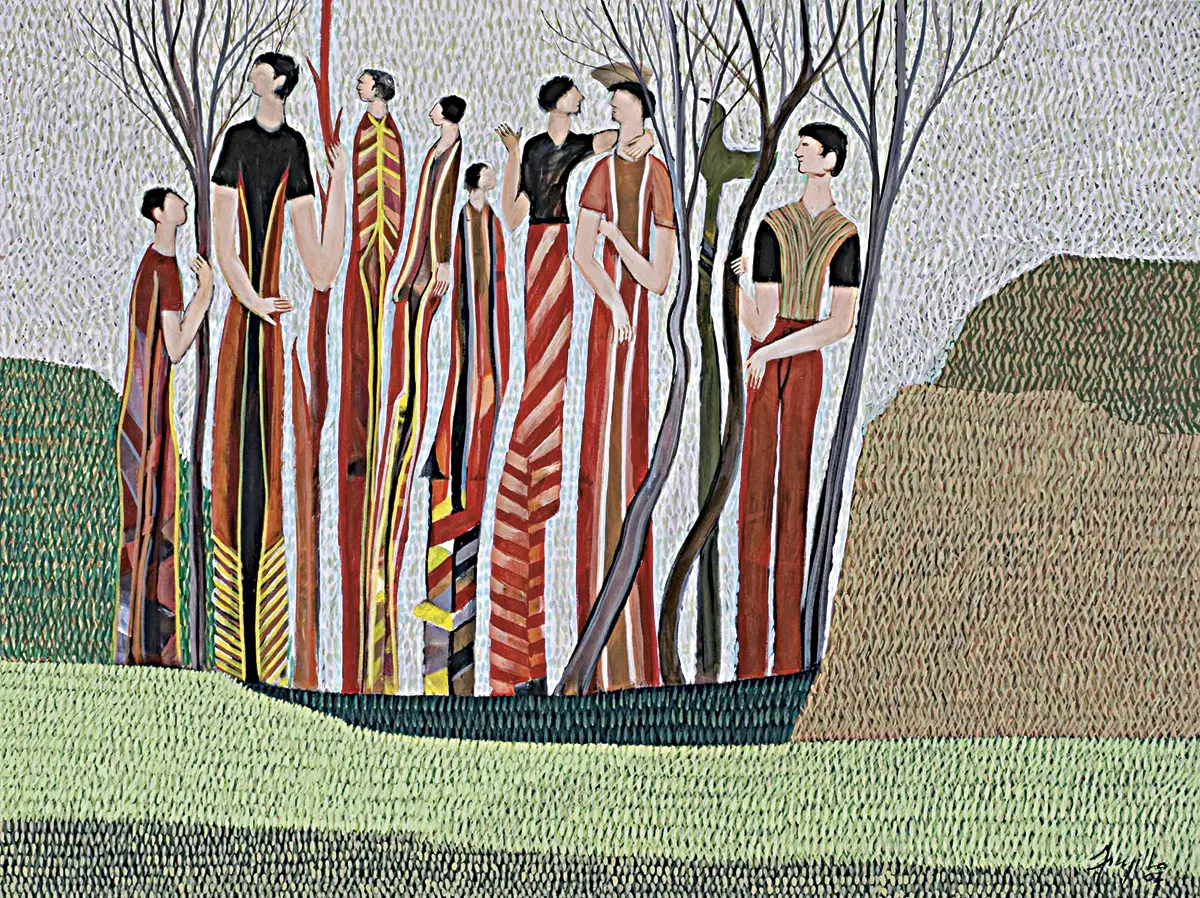
Trujillo was born in Horconcitos, in Chiriquí province, a region whose spirit is filled even today with the living presence of the Guaymí or Ngöbé, the nation’s largest indigenous group. The Ngöbé culture possesses a rich handicraft tradition, distinguished by its colorful clothes, its chaquira bead necklaces, and a wealth of myths and legends that Trujillo subtly weaves into his visual universe and generously offers to the viewer. The area is also overflowing with natural elements; forest, ocean, and volcano have influenced the artist’s sensory world and these features bloom before the viewer with each new painting.
Trujillo is indebted to the exuberance that has surrounded him since early childhood and determined his thirst for expression. Thus, he explored different media: painting, ceramics, printmaking, gardening, and tapestries. He is an avid spirit that encompasses a vast universe. He has tried watercolor, ink, oil, and acrylic. In this way, he forged for himself an ever more complex and ever more distilled technical apparatus. Trujillo’s works seem woven rather than painted with a brush. They are the fruits of the most refined artistic virtuosity, in which a painstaking sense of dedication and the repetition of a unique and minute pattern make a sacred universe emerge. His work exhibits a kind of horror vacui or an assertive need to caress each being that rises to reach the skies.
Trujillo synthesizes, recreates, and reinvents a cosmos that maintains tangential points of contact with his childhood, his culture of origin. The artist himself admits that his European sojourn opened his eyes and helped him discover the universal value of his local culture. A desire to differentiate himself from the modern art movements in Latin America is a constant in Trujillo’s work, which emerges as a synthesis of Western European and Latin American art and the indigenous culture of the western Panama isthmus. Learning the various schools and trends of art drove him to explore his culture of origin, where myths and magical realism are anything but exotic; rather, they are part of the everyday collective imagination. However, Trujillo is neither commentator nor interpreter of these myths but an insatiable fabulist of mythical characters that do not exist.
Nevertheless, it is possible to identify clear references in his works to emblematic elements of the Ngöbé indigenous culture, such as the nucho, the molas, and the bote, revisited and integrated into a new cosmogony. In particular, the nucho, a kind of totem staff, emerges as a crucial element in Trujillo’s oeuvre, even becoming anthropomorphic or coupling with the human element to create a unique hybrid, a stylized figure that grows and merges with the azure sky. Another essential element of Trujillo’s work, one clearly present in this show, is color. While the stylization of the human and landscape elements mark a reverence for the native spirit and culture, color imposes a mood, moving from vivacious chromatic to monochromatic compositions.
The aesthetic dimension in Trujillo’s solid body of work moves between search and assimilation, between seduction and resistance. His work features a perfect balance that reconstructs a past/present where myth and spirituality preside over each quotidian act and where the human element is a natural link in the chain, as part of the balance that must be respected and restored, if possible. The man seems to revere the world he inhabits, and in gratitude, he imagines, venerates, and offers ceremony.
Guillermo Trujillo: Panamanian Master was a magnificent opportunity to pay tribute to the work of this Central American artist, in which identity, universality, recovery, and homage lead the viewer into a dream.
JANET BATET