Celia Sredni de Birbragher: How and when were you discovered?
León Ferrari: That was only a joke. The truth is that I started making art when I was very young-—in 1940 at the age of twenty when I was studying engineering. My father was a painter but he didn’t think it advisable to study art, because of the difficulties entailed in supporting a family with that profession; it is not that he forbade it, but he directed me toward other professions. I made some things in clay, and finally, in 1955 I started studying ceramics, as a hobby in Rome. I realized I really enjoyed it and devoted myself to it, but I also continued in engineering until 1976. My road with art was somewhat bumpy because my first show in Argentina was in 1960 when I was doing abstract art (with other shows in 1961 and 1964) and that’s when friends started to know me, the artists, and the local scene.
I stopped doing abstract art in 1965 when I made the airplane that is now at the Pinacoteca.1 Between 1965 and 1972, I practically did nothing but stuff for political shows that were entirely outside the museum and gallery circuit. We exhibited at trade unions or artists’ societies. In 1973, I left that entirely. My art production was somewhat staggered, but in 1976, in Brazil, I went back to abstract art and worked hard. I took a workshop and for the first time devoted myself to working as an artist full-time. At first, I sold almost nothing, and although there were critics—especially Andrea Giunta, who began working with me and other timid friends years ago—it had no transcendence. I lived in São Paulo for almost fourteen years, but this is the first time I am at the São Paulo Biennial.
Ivonne Pini: In Argentina in the 1960s, there was a movement called Nueva Figuración with Noé and other artists, some of them with a political bent in their work, concerned with finding new forms and languages. Another experience was Tucumán Arde. How did you experience this complex period, with a dictatorship and with art experiences that confronted the situation?
L.F.: Undoubtedly, Noé, de la Vega, Macció, and Deira all have works about torture, and they formed the Nueva Figuración group. Somewhat later, the Di Tella Institute gave them its support. From there, Romero Brest fostered formal freedom and new experiences. Despite having had great differences with Romero Brest, he was, in my view, very important in Argentina as a generator of new movements, of interest and emulation among artists. Now, the emergence of Tucumán Arde is interesting, if you take into account that Romero Brest was against anything that had to do with politics. “Ideology is the antibody of art,” he used to say. But the people that later did Tucumán Arde came out of the Di Tella Institute. Some came out of there and abandoned the gallery circuit entirely; they sought a new form, in order to intervene in the political life of the country, to use art as a revolutionary weapon. There were two or three meetings and two shows: one at the CGT of the Argentines, in Rosario, and another one in Buenos Aires. But the funny thing is that the Tucumán Arde group, which wanted to escape the “-isms” and the history of art, faced art as a political weapon and dissolved after two or three months. Maintaining a group with such great differences was very difficult and the truth is that this movement that wanted to break free from the history of art in order to do politics was unable to do politics and instead entered the history of art. Many people left this, many people went to fight with the guerrillas: Rodolfo Walsh’s daughter, Vicky Walsh, died there. I stopped making art for a time, but later, when I got to Brazil—where I went, also fleeing from repression—I took up art as a profession in order to make a living and for the first time, I devoted myself to it in full. I went back to things I had not only left behind, but things I had denounced in my writings of 1968, all connected to abstract art; later I went back to it as a way of life. Sometimes people criticize me; they ask me why some of the things I do have such great charge and others don’t. I do what occurs to me; it is like life, sometimes you go out for a drink, sometimes you go to the cemetery; these are different things. Many things happen in life: there is a pretty field of flowers, and all of a sudden there are scores of dead from a bomb dropped by the Americans. So, this would be in brief my history in the last fifty years.
C.S.B.: In your work, there is courage, a strength to say certain political, sexual, religious things without fear, openly. Why?
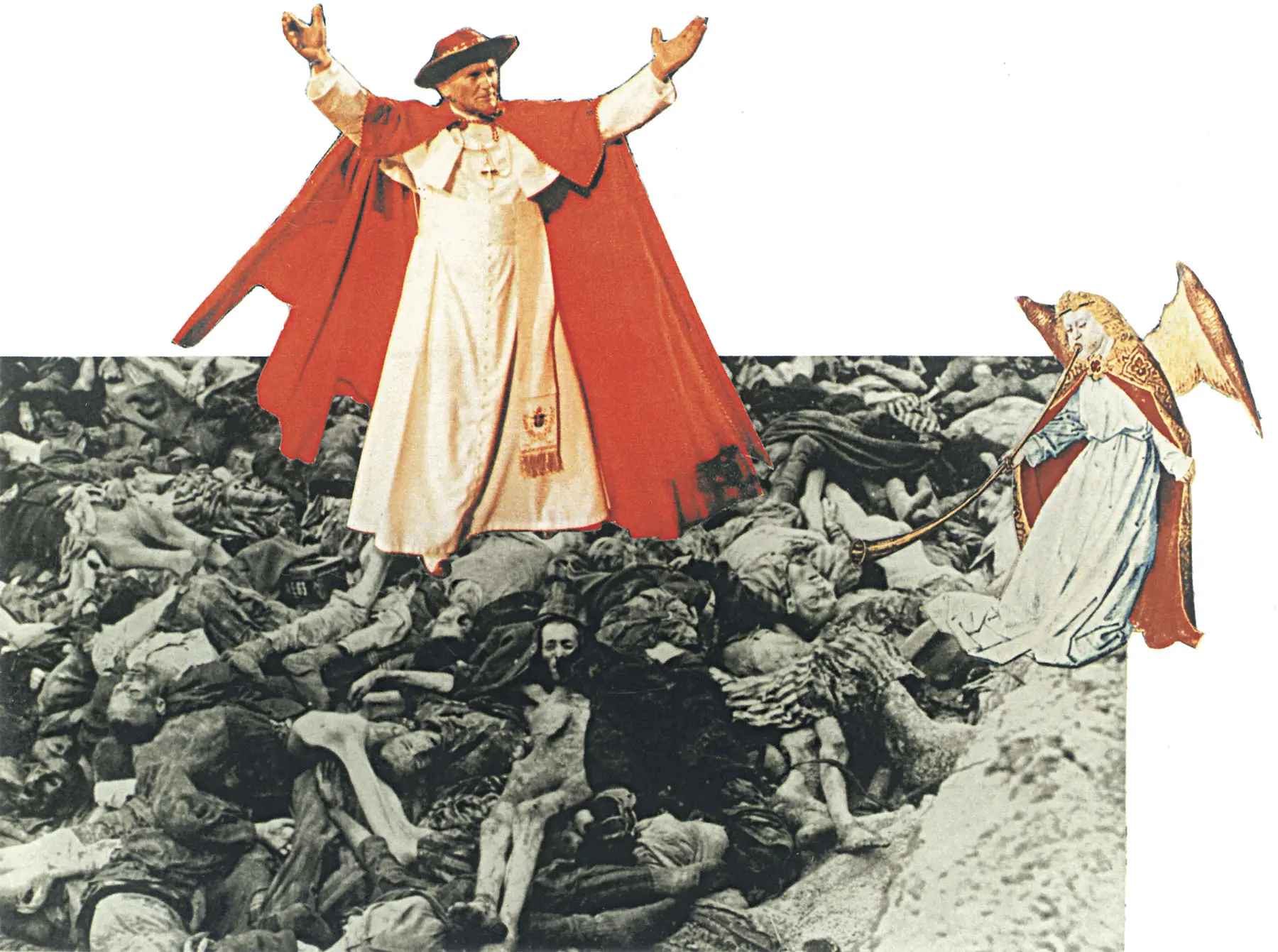
L.F.: I think that the axis of the West is religion’s threat to those who are different: intolerance has taken to the extreme. In other words, not only disliking what the other says but also punishing him with torture. Such intolerance is embedded in our culture. Atheist or not, we have it inside of ourselves, and it seems to me that anti-Semitism originates in the Bible and especially in the New Testament. Whether the story of the life of Jesus is true or not, whether it is distorted or not, what matters is the book, the existence of the book. Anti-Semitism is born of the book: Jesus’s struggle against Jews who did not believe in his divinity, Peter’s condemnation of the Jews for killing Christ. Also, anti-gay intolerance is in the Old Testament with the destruction of Sodom; later, Paul repeats the thing about punishment by death, discrimination against women, all that. Intolerance is one Biblical feature that has survived through the actions of the Church and the Western culture that supported it.
In the work of many of the artists we admire—artists who I also admire—the content is awful. Giotto, Michelangelo, Dante, Bach—all have terrible things. Art served as a P.R. tool for the Church in its effort to entrench itself, to maintain power, to communicate those ideas: kill the natives, kill the witches, kill so many people. I mean, this concern with what the West is—which I’ve been talking about for years since 1965 with that airplane, which had no repercussion—found an echo when I made those upside-down hells, those that are now in the Biennial and that it seems many people protest against. They are classical views of hell, religious, repetitive, but the tortured are the inventors of hells or of what are said to be hells. The Church’s response in Buenos Aires (in 2000, a group called Custodia threw tear gas at me at a show, as well as garbage and paint) was to celebrate Mass in front of the ICI, the Spanish Cultural Center, but it turned out that now with La Recoleta, Cardinal Bergolio’s response was to ask for a day of fasting and prayer, with some nuts who prayed at the door of my show... whatever.
I wanted to initiate a debate, but I couldn’t. I wrote several things responding to the issue of blasphemy, telling them that the only difference or the most important difference was that I am against torture and they are in favor of it. They were in favor of the Great Beyond. I think that religious people have two separate areas in the brain when it comes to reasoning about morality and the ethics of life in common. They condemn violations of human rights on Earth, and they threaten unbelievers with just such violations; it is a giant contradiction.
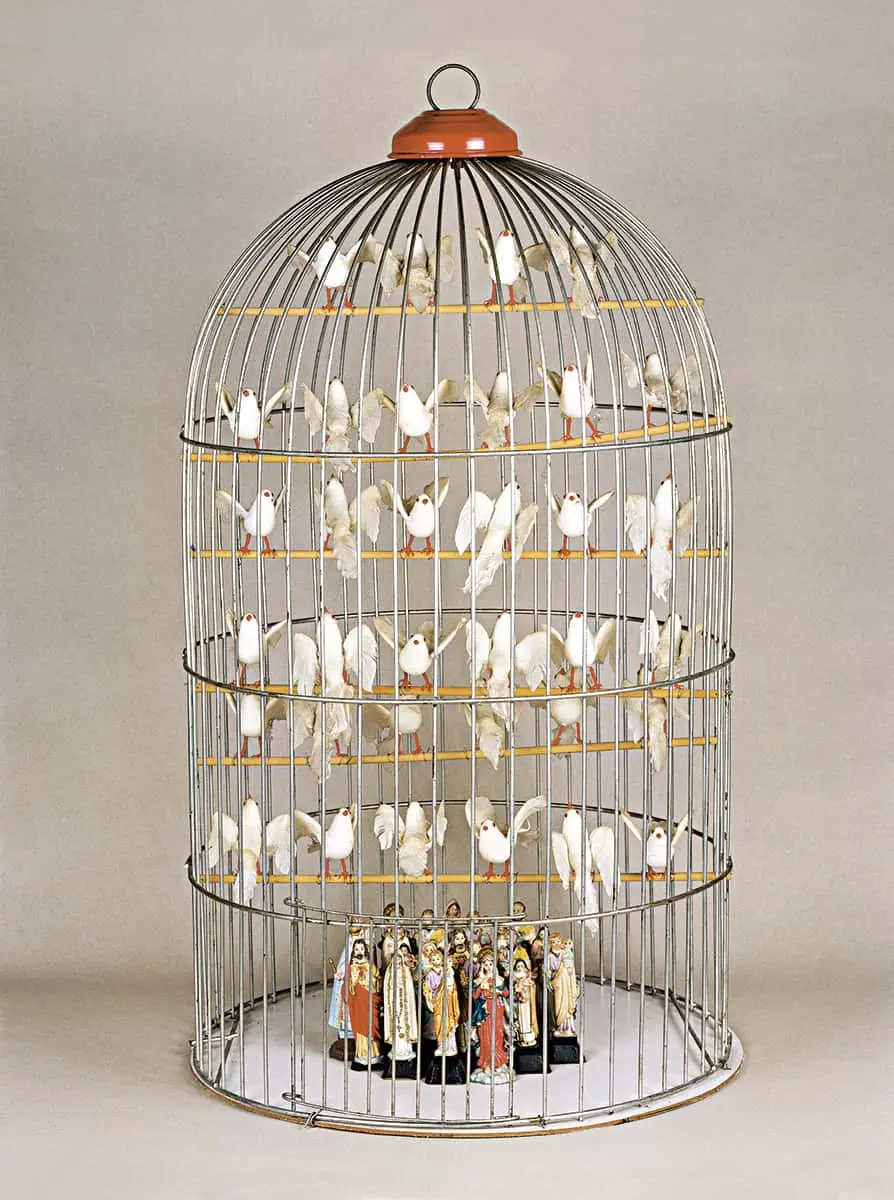
I.P.: But it is also very interesting that, when the event at La Recoleta happened, the effect they achieved was to incite many people to come to see the show. There were lines of people because it obviously arose curiosity. They even closed the show for one day.
L.F.: It had to be closed because it was the Day of the Immaculate Conception or something, and I said let’s close it to avoid the appearance of provocation because, among other things, Luisa Carrió—a very political woman who wears a big cross on her chest—said that it was stupid for the government to give me space next to the Church of the Pilar, and in the middle of Advent to boot. They might be right with their religion, but there are others who are not. So I responded in the newspaper, saying that Videla and others also had communion at this church; and also that every Sunday someone was attacked, be it those they call sinners, or gays, or the condom camp; and I said that you can read really terrible things in the Bible. Why is it possible to say those things in church without being bothered, while I can’t come and say that I dislike torture? Some people supported me, many friends, and sometimes I even run into people in the street who greet me and say “Thanks.” Meanwhile, those who are against me are nowhere to be seen. Once I met a young woman who did say something, but it wasn’t important—it was at a wedding in Ushuaia, to the south, and she came to greet me. It was a good thing both for the repercussions of the show and for the chance it gave me to express what I think, and also for this parallel show mounted by the Church, practically illustrating the point about intolerance.
I.P.: Publications like León Ferrari: Prosa Política include texts from various periods.2
L.F.: Yes, the first one is from 1965; it was a response to a critic because, at the Di Tella they didn’t show the airplane, they took it down. There was a very strong critique in the newspaper La Prensa, saying that I was a subversive, a communist, and all that. So there is a first response letter to them in which I end by saying that maybe they could prove to me that what I did wasn’t art, but that even so I wouldn’t stop doing it, I would simply call it something else–I’d call it “revulsive critique” or something like that. There are two texts from that period; the first one is this and talks about art. There is something there from Tucumán Arde about the art of the signified that talks about how the signified is part of the work of art as if it were another color. And then there is, above all, reflection about the Nazis, anti-Semitism, gay issues, the Conquest, witch hunts—a bit of a grab bag; these are loose things, some of which I published, some of which I didn’t.
I.P.: I thought it was interesting because it establishes a dialog; however, there is no answer from the other side.
L.F.: I didn’t get a response although responses were not a justification of Hell. It can’t be justified. What some do is deny its existence, but then they are heretics. If you are Catholic and you deny the existence of Hell, it is like what Peter said, I think: whoever doesn’t believe in Hell is anathema, and whoever doesn’t believe the New Testament is anathema...
C.S.B.: Let’s go back to the currents in your work. There is the protest part, the abstract part, and photography. Tell us about photography. Why do you use it?
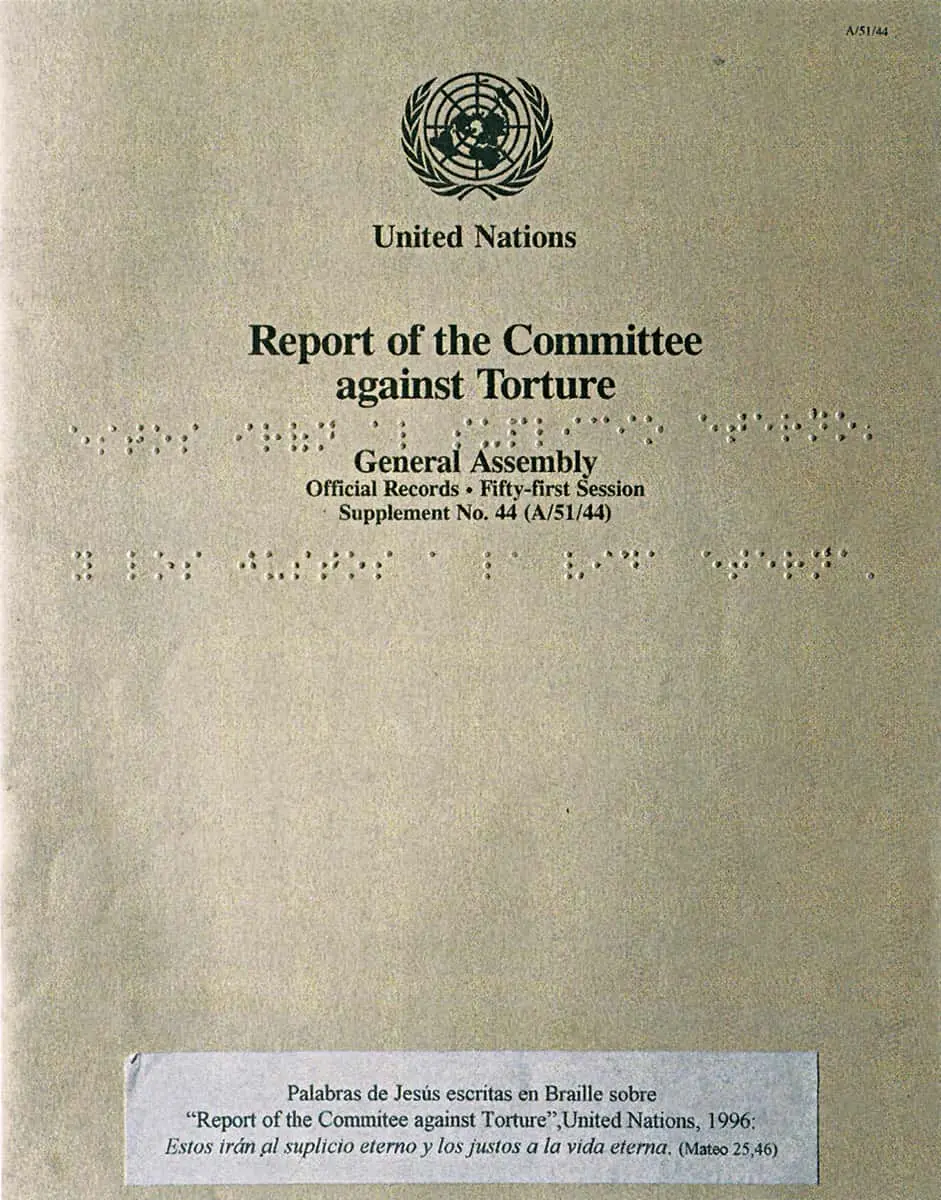
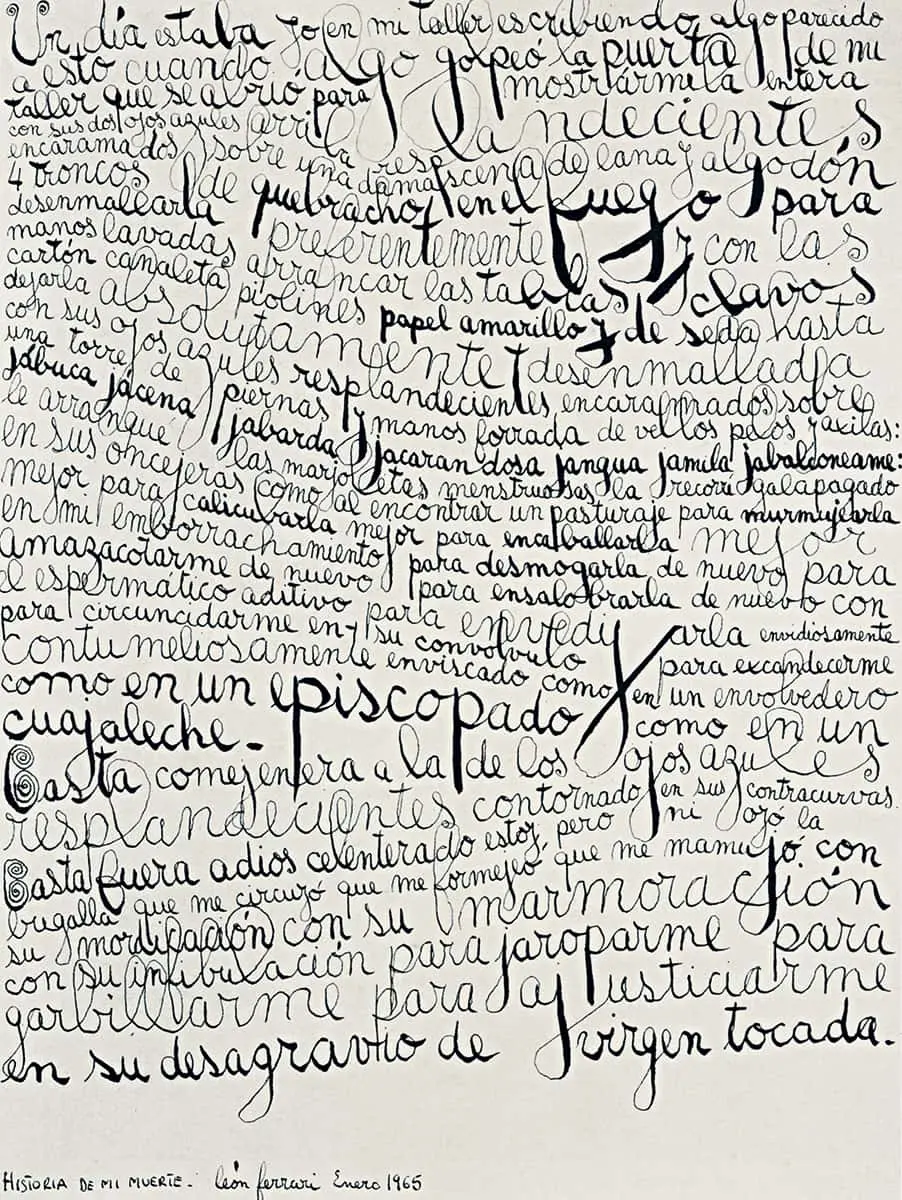
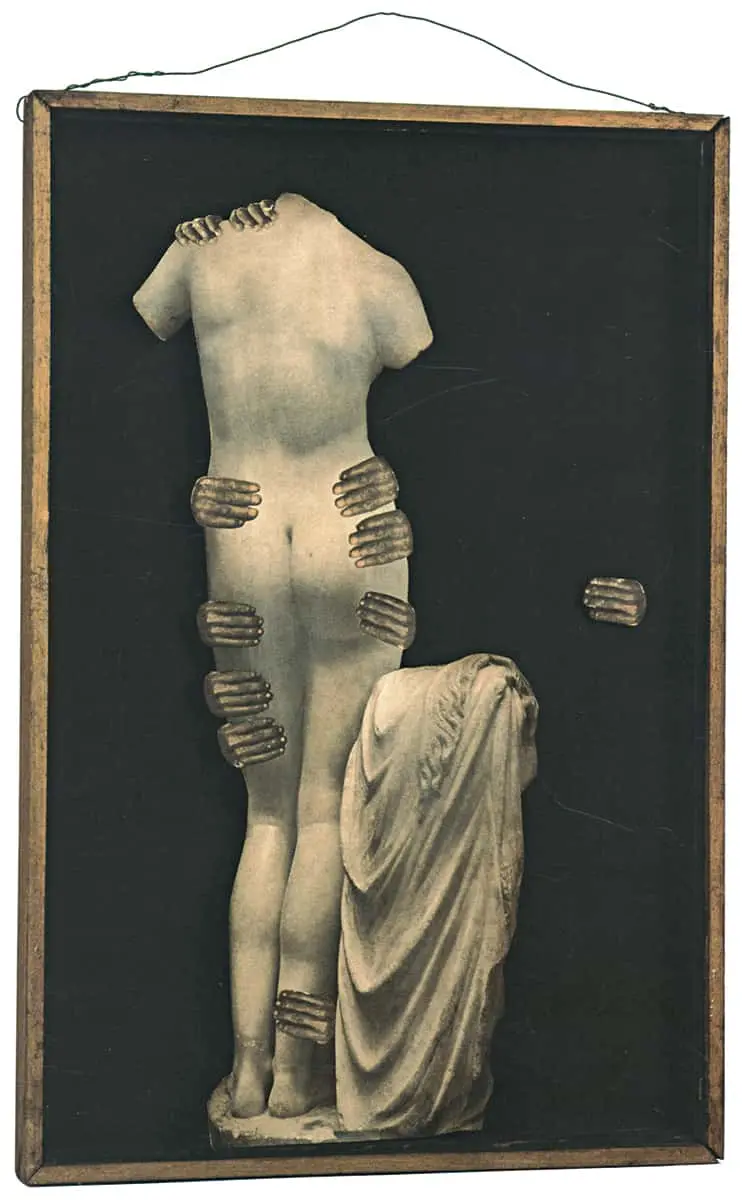
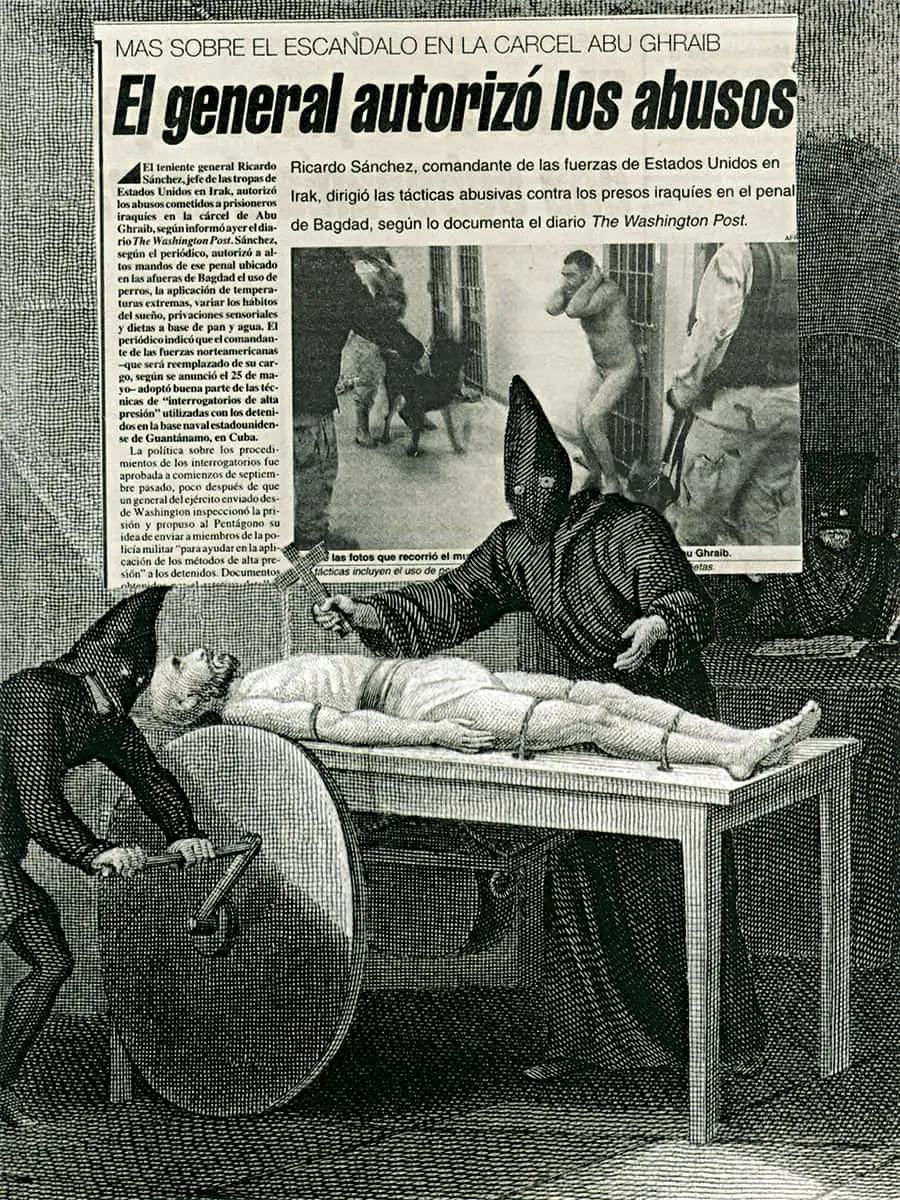
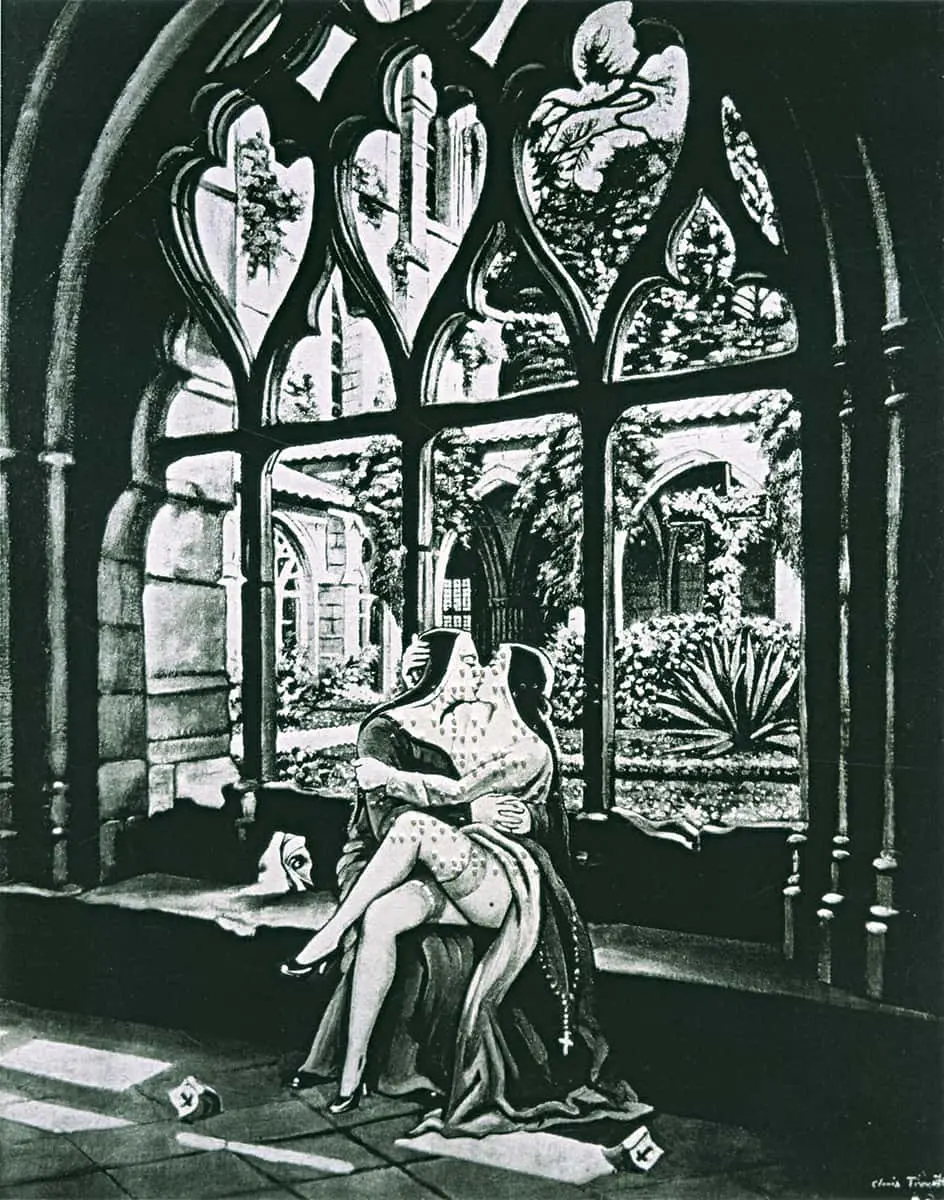
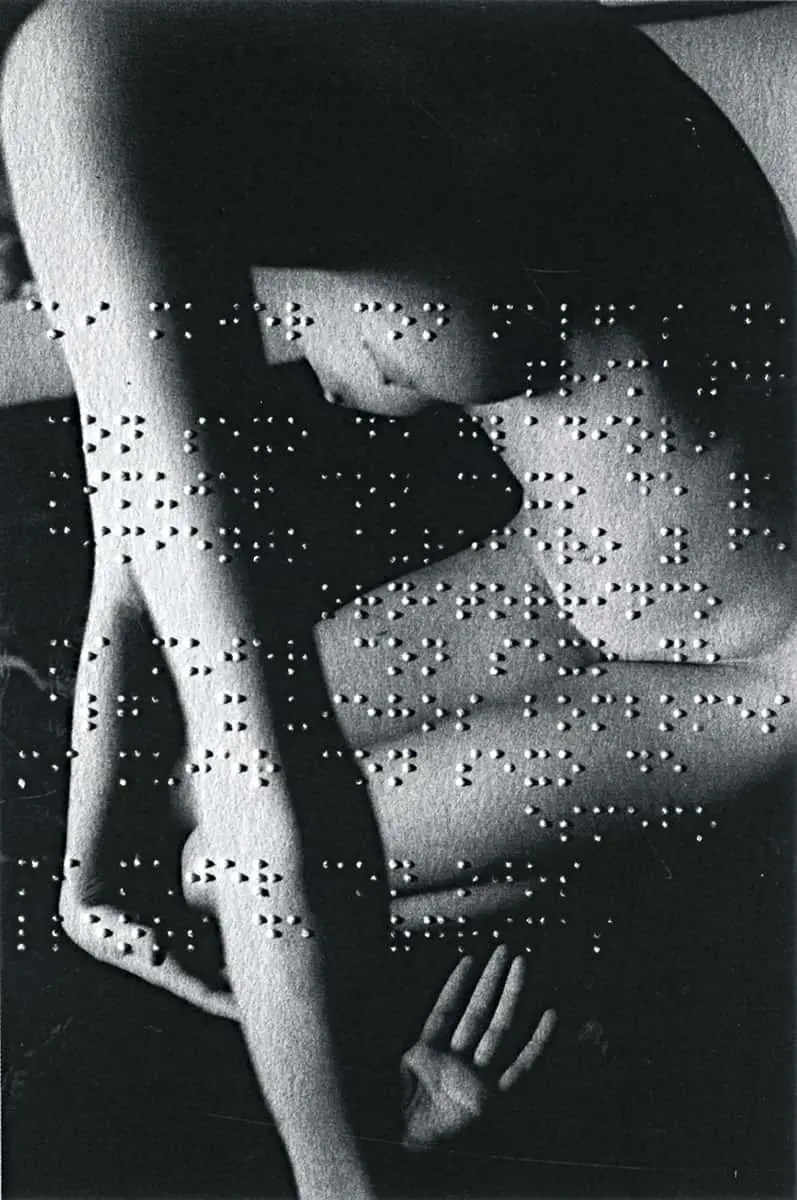
L.F.: I used photography a lot in that period of the show at the Di Tella. Among the things that remained are photos from newspapers, photos of torture that appeared in newspapers, and that I pasted as a background collage. Later I used photographs by Man Ray and by my father, with a different intent. In fact, the cover of the catalog that’s coming out is a picture taken by my father of a female model he used in his painting, with a love poem by Borges in Braille. The poem was printed on the girl’s image so that one had to caress the photograph in order to read the poem. I used the photographs in other places, like in the book El nunca más, published in 1984 with all the denunciations. But later the newspaper Página 2 published it in booklets in 1992; now it has put out a second edition and I illustrated it with various collages that use many photographs of the repressors. I link the excesses, the violations of human rights by Catholics with violations of human rights in their religion, the deluge, and things like that.
My father actually used photography a lot; he painted churches and had people wear costumes. For example, I have a great picture of my parents dressed up as if for the Canaan Wedding: she was criolla and he was Italian, twenty years her senior, and they are there as if ready for a wedding. He painted churches and cathedrals in Córdoba. So, photography is something I use also.
C.S.B.: Why Braille?
I started with the idea of Borges’s love poems, which are very beautiful, and then I connected blindness, love, and Man Ray’s photographs. Then I added Braille. I also used it in biblical stuff: “ . . . Blessed be who seek justice because they will be satisfied . . .” Justice is the final judgment for everything.
Later there was one work that was censored in Rosario, using a drawing by Utamaro of a scene of female masturbation. I wrote on the finger. It was fun because there was the title about masturbation—I remember the technique especially—I don’t remember the name but I wrote in Braille: “Love your neighbor as you love yourself”; I titled it Ámate and I sent it to a visual poetry show in Rosario. When it was censored, my friends took it and paraded it around the show on opening day, and after two or three days it was on view again. Finally, I said, “OK, I will donate one of the works.” The director of the museum said “We will hang Ámate up,” and they have it there. I made another one, which is at the Pinacoteca.
I.P: So, you studied engineering but not art, and the interest arose from your relationship with your father but you continued as an autodidact.
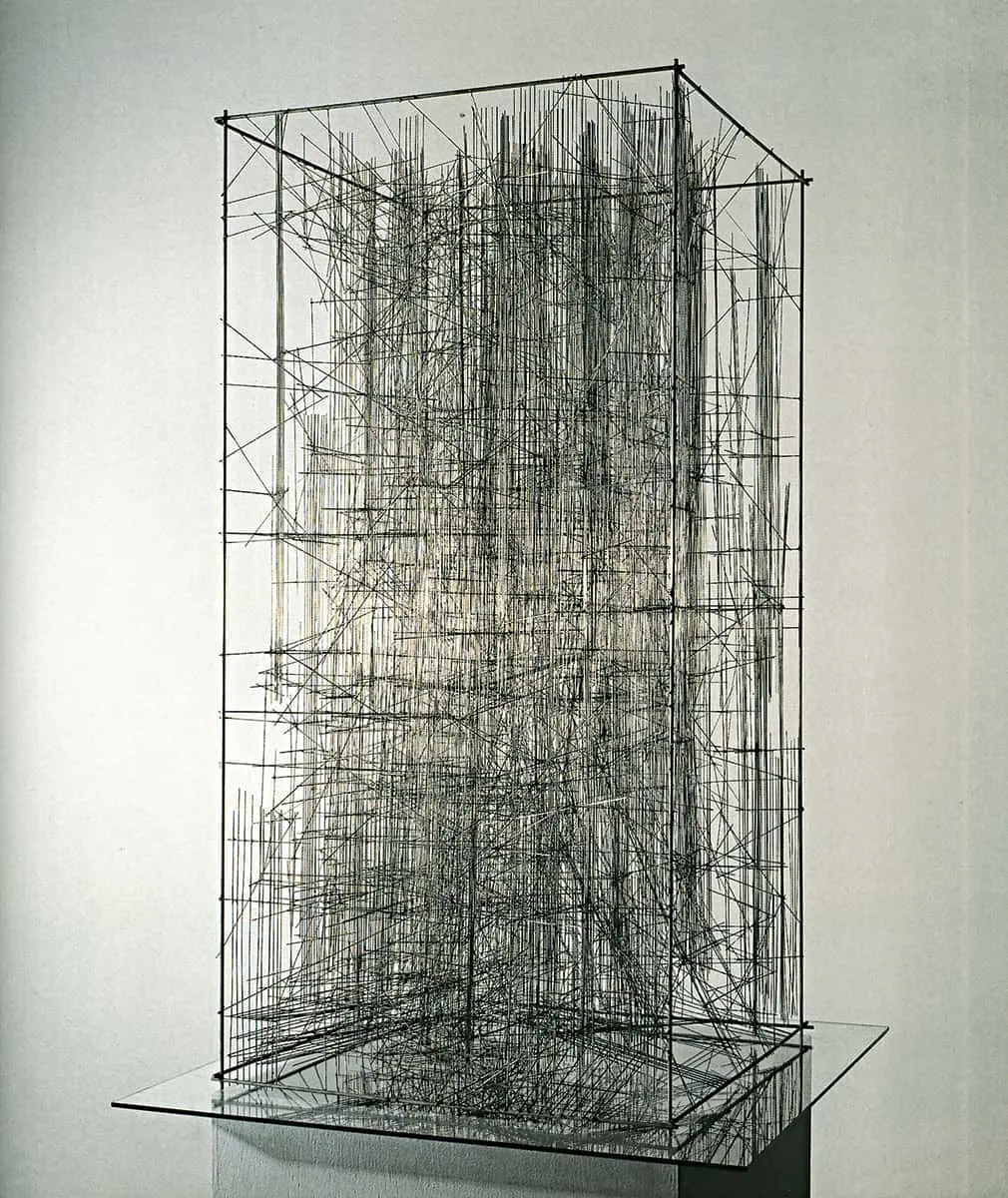
L.F.: I started working in clay before studying and learning ceramics techniques. But although I think studying is a good thing, I always say that not studying art has the advantage of one having to find a way; so maybe you end up inventing things, maybe you are freer, maybe your head is clearer, and in my case, there are things I maintain, like drawing. But when you go to one of my shows, it looks like a collective, and it is precise because I make a series and then I leave it and work on something else. For a long time, I made welded-steel sculptures and then others with knots, like the one I’m working on now.
C.S.B.: You were telling us that now you have a larger workshop.
L.F.: I sold several works unexpectedly and was able to buy a larger space, and it turns out that when one has more space, there is a need to do more things. In a small workshop everything is full, even my head. Here, however, I have plenty of room: I have a patio and large doors. I used to have a workshop where everything was limited to 180-by-140-centimeter paintings because nothing else would fit in the elevator to the fifth floor. Now my door is 240 centimeters.
I.P.: What show are you preparing?
I am always working, and recently Ticio Escobar invited me to the Valencia Biennial. He made a good selection, especially works of this black polyurethane, a material that is used to fill gaps in plumbing. You pour it and things form by themselves; it seems like there is a sculptor inside, and it creates incredible shapes that you would never think up by yourself. This does it on its own. They look like turds, but I think they have great force.
C.S.B.: At the biennial, there are works made with human bones or what resemble human bones.
L.F.: For a long time I looked at skeletons in medical supply stores, very well done skeletons, and one day I was walking by a place that sold such things and I bought a skeleton. I took it apart and made one of the works after breaking the bones, and later I made a bigger one with parts from almost eight skeletons. I was interested in bones as an aesthetic element because I approached a kind of forgetting what death means. It is like making a sculpture, although the material gives it a different charge, one that is tragic, strong, I leave it to the viewer to deal with the meaning. Because sometimes people come up with theories that make me say, “You better explain it to me,” because their interpretations are better than the authors. The work of art is often like a poetry generator. You read some critical comments on works that for you have nothing to do with that, but it is a poetic work that generates different interpretations.
I.P.: What is your view of what is happening, in Buenos Aires and now at the Biennial, of the multiplicity of possibilities and the use artists make of them?
L.F.: I am a little old fashioned because I continue to make paintings and sculptures, and that is something that has been left behind for a long time. Looking at the Biennial, I think that originality can be provoked by something that is traditional. This is to say, to make something traditional at this time, such as a sculpture or a painting, even of a different kind, can be something “new.” Now at the Biennial, I didn’t see it, but one thing impressed me tremendously and it is that cat that eats a rat—what a terrible thing! With nothing but a TV and the cat...
C.S.B: What do you think of a work like that?
L.F.: I thought it was good. I was impressed. This is the kind of thing one doesn’t notice. And it made me think; I have two granddaughters who are vegetarians, and so I think, of course, what if we were all eating ourselves like that? Without analyzing the meaning of the work, I thought it was strong.
NOTES
1. He refers to Civilización occidental, 1965.
2. León Ferrari: Prosa Política (Buenos Aires: Siglo Ventiuno Editores, 2005).
CELIA SREDNI DE BIRBRAGHER
Founder and Publisher, ArtNexus.
IVONNE PINI