
While
many kinetic artists lost their way, rendering effects that turned their works
into simply decorative gadgets, Luis Tomasello became an unequivocal example of
an artist who finds primary aesthetic resources in movement and transformation.
With a low profile, Tomasello’s interest in perceptual changes has been focused
on subtle color-light variations, and he ignored the temptation of pursuing an
easy kinetic entertainment that briefly attracts attention.
Born in La Plata, Argentina, in 1915, the artist eventually chose Paris as his permanent residence. Tomasello moved there definitively in 1957. He soon established a relationship with the Dense René Gallery, an international leader in kinetic art. It was not long before his work was appreciated both in Latin America and Europe. In 1970, he received the Gran Premio at the Bienal de Coltejer (Medellin, Colombia) and a few years earlier was chosen by Frank Popper—a deeply knowledgeable kinetic art expert and author of one of the first books on the subject, Naissance de l'art cinétique—to join the great collective exhibition Lumière et Mouvement at the Museum of Modern Art in Paris, in 1967. This exhibit was, to a certain extent, the international launchpad for the representatives of Kineticism. Popper’s selection included many Latin-American artists (around 30%), especially from Argentina (more than 20%).
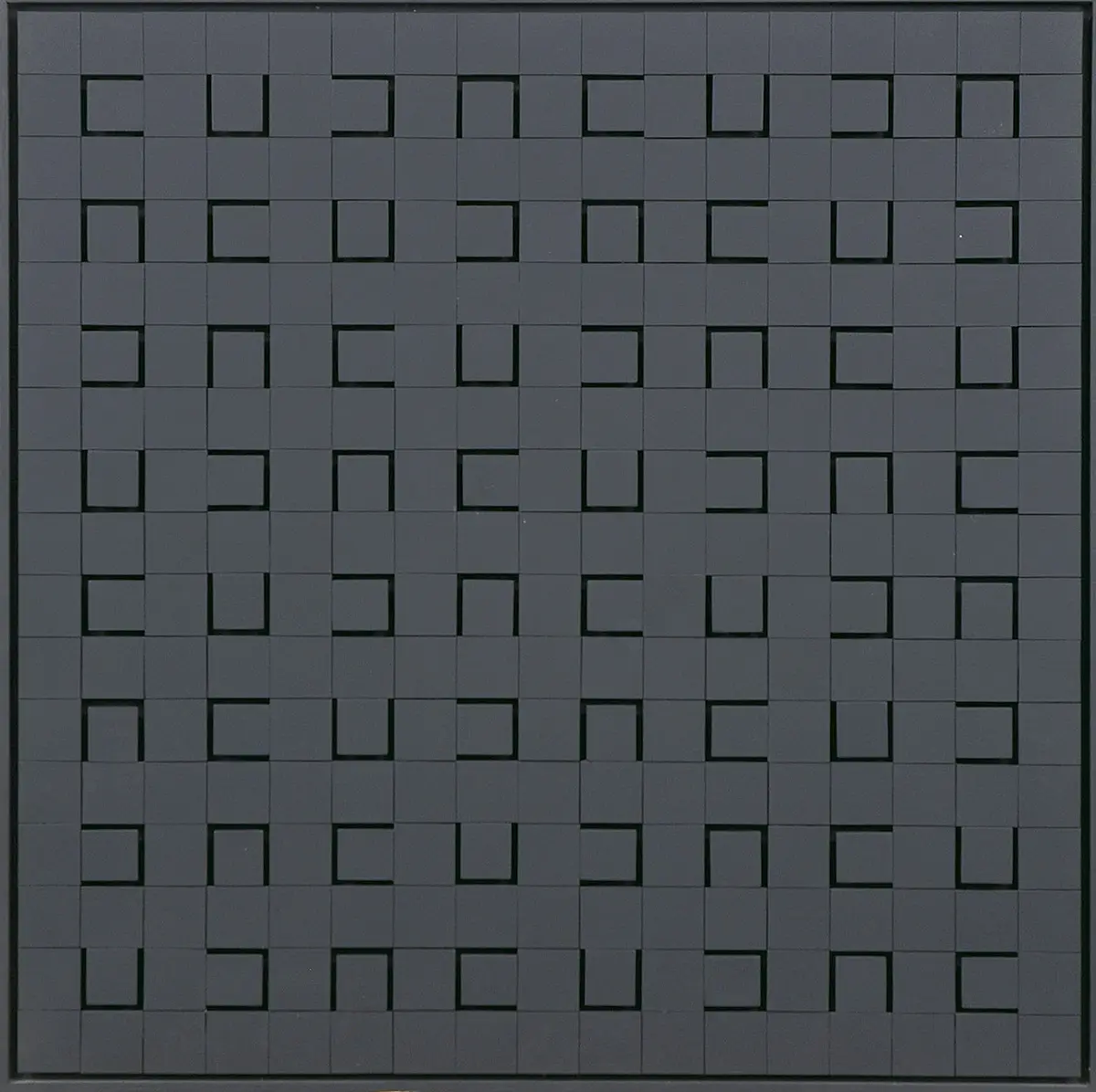
What has been observed as a tendency toward geometry in Argentine art could in fact be considered Kineticism. Such a consideration is backed by the fact that kinetic art has been influenced by geometric abstraction. Tomasello explicitly acknowledges this genealogy when he affirms: “My research originates in Concrete Art, mainly from Mondrian,” an artist he admires for the latter’s systematic work with orthogonality, his focused use of the straight line, and his preference for the minimal. Nevertheless, Tomasello observed that the Dutch artist’s stubborn struggle to find stability in the flat surface resulted in the opposite. This is usually what occurs when colors are freed from the black grid, as seen in the Boogie-Woogie paintings. By studying Mondrian, Tomasello confirmed a fundamentally important principle for the progression of his quest, a sort of drama of color: its inability to remain fixed, to be stable.
Tomasello’s works exhibited at the Fundación Klemm spanned different decades and transmitted the difficulty of finding a planar solution to color, as they displayed the potential of including the spectator’s movements and color-light transformations, namely, the fourth dimension. Cubes, cylinders, parallelepipeds, and regular or irregular polyhedrons from Tomasello’s Chromoplastic Atmosphere series unequivocally penetrated the space, clinging to the planar surface through their angles or some of their edges. In these works, the faces of the cubes, which were painted white in many instances, reflected light with varying degrees of intensity, showing several values of gray. The interior faces featured warm colors (reds, oranges, yellows) or cool colors (blues, greens). Their function was to reflect color onto the bases of the surfaces. They were spatial, two-dimensional colors; thus, Tomasello regards these works as “painterly rather than sculptural.”
The kinetic characteristics of Tomasello’s work reside in the variations of one external element, light, and the movement of the spectator, not on any mechanical movement within the work. The artist meticulously “combs the hair of the light” to place in evidence “the emotions of matter” affirms his friend Julio Cortázar, who adds: “It just takes the light getting to the niches, into the apparently cold and austere beehives, for a tremor of life to spread over the adjacent space that is pulled toward the unstoppable dance of the work. This alchemist does not wish to freeze light into a precious jewel; to the contrary, a solid and immovable object expands with light and color, it trembles in the space, and throbs with the same heart that is looking at it.”
The excellent critical reception Tomasello’s work has received is predicated on his faith in rationality that embraces enigma, which is demonstrated to a greater degree in the works that have suggestions of black. Tomasello’s work also overcomes the limits imposed by the relief and successfully integrates the work into the realm of architecture when projected outside the museum setting, rendering an aesthetic quality to everyday surroundings.
ELENA OLIVERAS