María Ezcurra self-curated and -designed her exhibit Me Visto, por lo Tanto Existo (I Dress, Therefore I Exist), on display from August 23 through the end of October at the Claustro de Sor Juana University in Mexico City. There, within the framework of the Colección de Indumentaria Mexicana Luis Márquez Romay (Luis Márquez-Romay Mexican Attire Collection), Ezcurra implemented four sections and a catalog for contemplating her work. In this gathering of pieces created during a lengthy time period, the fabric was deconstructed and relieved of its function as clothing, while the textile craftsmanship in each garment worked on became an aesthetic discovery, a moment frozen in time for pondering personal dressing rituals and to look into the self-critical memory lane of Mexican society. Therefore, the pieces (the intervened garments), the subtext (resulting comments), and the artist (the individual reflecting upon being a woman) melded into one proposal.
A thirty-four-year-old woman born in Buenos Aires, Argentina, and a naturalized Mexican, Ezcurra belongs to the most recent generation of Mexican artists. She has been active since the early 1990s and her preoccupation with the reality in which she lives leads her to reject the idea of creating art as an excuse for participating in frivolous social occasions. This retrospective exhibited an Ezcurra evaluating her own artistic career while at the same time letting her own work become known, as well as works by other artists from that generation, such as Sebastián Romo; this was an unavoidable necessity back then, as it also was to find places (presently regarded as mythic) to exhibit and think about art, such as La Panadería (The Bakery).
Ezcurra sees her work as the relationship between her inner self and the way she experiences the city in which she lives. The garments she uses in her artwork are all purchased second-hand. They are found objects that document the artist’s reactions and the ideas and problems confronting all women in everyday life. The exhibit flowed easily between the public and the private, from gender issues in Mexico to a sort of visual-intellectual biography of the artist. Although Ezcurra’s work consciously remains trapped between sculpture and the interpretation of space, this exhibit provided a welcome opportunity for reviewing the interpretative lexicon, to explain a certain degree of evolution in Mexican installation and intervention exercises. It is a practice that makes for the meticulous staging of reality; it proposes a relational aesthetic and a sculptural game for reinterpreting certain values from architecture.
The strength of this exhibit was also manifested in the unexpectedly advantageous manner in which the artist utilized the otherwise difficult and restricting venue. Four rooms in the old San Jeronimo Nuns’ Convent of New Spain, built-in the sixteenth century was used to convey ways in which the bodies of women are used—both in the colonial past and today—and to denounce and dissect the circumstantial demands with which women are confronted in any given context. In Cuerpo de Trabajo (Body of Work), we observed the transformation of clothing as used in social roles; in Quince Primaveras (Sweet Fifteen), we were present at the waltz each woman’s interior world must perform to the tune of social expectations. Guardarropa del Ama de Casa Perfecta (Wardrobe of the Perfect Housewife) revealed the site where a woman loses her autonomy and where the context transforms her being into a piece of furniture and gibberish.
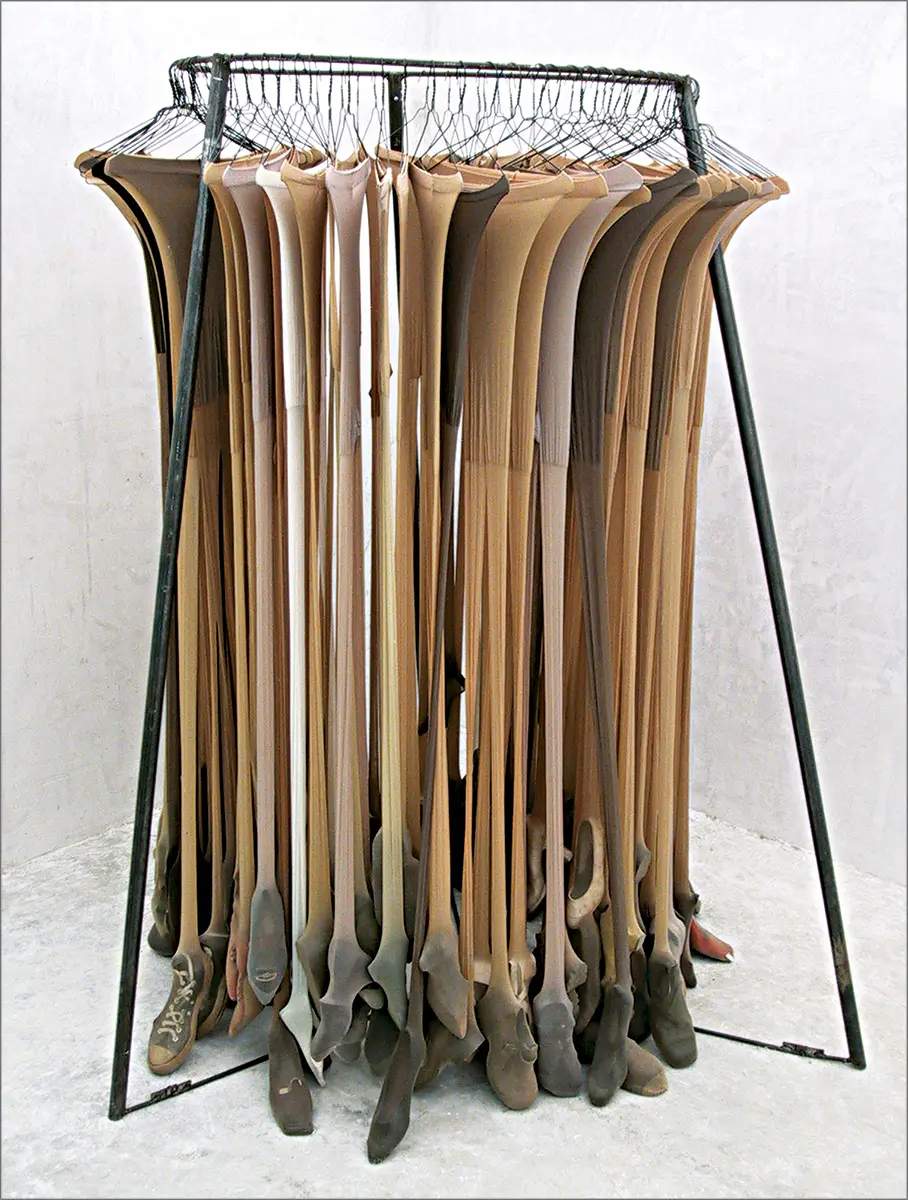
María Ezcurra proposes obscenity as the essential strategy, without assuming in this instance a value judgment or a moral stance. Obscenity is understood as the public practice and revelation of what is usually a private exercise, an intimate experience. Accordingly, the exhibit contained a work in which twelve red panties speak of a consumer ritual that sells the hope of love if this lingerie is worn on New Year’s Eve. Every impression presented is at once an intimate chronicle of the dreams of this Mexican woman and analysis of rituals shared by all Latin American women. Other altered clothes played with their alluded significance and with the significant role assigned to the space they occupy: the industrial prints on textiles, stamped with animal patterns similar to extended skins, were a clear example of this. Five large-format photographs complemented the reflections their titles provoke. The circle composed of fifteen dresses for parties in honor of five anonymous fifteen-year-old girls unified the names and feelings of these young ladies. We witnessed once again the role of clothing both as a nodule within which the engagement of Mexican women with their society occurs and as an ethnologic note on the otherness amongst women. Finally, and halfway between the poetic and the brutal, there was Ni Una Más (Not One More) —a garter belt fastening nylon stockings that have a shoe inside—a desperate forensic finger pointing at the wave of murders of women of all ages in Juárez, a border town in northern Mexico.
CARLOS MOLINA