Besides
a few appearances in Spanish exhibitions, this solo show at Elba Benítez
Gallery marked the debut of the young Mexican artist Mario García Torres (born
1975, Monclova). Objetos para un rato de ocio was an excellent exhibition
marked by García Torres’s ability to articulate a discourse that coherently
argues his postulates and makes conceptually rigorous allusions to the history
of art. All of this is based on a formal language that prizes austerity over
the excess of narrative resources so in vogue among the region’s artists. The exhibition was composed of three works, two seen previously and a third one
that continued the dialogue and presented a conceptual vision supported by the
nature of the work.
In a little over five years, García Torres has enjoyed the success of a meteoric ascent. His intellectual efforts include not only the production of suggestive artifacts that question the status of reason and its narratives but also the move into the domains of the academy and publishing. His rise on the international art scene owes much to his participation in some of the leading events of contemporary art practice. His work’s presence in the most recent Venice Biennale (curated by Robert Storr), the success of his show at the Stedelijk Museum in Amsterdam and the Cartier Prize he received in 2007 (presented recently at London’s Frieze fair) have granted García Torres such lighting-fast recognition that some have ascribed it to inflation of his work. In Spain, he was part of a project led by Filipa Ramos, Clearly invisible, at Barcelona’s Santa Mónica Art Center and one of the works reviewed here was projected as part of the cycle Una noche en el museo (o lo que vio Betty Boop), at the Museo Nacional Centro de Arte Reina Sofía (MNCARS).
García Torres’s interests have in great measure been determined by his passion for social, political, and cultural issues. This is one of the reasons behind his work’s appeal to a large number of critics. In the recent exhibition, Torres looked critically at issues that surround art itself and its most widespread habits, which establish conventional criteria of what constitutes an artistic experience (and what doesn’t). In fact, according to the artist, a thread ran among the three works included in this show, connecting them with a critical and ironic sociological commentary on art, art history, the mechanisms behind them, and institutional landscapes. The museum, as a social space for the consecration and validation of the aesthetic fact, was the focus of a hard critique of our habits of reception and valuation.
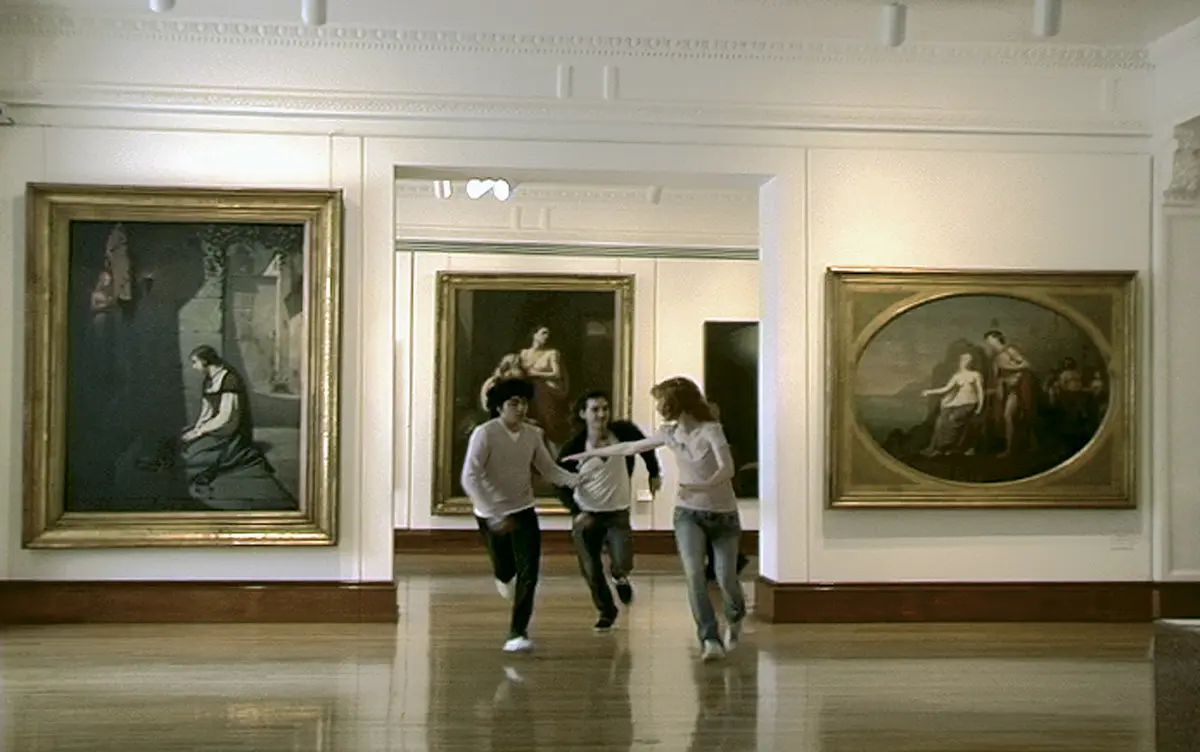
The video A Brief History of Jimmie Johnson’s Legacy focused on the conventions, the uses, and the meanings of institutions in charge of forging collective aesthetic taste, on the basis of performance rituals and protocols that Garcia Torres likes to question with an entirely straight face. In this revisionist effort, the artist took advantage of previous interventions by artists and filmmakers such as Jean-Luc Godard, Bernardo Bertolucci, or Mexico’s Juan José Gurrola, in order to interrogate the nature of artistic acts with regard to actions that could be artistic but are not consecrated as such.
In a similar, equally ironic way, Abandoned and Forgotten Land Works that are not Necessarily Meant to be seen as Art transformed a roster of abandoned WWII-era landing strips in the state of California into a dossier of Land Art works, thus opening up the possibility of seeing the tour of transparencies as a highly rigorous collection of artworks of this school. García Torres’s simple, well-orchestrated, and conceptually solid idea resulted in one of the show’s best works and of his career.
The last work in the show was a game of appropriation common among artists of García Torres’s generation. It consisted of borrowing a title from a work of art in the Thyssen-Bornemisza Museum, which was used to title this show. By doing so, García Torres developed an action both in the museum and the gallery. Título prestado referred to a work in the museum through its catalog data: William M. Harnett’s 1879 still-life painting Materials for a Leisure Moment signals recurrences, repetitions, and habits that persist through the entire history of art. With this intervention, García Torres traced a congruent metaphor around the relationship between past and present.
ANDRÉS ISAAC SANTANA