
Under the title The World Outside, the Bronx Museum presents a panoramic survey of Quisqueya Henríquez’s work, comprising a variety of works dated between 1991 and 2007. It is a selection of photographs, videos, objects, and installations characterized by an inescapable formal exactitude. Every instance of materialization of the ideas that guide Henríquez in the execution of her work seems to be attended to with painstaking care. The works reach a great precision, and nothing about them is unnecessary. They manifest a rare kind of beauty that, while exact, escapes any rule.
Yet despite her severity, Henríquez does not abandon her sense of humor. Moreover, she displays a special perspicacity in the creation of subtly comic situations that reveal a world usually hidden from our view. Henríquez’s works move beyond the borders of our everyday certitudes and inventively subvert the categories of reason. The video El mundo de afuera (2006) was shot with a fixed-position camera from Henríquez’s balcony in Santo Domingo. Over a period of three years, the artist captured the movements of the world outside her home. In a series of progressions, the video shows the advance of motorcycles, ships, and parachutes, the tireless comings and goings of a sweeping woman, and a man lifting weights. The athletic activity of the latter was the starting point for separate work. Henríquez noted that the weights used daily by the man were homemade, built of concrete planters; she appropriated the idea and created her own homemade concrete weights. Placed inside the gallery, these weights became a sculpture, titled Pesas caseras (2006). El mundo de afuera and Pesas caseras mark the passage of time and exhibit a fine sense of humor. The connections within and between both works also signal the rhythm of a world comprised of flows and exchanges that force us to challenge what we perceive as discreet and distinct entities.
Here is the key to the outside world shown by Henríquez: everything is connected. According to the show’s curator, Amy Rosenblum Martin, the artist’s refusal to line her work up with common sense marks an aesthetic of the rhizome. Following Deleuze and Guattari’s theory, Henríquez’s works are marked by a dynamic of fusion between heterogeneous elements and a proliferation of new relationships. I would venture that this rhizomatic world emerges from a sharp observation of reality, from a gaze that reveals the traps of reason. Henríquez’s work strains definition and questions especially the labels “Caribbean” and “Latin American.”
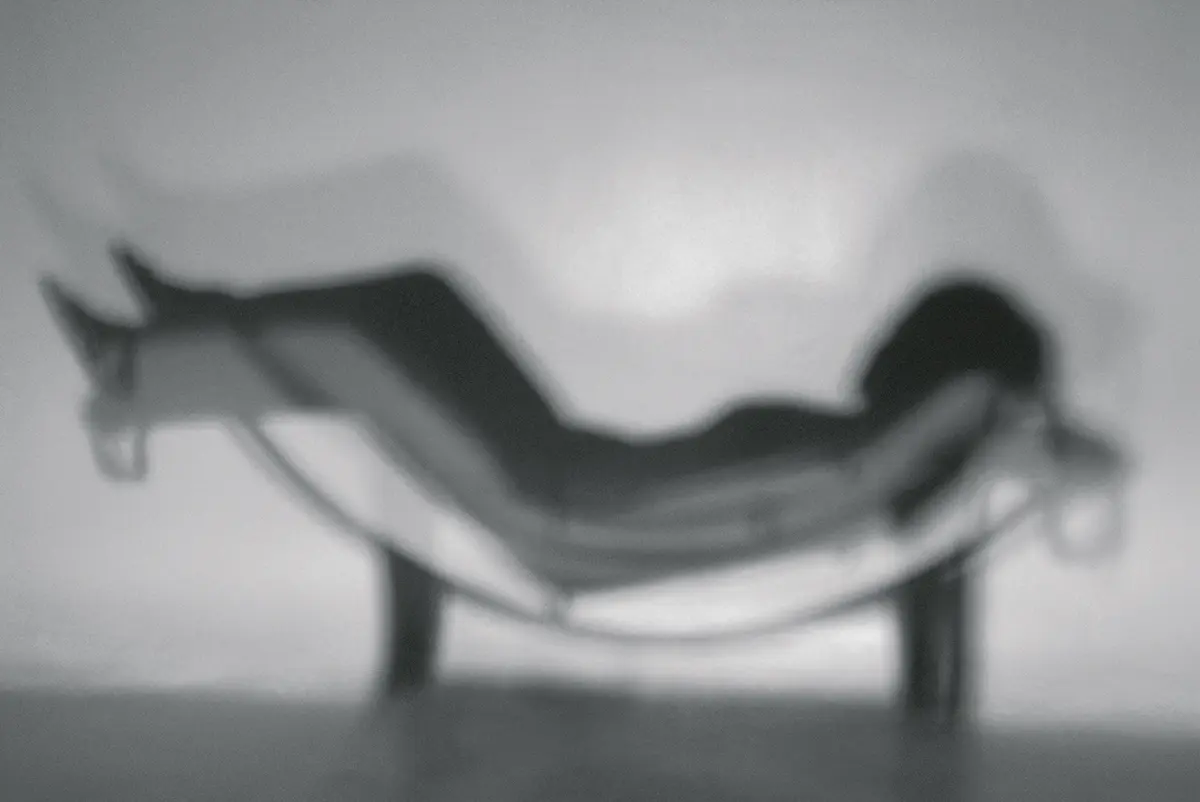
B306 (2006), a black and white photograph, is based on another photograph, a famous self-portrait of the designer Charlotte Perriand reclining on a chaise lounge. The modernist chair was named B306. Operating a conceptual twist, Henríquez took Perriand’s place and reclined on another chair. Then she created a self-portrait in which one can only see the chair’s shadows and her own resting video. With this game of contours and replicas, Henríquez interrupts the debate about art in Latin America and resists the push of the derivative perspective that sees the local avant-garde as affiliated with European modernity. Something similar occurs with Helado de agua del mar Caribe (2002). The viewer is able to taste that intensely turquoise-colored ice cream, which brings to mind the tropic skies and seas. The taste is salty rather than sweet, with a certain coconut undertone, and some ambiguity is left on the palate. The taste of Henríquez’s ice cream defies any facile adjective, just like the Caribbean region does.
Against stereotypes, Henríquez’s art leads us in unsuspected directions. She evades reductionism and opens a world situated outside the borders of the commonplace.
FLORENCIA MALBRAN