
Sombra Luminosa, the first anthological show of
works by Regina Silveira curated by José Roca, was presented at the Museo de
Arte Banco de la República, Bogotá. In this exhibition, giant shadows seemed to
be in a constant process of expansion and movement, as if ready to inundate and
even devour the world. On the building’s main white façade, a large number of
black paw prints expanded like an explosion, advancing toward the sky and
seeming to extend to other walls (Tropel,
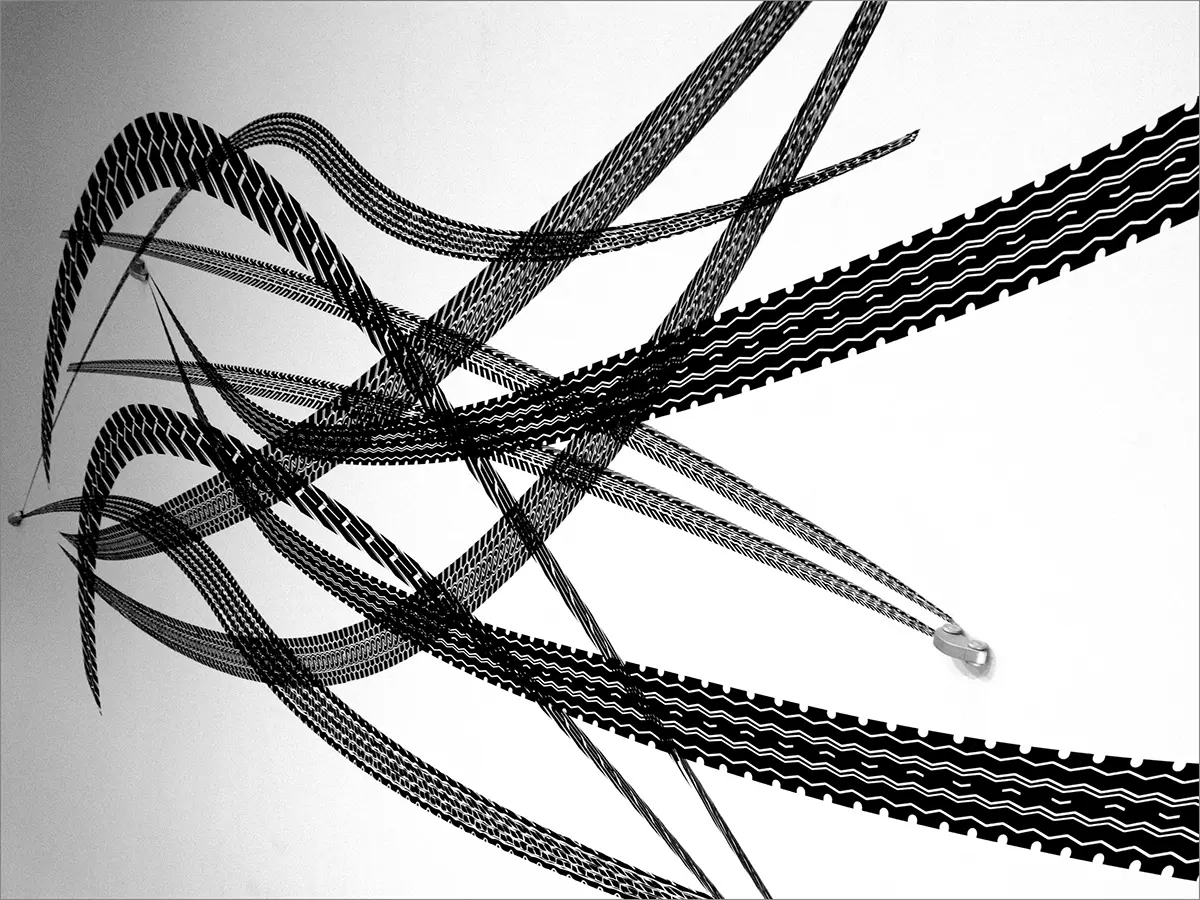
1998–2007). On the upper section of the wall of the building’s entrance hall, a
small car left traces of its trajectory: giant tire tracks that devoured it and
made it almost imperceptible, invading the architectural space with their
dynamism (Derrapajes, 2004–07). A
light bulb in one of the exhibition galleries, instead of projecting light,
emanated a large shadow that became surreal and absurd, with outsized
proportions; this great black stain in the shape of a droplet took over the
entire space of the gallery (Quimera,
2005).
Shadows and traces are part of what Rosalind Krauss deemed the index, “that kind of sign that appears as the physical manifestation of a cause, examples of which are traces, imprints, and indicia,” as well the shadows. For Regina Silveira, indicative signs imply the presence of time and possess a “phantasmagoric component that is their own referent or origin.” As shadows are the strongest element in Silveira’s work, objects are apparently minimized. Yet shadows would not exist without objects so that between the corporeal and its phantasm an intrinsic relationship is established. As Leonardo Da Vinci said: “A shadow is the lack of light and a mere obstruction of light rays by dense bodies. The shadow is of the nature of darkness; light is of the nature of clarity. The former hides, the latter reveals. They are always joined together to the bodies. But the shadow is more powerful than light, because it deprives bodies of light entirely, while light can’t ever expel all strength from a dense body.”
The work of Regina Silveira speaks of the power of the shadow and, following Leonardo, the power of darkness, but what do her powerful shadows hide? As in Leonardo’s case, Silveira’s interest in shadows is accompanied by an interest in perspective. In Desapariencia (2001), the object of study is an easel that follows the principle of anamorphosis (which creates a distorted image that appears normal when viewed from a specific point) and is observed from a variety of angles and represented by an ink-on-grid-paper drawing. This work includes a small model that resembles the stage cube of which Francastel spoke or “the box” alluded to by Panofsky. Using the principles of perspective, the model constructs a perfect architectural space, with walls, windows, roof, and floor. Destroying the laws and logic of perspective, the easel drawing is placed in the model with an interrupted line of adhesive paper, breaking the illusion of reality. What is a solid body becomes a sinuous, malleable silhouette in its shadow. This work, like the others, plays with and reflects on perspective. “The interest in perspective in my work,” says Silveira, “was always inscribed in a framework of wider investigations about representation itself, about the codified nature of visual images and the constitutive elements of illusion. What representation is and how we represent have been recurring issues in my work, although from different points of view."1
We know, thanks to Panofsky and Francastel, that perspective is inherently joined to the scientific and philosophical ideas of the Renaissance and that the roots of mathematics, humanism and art converge on their formulation. We also know that despite the many changes since the inception of the modern world through the current moment—postmodern, media-dominated, etc.—perspective-based representation is still, a useful tool that allows us to understand and figure the world. The single point of view in which it is rooted agrees with the position assumed by the Cartesian subject regarding the world, which implies a distancing that turns the modern subject into a privileged subject, the originator of the “image of the world,” of the universe of representation—an attitude that implies the notion of domination and aspiration for truth.
Regina Silveira works from a critical distance with regard to this modern world, its tools, its certitudes, and its presuppositions. At a certain point in her research, she “sought for perspective to function as a kind of philosophical gaze on the world of appearances.” Her shadows break with the laws of perspective and the logic of rational representation; they investigate this world built by Western thought following the “logic of the index” identified by Krauss, the origins of which lie in the work of Duchamp, whose oeuvre “expresses a kind of trauma in signification,” according to Krauss. Similarly, Silveira’s shadows follow a logic inherited from minimalism, which opened up new possibilities for perception with the insertion of art into the surrounding world. By going beyond abstraction, minimalism also helped viewers to understand new aspects of inhabited spaces, and the work of Regina Silveira continues to broaden this understanding.
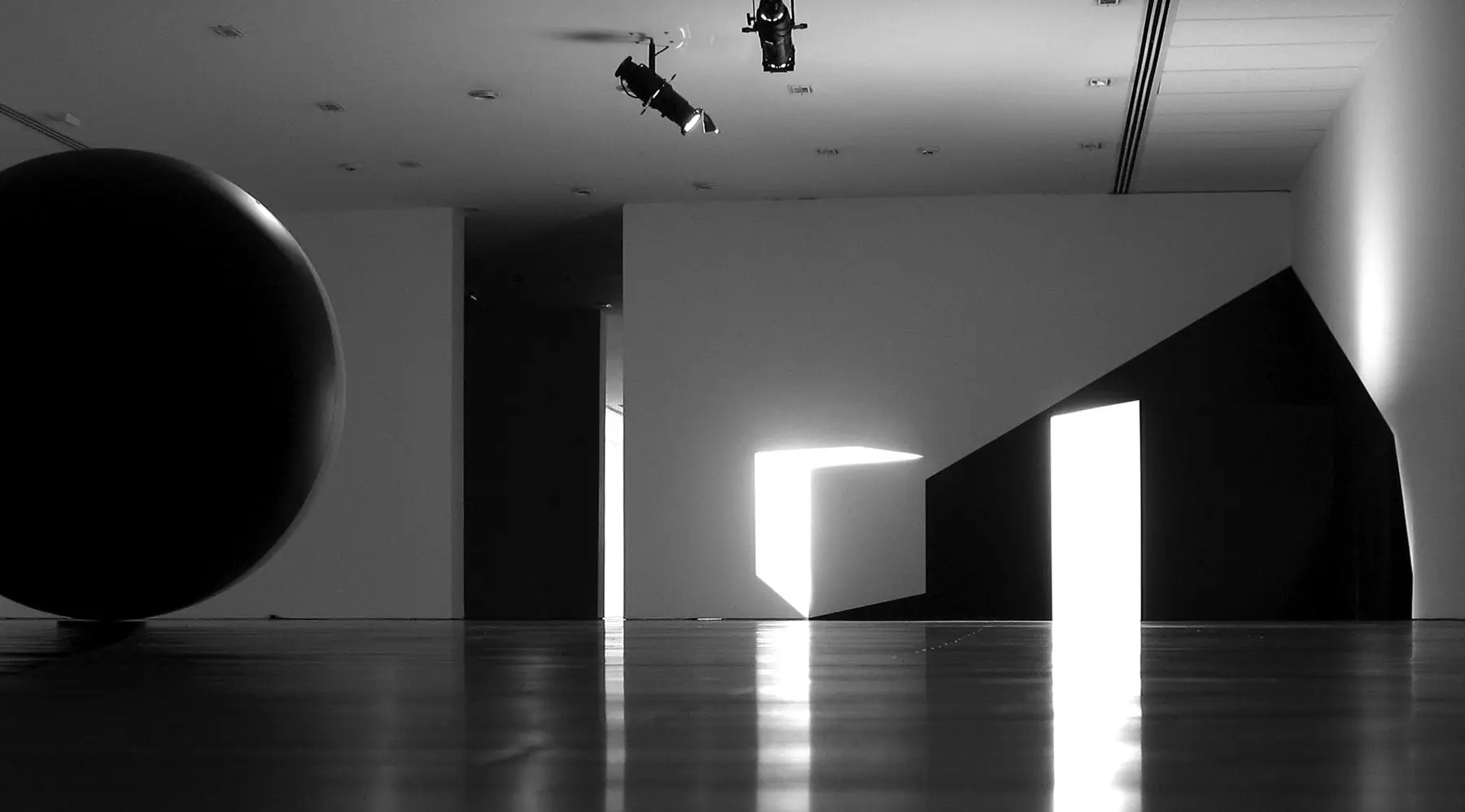
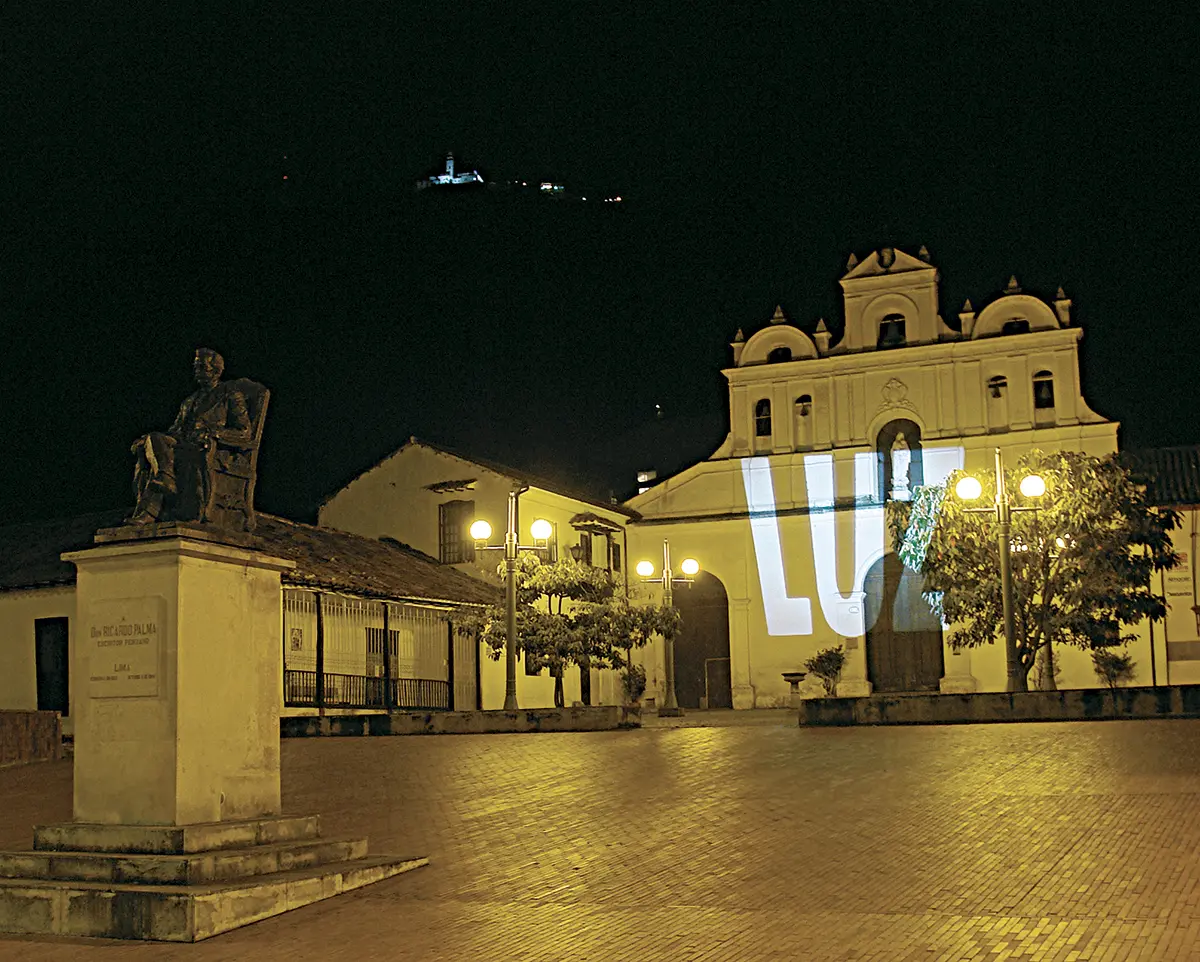
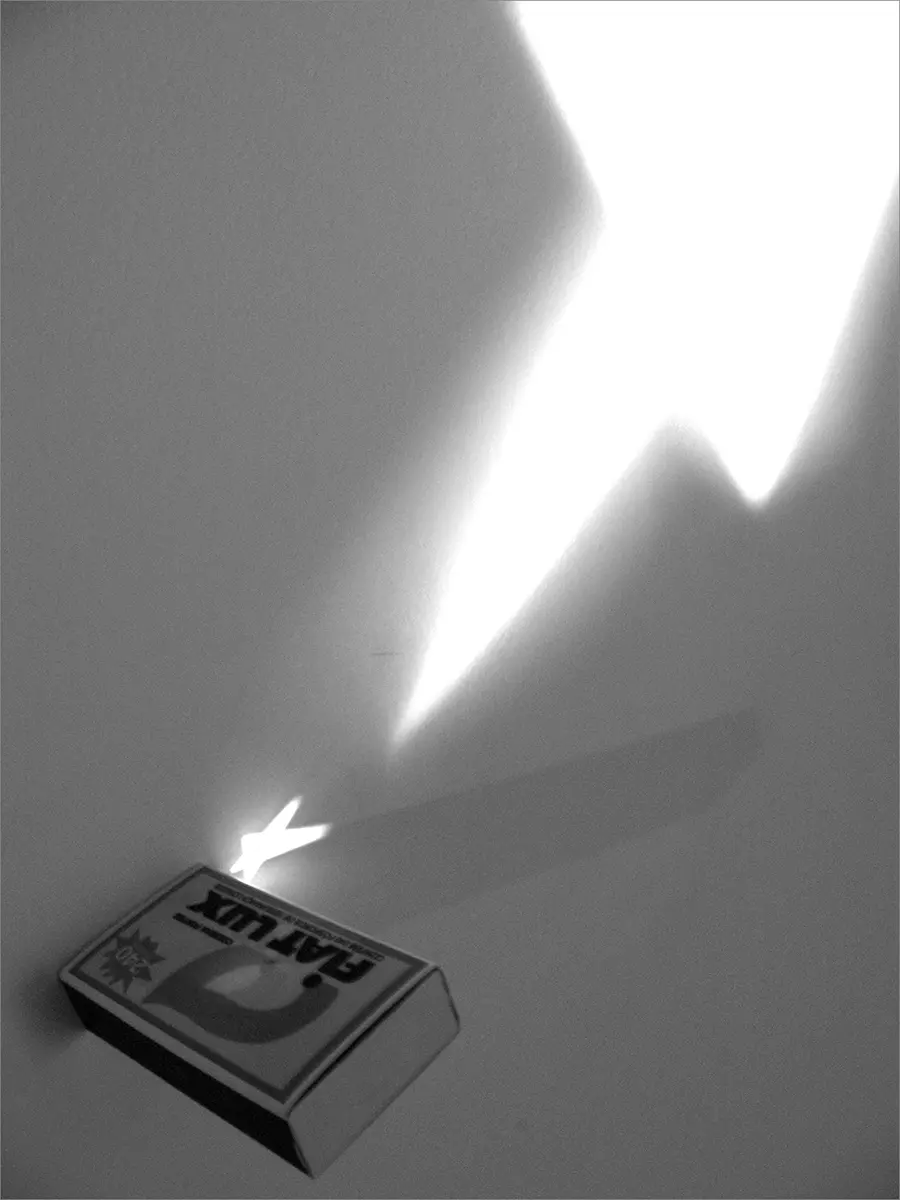
Regarding Silveira’s process, her shadows do not veil; like light, they reveal, and they belong to the realm of clarity alluded to by Leonardo. As the show’s beautiful title described, they are powerful “luminescent shadows” that reveal hidden aspects and illusory constructions of the world with poetry that approaches mystery and magic. The work Double (2003) resulted from Silveira’s study of the behavior of light on solid bodies. When one approaches the work from a certain angle, one can see a lighted white cube that appears with strongly contrasting light and dark faces. The opaque shadow is an entirely black plane that contrasts with the face that is awash in the light; projected behind the cube is a strong black shadow that ends on another cube, following the perspective lines. From a certain distance, the second cube appears identical to the first, and the approaching viewer notices the large black shadow that unfolds between the two solids; careful looking reveals a false cube, nothing but a projection on the wall. The powerful construction of this image and the apparition that surprises and misleads one’s perception is at once mysterious and magical. There were two other profoundly poetic and simply executed works: a small lamp projecting the word “light” downward (Lucero, 2003) and a matchbox that irradiated light in the shape of a star (Pulsar, 2005).
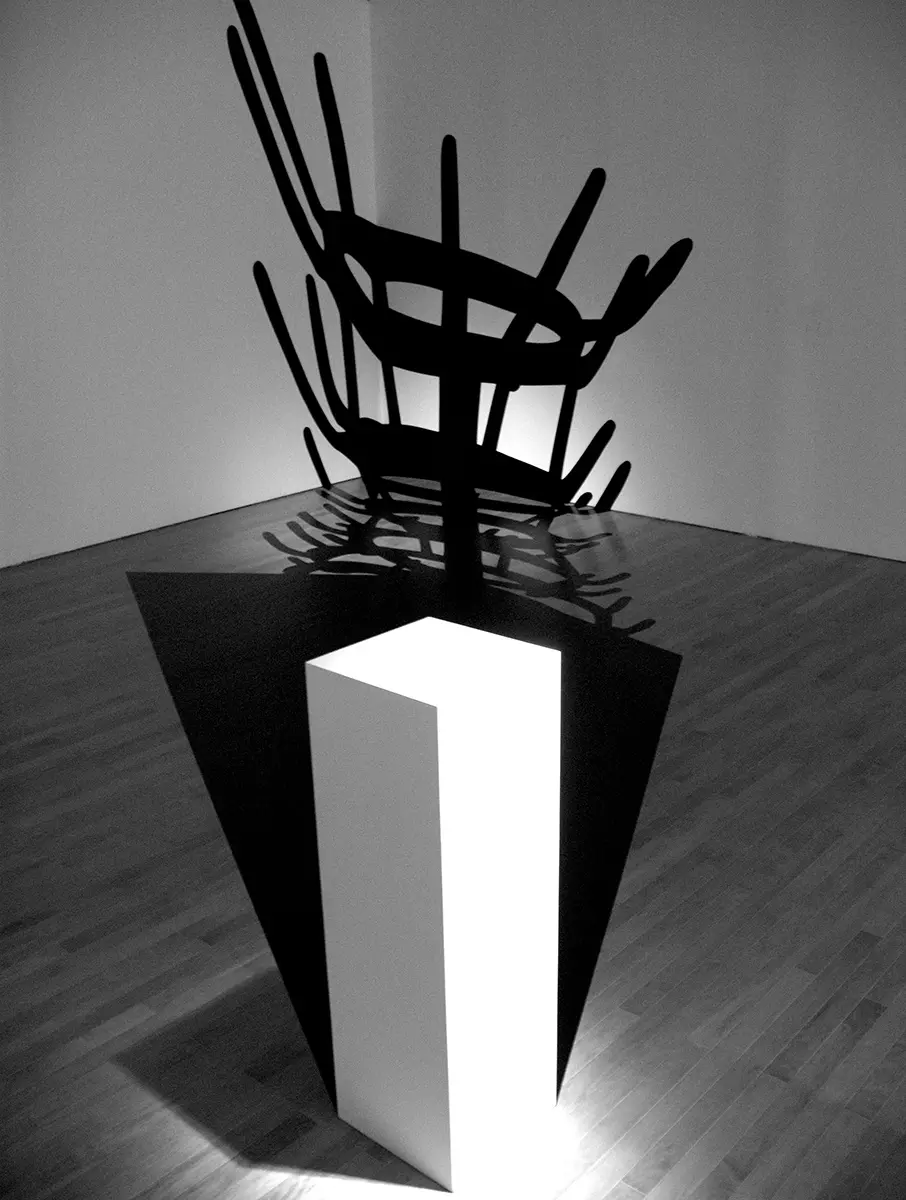
To conclude, Regina Silveira’s works seem to project with expansive force into the physical world—on façades, walls, and windows—but they also advance on the field of culture and particularly the field of art.2 The work In Absentia, M.D. (Porta-Garrafas) (1983–2000) is a poetic tribute to Marcel Duchamp; a very strong light illuminates a wooden pedestal that supports no object, but the large shadow projected is one of Duchamp’s most famous ready-mades: the bottle rack. Here, the index occurs in the absence of its referent, the powerful shadow that contradicts the laws of physics. The light and shadow name a phantasm or perhaps an illuminating presence that opens a trail for today’s art, including Silveira’s “luminescent shadow.”
NOTES
1. All quotations from Regina Silveira were taken from the written materials that accompanied the exhibition.
2. Alcuadrado Gallery concurrently showed a series of light interventions by Silveira on the façades of various city buildings.
MARTA RODRÍGUEZ
Art critic and member of AICA. Professor at the Universidad Nacional de Colombia.