
Alexandre Arrechea’s objects and paintings in his exhibition What Could Happen If I Lie? challenged the viewer to discern truth from fabrication. Arrechea, once a member of the widely known Cuban artist’s collective, Los Carpinteros, created works at once haunting and humorous, posing questions that disturbed the viewer, particularly in this era of Congressional debates over government-authorized covert surveillance. Arrechea’s themes resonated deeply, conveyed through works that seduced with their seemingly playful address.
In Cm v. Inches (2007), a square lightbox projected uniformly interwoven, yellow measuring tapes that appeared at first glance to sit upon the glass surface. Closer scrutiny revealed that the tapes had been photographed and did not reach the edges of the glossy, seamless surface. As one viewed the to-and-fro, in-and-out pattern of the yellow tapes edged in orange, divided by black lines, and punctuated by the sequence of black and red numbers, one noted a barely visible illumination of two white circles, like wire eyeglass frames, subtly reflected upon each tape. This enigmatic detail, conjured up the idea of someone watching the viewer, a constant presence silently spying from behind the mesmerizing weave of yellow.
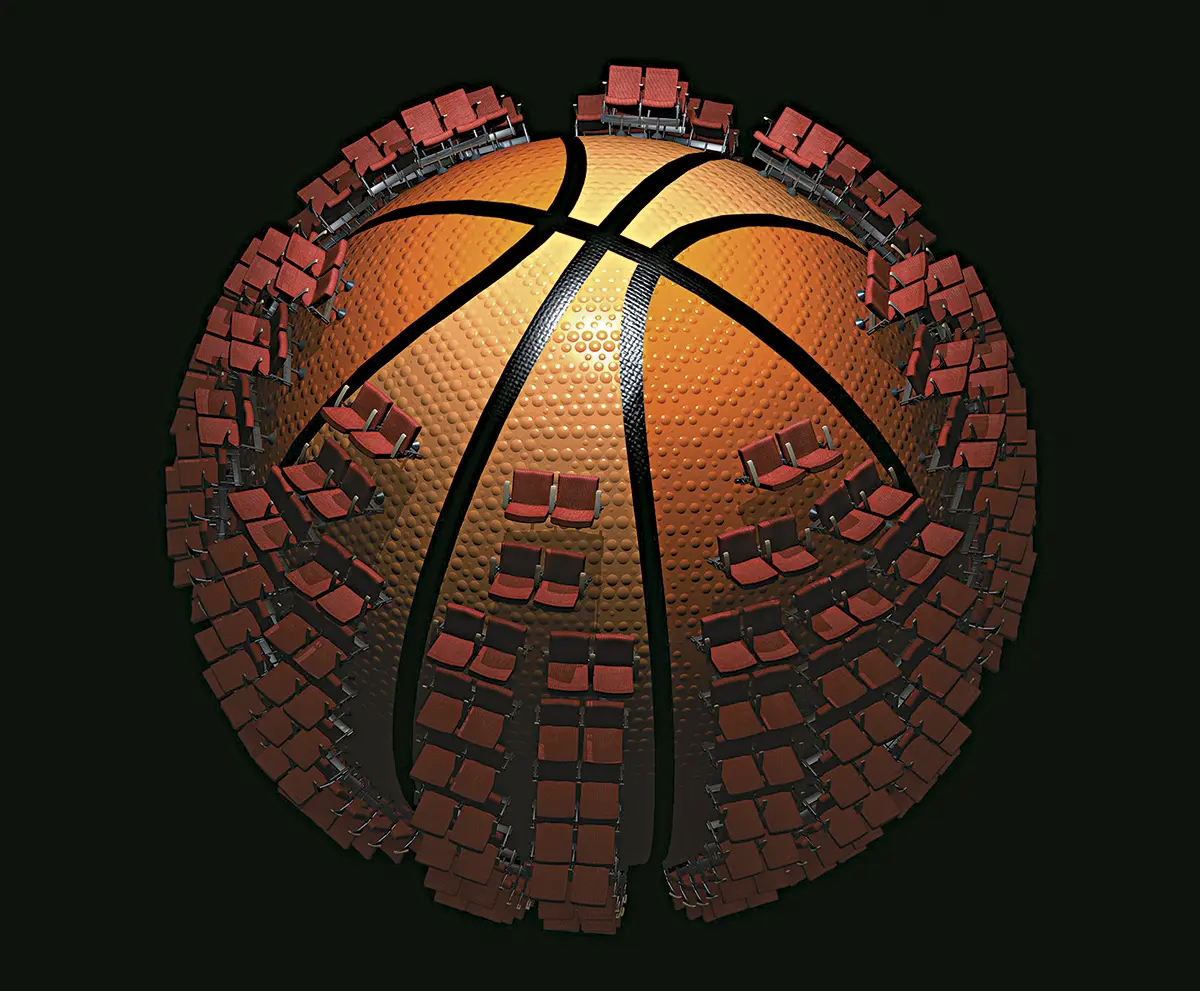
Arena 2 (2007) presented an enormous constructed basketball, its sides filled with small red plastic chairs fastidiously placed between the black lines that divided the ball into sections. The audience and the athletic spectacle were combined in a single statement, the sport inflated to an absurd scale, with the viewers attached as if going along for the ride. But this piece also imparted the unsettling suggestion that the viewers in a public event are watched while sitting and observing others.
In America (2007), one’s attention was captured by the ominous sight of a wrecking ball conceived of smoky-gray, hand-blown glass hanging from a giant hook attached to a wire cable. Suspended below eye level, this powerful work bore the word “America” etched in small, crisp letters in the glass. A handful of rubble, shards of bricks, and pieces of mortar and stone rested inside the bottom of the smoky globe, reminding one of Ground Zero and the endless debris left by the 2001 World Trade Center attacks.
Finally, the striking simplicity conveyed by the paintings What Could Happen If I Lie? Red Hand (2007) and What Could Happen If I Lie? Black Hand (2007) belied the complexity of the issues they addressed. Each watercolor depicted a large hand, reminiscent of the flat palm with long, tapered fingers that is characteristic of the art of the Jain sect of Hinduism. Arrechea’s hands, one red and one black were covered with rows of small circles, within which a letter was framed. Together the circles spelled words and phrases (in Spanish) that composed true or manufactured statements about the artist. The viewer reads each hand, uncertain as to what was fact or fiction, and hence was unable to learn anything about the artist by “reading his palm.” Ultimately, these paintings summed up the challenge Arrechea successfully posed through the works in this exhibition: what is true if we cannot tell truth from lies, particularly when “the system” encourages this ambiguity?
MARY SCHNEIDER ENRÍQUEZ