
With
a perspective that oscillates between that of an artist and that of a
scientist, Andrea Juan has been studying the southernmost areas of the western
hemisphere. There, she explores measures and compares. Her project has the peculiarity of unfolding at the border between aesthetics and ethics, pushing
for an increased awareness of climate change and its consequences. Squarely at
the center of the issue is humankind’s responsibility for these changes, as
could be seen in the show Lethal at Praxis. Twenty photographs and one video
conveyed the second phase of her Methane
Series–Antarctica Project, for
which Juan received a fellowship from the Guggenheim Foundation and another
given by the government of Canada, as well as support from local institutions
that undoubtedly rewarded her long and recognized career in the fields of video
art and photography.
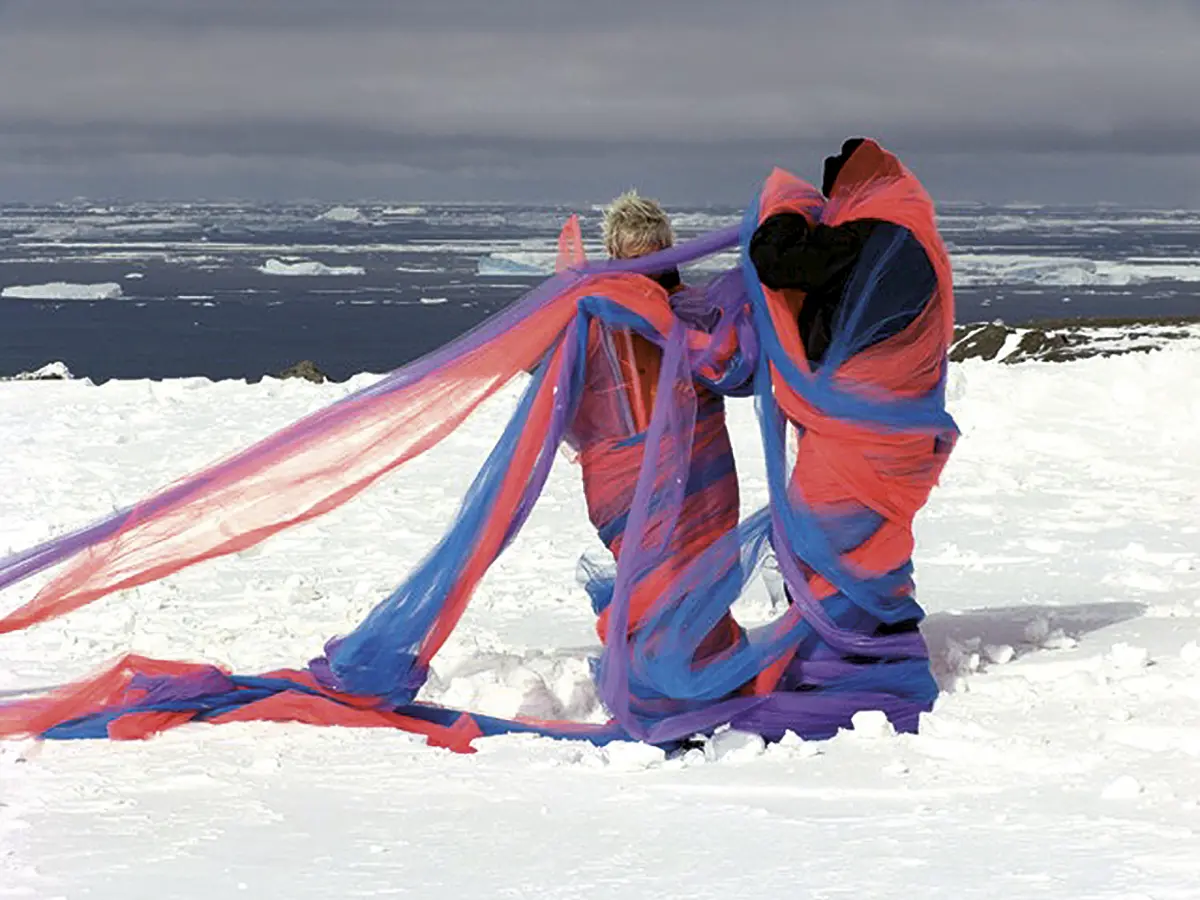
The artist began with research conducted by the Argentine scientist Rodolfo del Valle on the appearance of methane gas particles on the surface of the Antarctic Peninsula. The danger is that rising global temperatures melt and diminish the ice barrier, releasing methane gas and multiplying the greenhouse effect. Faced with this fact, Juan produced photographic and video records of large ice masses and detached ice blocks as a warning. They remind one, for instance, of the loss of the Larsen Ice Barrier, which is today only thirty percent of its former area.
The video that accompanied the photos recorded three performances on three different days that reflected climate change. On a snowy mesa on Marambio Island, two performers walked through the immense desert, hauling meters of gauze in colors that are associated with methane: purple, blue, and orange. The first action was held on a sunny day and was followed by one on a cloudy day. In the second, the action was recorded from a helicopter; the gauze veiled the camera’s view of the continent and became a metaphor for the dangerous ecological situation caused by the toxic methane gas found on its surface. The third performance took place in the middle of a storm, which made the performers’ actions extremely difficult as they were forced to fight the wind and the rain in order to remain on their feet. The contemporary tension between Man and Nature were conveyed by the figures in a highly dramatic fashion.
Although these three performances were presented as three parts of one video in the exhibition, the artist also conceived them as sections of a video installation, to be projected simultaneously. This is how they were exhibited at the recent Biennial of the End of the World, held in the remote city of Ushuaia. One can easily imagine that the effect produced by the images was similar to that of some of Caspar David Friedrich’s works: a sublime feeling, a mixture of pleasure and fear caused by the unbridled force of nature. Thanks to the possibilities opened by new technologies, Andrea Juan overcomes the merely representational plane and appeals to lived experience. Although her viewers are often thousands of miles away from the depicted places in her videos and photographs, it is possible for one confronted by them to experience the undesirable situation in which we are all immersed and to reflect on it in depth.
Juan’s Antarctica Project began in 2004, when the artist made her first expedition to the site, which was followed by others over the next three years. The first result of her journeys was the performance Red, in which she deployed fifty meters of red-colored translucent material over a glacier on the Antarctic Peninsula to produce eloquent associations with blood and injury, metaphors for the environmental disaster. Red was followed by Projections, an installation of two videos projected on-site on the southern ice: Sunflowers and Encapsulations were equally spectacular metaphors for the current environmental crisis and the planet’s increasingly uncertain future.
Susan Sontag pointed out in On Photography that art becomes a “visual ethics” when it indicates what must be seen, the hidden or semi-hidden reality that is necessary to become aware of and upon which it is necessary to act. Andrea Juan’s visual ethics clearly conveys the position of a Romantic artist at the dawn of the twenty-first century.
CECILIA FIEL