
If Myrna Báez and Zilia Sánchez helped define an intelligent feminism in the Puerto Rican Fine Arts of the 1970s, if Marta Pérez-Morales, Maria de Mater O’Neill, Rosa Irigoyen, María Antonia Ordóñez, and Anaida Hernández continued on that path in the 1980s, and if Nayda Collazo-Lloréns, Ada Bobonis, and Annex Burgos gave this movement a new direction in the 1990s. The then young painter-photographer Cacheila Soto has provided a provocative and daring new impulse to the aesthetic and ethic art that deals with the realities of women on this conservative island.
For over five years, Cacheila has been developing a very effective feminist discourse not only of exceptional technical quality but also daring and controversial within the established norms of present post-feminist currents.
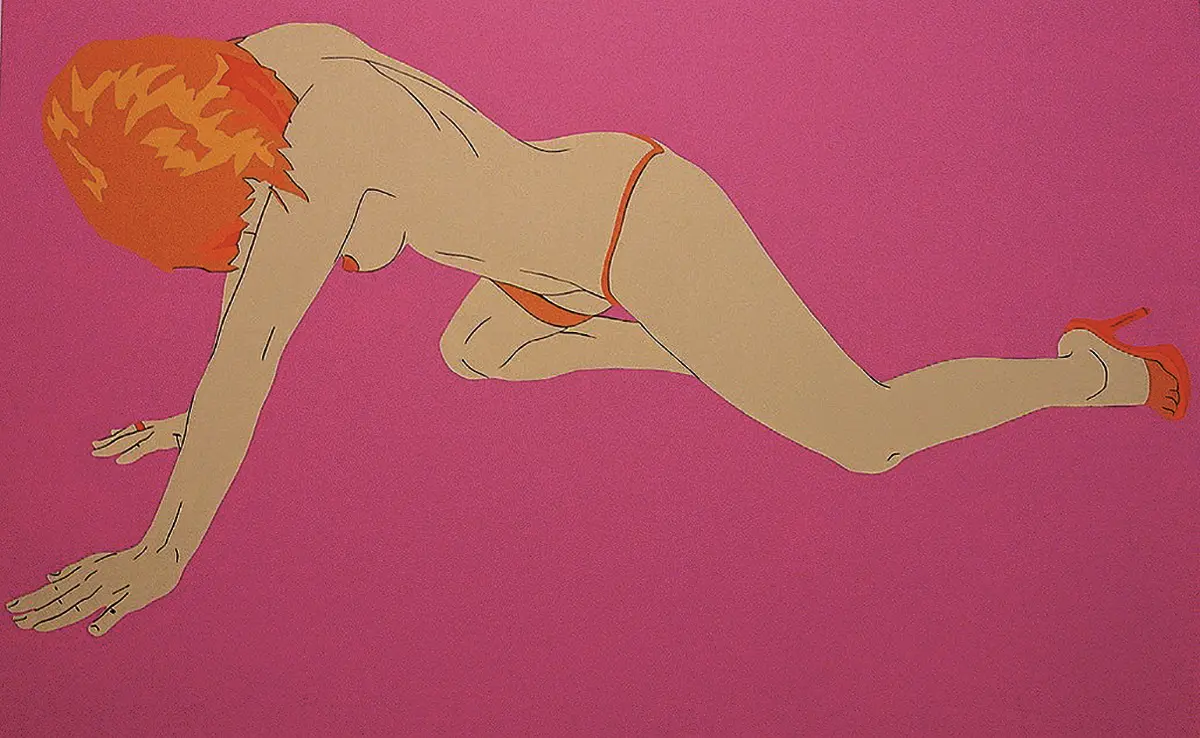
Although Cacheila concentrated on photography at the Escuela de Artes Plásticas de Puerto Rico (the art school from which she graduated in 2003), the prestigious Amigos de la Escuela de Artes Plásticas de Puerto Rico scholarship broadened her horizons when facilitated her trip to Spain in 2002 to visit ARCO and other important museums in Madrid, and the Guggenheim in Bilbao. On returning to Puerto Rico, she began painting a series of portraits of women (and some self-portraits), stylistically Pop in their execution, to which she applied a few brilliant colors. The influences of Warhol, Lichtenstein, Katz, and Hockney, among others were evident in these works, and Soto demonstrated with these paintings that she was a skilled portrait (and figurative) painter. But more importantly, these works clearly presented to us an artist who, while in the process of discovering her own voice, also had the ability to construct an original, powerful, and consistent visual discourse that would ultimately set her apart from other artists of a generation—the Global-Islados—that has produced interesting artists such as Michael Linares, Radamés Figueroa, MERO, ISMO, Sofía Maldonado, Obdulio Peña-Forty, and Sebastián Vallejo, among others.
After many extremely successful exhibitions (from critical and commercial standpoints) at the La Pintadera Gallery, where Cacheila established herself as a new, refreshing, and “distinct” voice, the artist put together the exhibit that will secure for her an honorary place in Puerto Rican visual arts: her tribute/celebration to Marilyn Monroe. Here, Soto not only successfully captures the beauty and sensuality of this twentieth-century icon, but also reveals the actress’s enigma, depth, loneliness, and pain.
On September 2007, after taking a break for a couple of months to reflect and evaluate, Cacheila presented at the Blackbox Foundation, a powerful and, yes, a controversial exhibit entitled La Carnada (The Bait). There, she reveals to us, through her painting with enormous professionalism, sensitivity, intelligence, and generosity, the world of the strippers, who dance for money in the thousands and thousands of strip clubs around the planet—women who, according to the artist, are misunderstood from a personal/existential and artistic viewpoint.
In La Carnada, Cacheila dares to “capture everything”: nudity; action/rhythm; seduction, and these dancers’ feelings when they perform their erotic dances on/with the famous poles. The compositions here are not only highly provocative, in that they generate a basic and powerful eroticism, but they also embody an astounding spirituality that invites the spectator to enter/understand that world.
The most recent collective exhibits in which Cacheila has participated, Bastardos and POP-07 at the Petrus Gallery, clearly reveal an artist painting from the vantage point of new existential and sexual freedoms. Now, “Cacheila’s Women” not only dance in the strip clubs, but we also see them enjoying their bodies to the fullest and getting close to other feminine bodies.
It is evident that Cacheila Soto has not set limitations in her quest to be near, as much as possible, to the essences of the female’s sexual nature: her body; her mind/emotions; her struggles; her falls, and her dreams in an approach that touches the lives of women in her own country and around the world, and that is helping to redefine feminism in contemporary art.
MANUEL ÁLVAREZ LEZAMA