
The architecture of the Landscape was the title of a show presented by Farside
Gallery, a new space on the Miami art scene. This solo exhibition of works by
Carlos Rodríguez Cárdenas included works from the series of the same title, in
which the artist established inscrutable architectural landscapes with at times
alarming clarity, symmetry, and self-control.
The show was composed of watercolors displaying great technical virtuosity, in which the interplay of light and color was woven into the geometric matrix that structured each landscape. Blues and oranges—water and light—appeared as reminiscences, reveries supporting a highly personal landscape: a concerto, one could say, of sensations experienced by the artist in his passage through the different cities he has made his home over the years. The element of the home was essential to these urban landscapes.
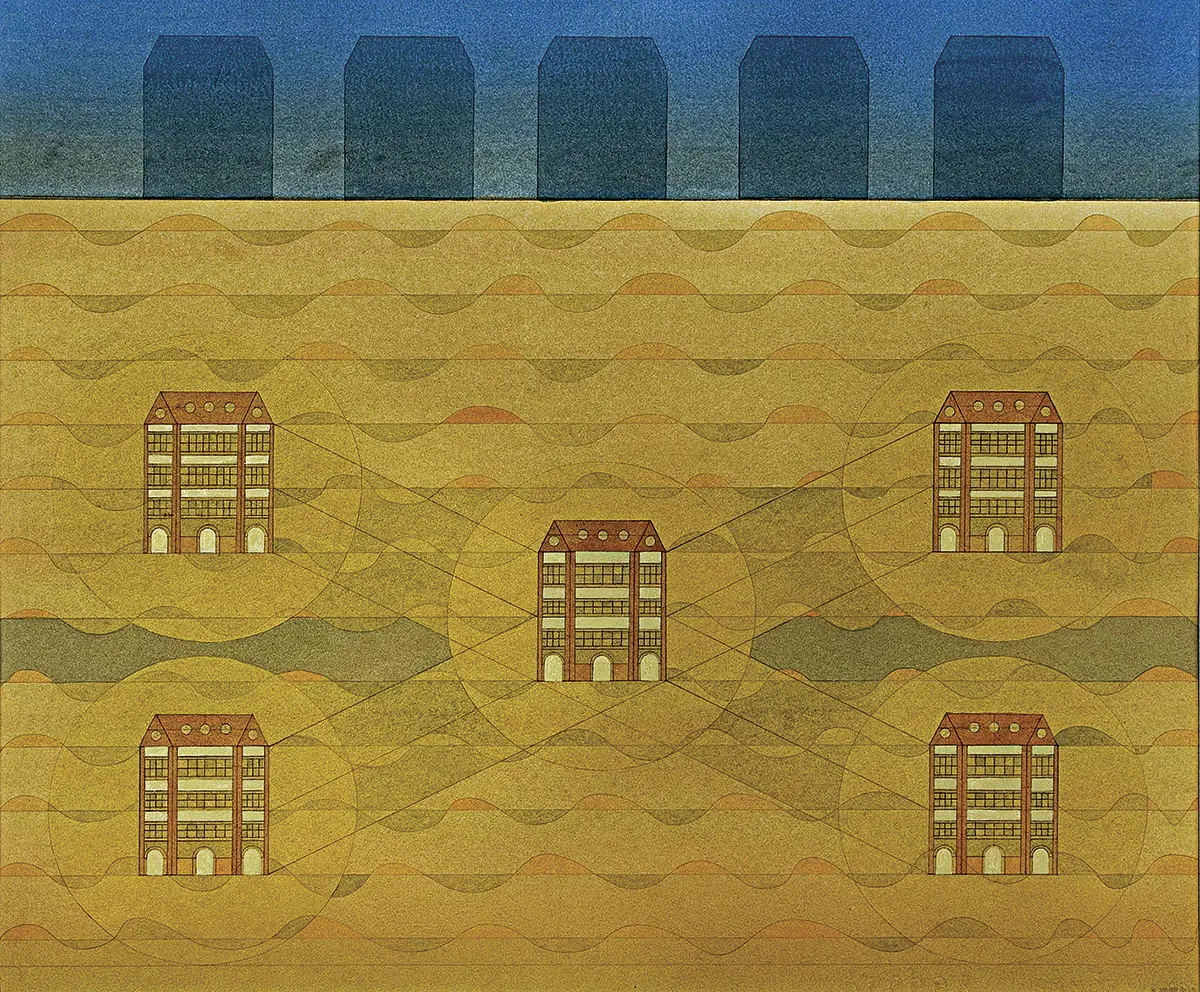
Cárdenas’s enigmatic landscapes preserved something of Paul Klee’s Tunisian experience, in which color and light excited the artist. Of course, in Cárdenas’s case, one confronted a journey in the opposite direction. It was not the German artist’s clouded senses when faced with the light of the tropics but rather a nostalgic remembrance, trying to recreate the architecture to support and reconstruct the landscapes of the soul. On this point, then, passion was held back, perhaps quieted—or drowned. It was as if the artist used art as a therapeutic survival method, where the reiteration of the same pattern redeemed the absence of the past and restored its latitudes. Undulations, rings, and niches reinstalled an evocative, unique universe.
This landscape period, in which Cárdenas has been absorbed for some years, could seem controversial to many. What is certain, though, is that architecture has always been, in one way or another, a returning component of his work. The architectural element has been revisited since the artist’s early period when he became known internationally for his work’s emphasis on Cuban political slogans from the 1980s. Bricks and walls were an emblematic element in the artist’s oeuvre, as were blinded eyesockets condemned by bricks, controversial skies built using blue bricks, and blocked islands. Of note was 1989 performance by Cárdenas titled Mi casa soy yo, in which his body was drawn in bricks, which were made into a house and a home. This work established a referent that brought together the works exhibited at Farside Gallery and implied new meanings for it. In the new works, however, the man was absent and a human element was synthesized with architectural elements: columns, niches, bridges, and specific homes. The artist’s referents have shifted. Manhattan’s physiognomy differs greatly from Havana’s. And the issues have also changed.
Cárdenas has referred to his work as an invitation to question reality and to see beyond what appears like reality, transforming what has been created in metaphors. Be it through the stereotypes of political slogans or through those of architecture, Cárdenas’s work deals insistently with man and his vital space. The exhibition at Farside Gallery was dominated by warm colors and sinuous elements. At times, its geometricism and its play of light led the visitor to referents such as stained windows; at other times, the component of playfulness overwhelmed the viewer with nostalgia. One could call it an unsolvable affliction, as one no longer witnessed physical, tangible spaces but pastiches, the marks of memory superimposed on one another.
Cárdenas’s show Architecture, Garden, Landscape: Memory of a Journey, presented in New York by Heidi Cho Gallery between September 20 and October 6, was dominated by much cooler-hued works, ruled by blues and grays. The image of a small slant-roofed house was set aside in favor of imposing constructions. However, the artist’s distilled lyrical feeling and his sensibility to capture the urban landscape was a constant between both shows.
Through these vivid images of urban stelae, Cárdenas seems to still identify with the metaphysical pronouncement that defined him as an artist decades ago: “I do not exist, only my intent does.” While the paintings in his new series remain faithful to the parapet, one may crash against this hard wall if one lacks the intuition to let oneself be seduced.
As part of the Biennial del Barrio, in New York, Cárdenas exhibited The Train, a paradigmatic work of this period in his career. In this work, each coach seemed to carry emblematic landscapes, unique architecture, and intangibles from here and there: collector’s items of our inner, collective imaginary; chronicles in an erratic flux in which the sedentary sense of a spatial enclave collapsed into a thousand pieces. There, without a doubt, is where the urgency of the artist’s inner architecture is rooted.
JANET BATET